

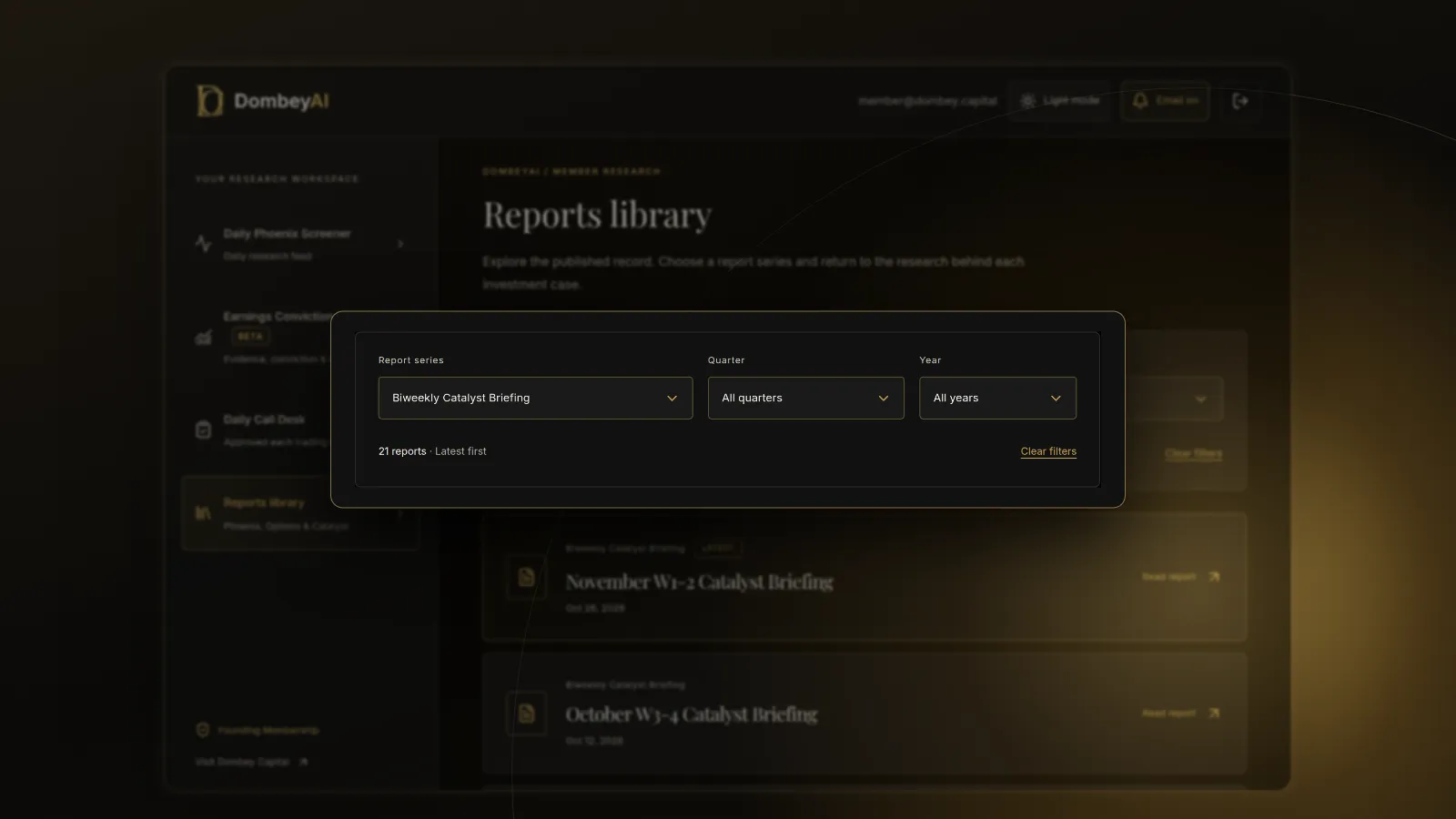

Full disclosure: Dombey Capital is our own research service and our top pick here, for the reasons below. The section on where it falls short is there so you can judge whether it fits your process.
Quick comparison
| Tool | Best for | Key features | Price (as of October 2026) |
|---|---|---|---|
| Dombey Founding MembershipTop pick | SPACs and dated catalysts written up as research | Weekly Phoenix Report, Daily Phoenix Screener, Biweekly Catalyst Briefing, valuation and execution analysis | Founding Membership $1,200/year, annual billing; Standard Access $80/year or $8/month |
| SEC EDGAR | Free prospectuses, proxies, 10-Qs and 8-Ks | Full-text search since 2001, form and date filters, CSV export, RSS by company or form type | Free |
| SPACInsider | A full SPAC database with alerts | Database of 1,800+ SPACs, customizable tables, calendar, news, filing alerts, mobile app | Basic $299/month, monthly billing; Institutional and Enterprise on request |
| SPAC Research | SPAC data with an annual plan | Database, calendar, newsfeed, watchlist, charts, financing and at-risk capital pages, AI access | $328/month or $3,299/year; API and Enterprise on request |
| InsideArbitrage | Free list of announced SPAC deals | Business combination table with dates and target, unit and warrant symbols, dated deal log | Full table is premium; Premium $150/month or $1,200/year |
| Boardroom Alpha | SPAC data inside a governance platform | IPO pricings, vote calendar, de-SPAC tracker, parsed filings back to 2000, API | Quote-based, billed annually per seat; 7-day free trial |
| SPAC Analytics | Long-run SPAC market data | Email updates, database back to 2003, status summary and IPO counts | Paid; see the vendor's site for pricing |
| Stock Analysis | Free list of new blank-check IPOs | Recent IPO table with IPO price, current price and return, IPO calendar | Free; Pro $99/year or $9.99/month |


How we compared these tools
We compared these sources from vendor documentation, pricing pages and public product pages read in October 2026, and from the SEC's own pages. We did not run trials with any of them, and we make no judgment on any vendor's speed or data accuracy beyond what the vendor states.
| Criterion | Weight | What it measures |
|---|---|---|
| Trust and redemption data | 25% | Trust balance per share, redemption counts after each vote, extension contributions |
| Dates and deadlines | 25% | Deadlines, extension votes, deal votes and redemption cut-offs, and whether new events are flagged |
| Interpretation | 20% | Whether it helps you judge dilution, sponsor terms and the deal valuation |
| Documents | 15% | Access to the prospectus, proxies, S-4 or F-4 and 8-Ks behind each figure |
| Cost for the job | 15% | What it costs to follow a working list of SPACs |
If you weight coverage breadth higher, for example because you trade the whole pre-deal SPAC universe on yield to deadline, the dedicated databases move up and the research service moves down. If cost matters most, EDGAR and the free lists cover the documents and the announced deals without a subscription.
Quick picks by job
Best for SPACs and dated catalysts written up as research: Dombey Founding Membership
Founding Membership is written research, not a SPAC screen. The weekly Phoenix Report covers selected special situations and earnings-related opportunities, and each thesis is published before its catalyst. When a SPAC or de-SPAC falls within coverage, the work reads the proxy, the dilution table and the target's financials and sets out what could break the case. It suits readers who want a view on what a deal is worth, not only a list of pending votes.
Best free source for SPAC documents: SEC EDGAR
The IPO prospectus, every 10-Q, the extension and deal proxies, the S-4 or F-4 and the 8-Ks that report redemptions all land on EDGAR. Full-text search reaches back to 2001 and exports results as CSV.
Best full SPAC database with alerts: SPACInsider
SPACInsider says it tracks more than 1,800 SPACs with more than 450 data points each and history back to 2009, with a calendar, news and customizable filing alerts on its Basic plan.
Best SPAC database with an annual plan: SPAC Research
SPAC Research publishes both a monthly and an annual price, and its plan bundles the database, calendar, newsfeed, watchlist, reports and AI access.
Best free list of announced SPAC deals: InsideArbitrage
InsideArbitrage's business combination table lists the SPAC, the target, the announcement and expected closing dates and a dated log of each deal's milestones.
Best for SPAC data inside a governance platform: Boardroom Alpha
Boardroom Alpha puts a SPAC module, with IPO pricings, a vote calendar and a de-SPAC tracker, next to its board, executive and activist data.
Best for long-run SPAC market data: SPAC Analytics
SPAC Analytics says it has supplied SPAC data to investment banks and portfolio managers since 2007, with a database reaching back to 2003.
Best free list of new blank-check IPOs: Stock Analysis
Stock Analysis lists recent IPOs with the IPO price, current price and return, and blank-check offerings priced at $10.00 appear in that list.
Full reviews
1. Dombey Founding Membership
What it does. Founding Membership is Dombey Capital's full research suite: the weekly Phoenix Report, weekly Options Research, the Biweekly Catalyst Briefing, and the DombeyAI Portal with the Daily Phoenix Screener and the Earnings Conviction Model, plus valuation and execution analysis and priority access. The Daily Phoenix Screener gives a view each trading morning of situations relevant to Dombey's coverage. When a SPAC, an extension vote or a de-SPAC falls within coverage, the research reads the filings and sets out the thesis, the dates and the risks. Published work is in the research archive.
Best for. Readers who follow special situations and dated catalysts and want a SPAC deal read and valued, not only listed.
Pricing. Founding Membership is $1,200 a year, billed annually. Standard Access is the lower-cost option at $80 a year, about $6.67 a month, or $8 a month on monthly billing, and includes the Biweekly Catalyst Briefing and the complete public-research archive. The Public Archive is free.
Pros
- Interpretation of dilution, sponsor terms and the deal valuation, which a table does not provide.
- Each thesis is published before its catalyst and kept in the archive, so you can compare the case with the outcome.
- SPACs sit next to mergers, spin-offs and other dated events, so one service covers the calendar.
Cons
- It is not a SPAC database; it does not list every SPAC, trust balance or deadline.
- Coverage is limited to the situations Dombey writes about.
Verdict: Our top pick for readers who want SPACs and other dated catalysts turned into research. Pair it with EDGAR and a SPAC list for names outside its coverage.
2. SEC EDGAR
What it does. EDGAR holds every document a SPAC produces. The IPO prospectus sets the amount placed in trust, the deadline, the extension terms and the redemption rights. Each 10-Q and 10-K shows the trust balance and the share count by class. Extension votes come with a proxy, and the deal comes with a proxy or a registration statement on Form S-4 or F-4; our S-4 explainer covers that filing. After each vote, an 8-K usually reports the result and how many shares were redeemed. Full-text search covers filings since 2001, filters by form, date, company and location, and exports results to CSV. RSS feeds follow one company or the latest filings by form type.
Best for. Anyone who wants the primary source at no cost. Our guide on how to search SEC EDGAR filings covers the mechanics.
Pricing. Free.
Pros
- Trust balances, redemption counts and sponsor terms straight from the filings.
- SEC rules effective in July 2024 require de-SPAC filings to show dilution across redemption levels, so the key table is in the document.
Cons
- No list of SPACs by deadline, no trust table and no calendar.
- The SEC states its email update service is not available for company filings, so alerts mean RSS or a third-party tool.
Verdict: Essential and free. Check any tracker's trust figure against the latest 10-Q here. For more filing tools, see the best SEC filing tools and EDGAR alerts.
3. SPACInsider
What it does. SPACInsider, founded in 2018, is a SPAC data and news service for banks, funds, law firms and sponsors. It says its database covers more than 1,800 SPACs with more than 450 data points each and history back to 2009, including PIPEs, convertible notes and preferred financing, and transaction narratives from pre-IPO through post-close. The Basic plan includes the database, customizable data tables, news and analysis, a SPAC calendar, twice-daily summary emails, customizable news and filing alerts, and a mobile app with the latest SEC filings. Institutional adds downloads, a SPAC History Tool, IPO coverage, an AI assistant and MCP server access; Enterprise adds unlimited users, a REST API and an Excel add-in. It also publishes a podcast.
Best for. Professionals and active individual investors who follow many SPACs and want one database with alerts.
Pricing. Basic is $299 a month on monthly billing, cancel anytime. Institutional, with a two-user minimum, and Enterprise are priced on request. The pricing page shows no annual price and mentions no free trial.
Pros
- The broadest dedicated SPAC dataset in this list by the vendor's own count.
- Filing and news alerts and a calendar on the entry plan.
Cons
- Downloads and the history tool sit on the Institutional plan, not Basic.
- At $299 a month, a high cost for someone following a few names.
Verdict: The clearest choice when SPACs are a large part of what you follow and you want alerts on all of them.
4. SPAC Research
What it does. SPAC Research runs a SPAC database with pre-deal listings, a financing overview, a calendar, a newsfeed, newsletters and reports, a watchlist and charts. Its site also lists pages on forward purchase agreements, at-risk capital, 13F holders, anchor investors, directors and officers, and an underwriter leaderboard, plus an AI chat assistant, an API and MCP access.
Best for. Investors who want a full SPAC database and prefer to pay once a year.
Pricing. The monthly plan is $328 a month and the annual plan is $3,299 a year, which the vendor says saves 16% against monthly. API access and enterprise licensing are priced on request. The subscription page mentions no free tier or trial.
Pros
- Holder, anchor investor and at-risk capital data alongside the deal data.
- A published annual price.
Cons
- The highest published monthly price here.
- No free trial is mentioned, so you pay before you see the data.
Verdict: A strong alternative to SPACInsider, especially if you want holder data or an annual plan.
5. InsideArbitrage
What it does. InsideArbitrage is an event-driven research site with SPAC IPO, business combination, SPAC news and potential SPAC IPO pages. The business combination table lists the SPAC and its target, the business combination date, the expected closing date and the IPO date. Each row expands to show unit and warrant symbols and a dated log of letters of intent, definitive agreements and terminations. The page does not show trust value or deadline columns, and the site says the full table, sorting and filtering are for premium members. It also covers merger arbitrage, spin-offs and insider buying.
Best for. Individual investors who want a running list of announced SPAC deals at little or no cost.
Pricing. Premium is $150 a month or $1,200 a year, and a lower Plus tier is $50 a month or $480 a year. The pages do not say which tier unlocks the full SPAC table, so check before you subscribe.
Pros
- Deal milestones in one log, including terminations and replacement deals.
- Sits alongside merger arbitrage data on the same site.
Cons
- No trust value or deadline columns.
- Sorting, filtering and the full table sit behind a paid tier.
Verdict: A useful low-cost view of announced deals; pair it with the 10-Q and proxy for the numbers.
6. Boardroom Alpha
What it does. Boardroom Alpha is a governance research platform covering directors, executives, shareholder meetings, activist campaigns and pay. Its SPAC module covers IPO pricings, a vote calendar and a de-SPAC tracker across the life of a SPAC. It also offers parsed SEC filings back to 2000, a data API and bulk delivery.
Best for. Readers who already study boards and management and want SPAC votes and de-SPAC tracking in the same tool, where sponsor and director backgrounds matter.
Pricing. Quote-based. Platform seats are billed annually per user, and Enterprise and Data and API plans are custom. A seven-day trial with full access needs no credit card and, the vendor says, does not auto-charge. The pricing page does not say which plan includes the SPAC module.
Pros
- A vote calendar and de-SPAC tracker next to governance data on the people involved.
- A free trial before any commitment.
Cons
- No published price.
- SPACs are one module of a broader governance product, not its focus.
Verdict: Worth a trial if governance research is already part of your process.
7. SPAC Analytics
What it does. SPAC Analytics describes itself as a provider of SPAC data to investment banks and portfolio managers since 2007. Subscribers get email updates on SPAC market activity and a database reaching back to 2003 that tracks each SPAC from its pre-IPO filing to the shareholder vote. Its home page shows annual SPAC and IPO counts and proceeds, a summary of SPACs by status and recent SPAC IPO performance.
Best for. Readers who want long-run SPAC market history and counts by status.
Pricing. A paid subscription; the site quotes no price. See the vendor's site or contact it for pricing.
Pros
- One of the longest SPAC histories on offer, by the vendor's description.
- Free market summary tables on the home page.
Cons
- No published price, and the site does not name its operator.
- The public pages do not mention trust or deadline fields.
Verdict: Useful for market-level history; confirm the fields you need before paying.
8. Stock Analysis
What it does. Stock Analysis is a general stock data site. Its IPO section lists the last 200 IPOs with IPO date, price, current price and return, plus an IPO calendar, lockup dates and statistics. Blank-check companies priced at $10.00 appear in the list, though the page shows no SPAC filter.
Best for. A free check on which SPACs have just priced and where their units trade.
Pricing. A free account is available. Pro is $99 a year, or $9.99 a month on the monthly plan, and Unlimited is $16.58 a month billed annually. The vendor offers a 60-day money-back refund.
Pros
- Free, with new SPAC IPOs listed beside other IPOs.
- Lockup dates for the period after a de-SPAC.
Cons
- No trust, deadline, vote or redemption data.
- SPACs are not labeled or filterable on the IPO page.
Verdict: A free starting list, not a SPAC tool.
Where Dombey falls short
Founding Membership does one part of this job, and its limits are real:
- Narrow coverage. It covers the special situations Dombey writes about. Most SPACs and de-SPACs will not appear in the research.
- No SPAC database or calendar. There is no list of every SPAC, no trust value table, no deadline tracker and no redemption alerts. Use EDGAR, SPACInsider or SPAC Research for those.
- No broad data terminal. It does not replace a platform for prices, warrants and financials across the market.
- Small team and pen-name author. The research comes from a small team, and the byline is a pen name. Read the proxy yourself before acting on any summary.
- Short history. Its record is short next to SPAC data services that have run since 2007 or 2018.
Free vs paid
Free sources cover the core of the job for a few names. EDGAR gives you the prospectus, the 10-Q trust balance, the proxies and the post-vote 8-Ks. InsideArbitrage's free pages show announced deals, and Stock Analysis shows new SPAC IPOs.
That check needs three filings, all on EDGAR. Our guide on how to read a proxy statement shows where the redemption amount and dilution table sit, and how share count changes dilute holders covers what happens to the shares left behind.
Paid tools buy one of three things: a market-wide database with alerts (SPACInsider, SPAC Research, SPAC Analytics, Boardroom Alpha), a cheaper list of announced deals (InsideArbitrage), or interpretation within a broader catalyst service. Founding Membership buys interpretation of the SPACs and other catalysts in Dombey's coverage, with Standard Access as the lower-cost option for the Catalyst Briefing and the archive. If you are weighing a broader research subscription rather than a SPAC tool, see Seeking Alpha vs Motley Fool vs Morningstar vs Dombey.
How to choose
Start with the question you need answered, then pick the cheapest source that answers it.
| Your situation | Pick | Add later when |
|---|---|---|
| You want SPACs and catalysts read and valued | Dombey Founding MembershipTop pick | You follow names outside its coverage: add EDGAR RSS and a SPAC list |
| You follow two or three SPACs | SEC EDGAR | You want every deadline and vote in one place: add SPACInsider or SPAC Research |
| You trade many pre-deal SPACs on yield to deadline | SPACInsider or SPAC Research | You want interpretation of the deals: add Dombey Founding Membership, or Standard Access as the lower-cost option |
| You want a cheap list of announced deals | InsideArbitrage | You need trust and deadline data: read the 10-Q, or add a SPAC database |
| You study sponsors and boards | Boardroom Alpha | You need full deal financing data: add SPACInsider or SPAC Research |
- If a SPAC has filed an extension proxy, read the sponsor's contribution per share and the new deadline before the vote.
- If a deal vote is set, mark the redemption deadline, which falls before the meeting; see how to build a catalyst calendar.
- If the target is a small private company with little history, read the reverse merger red flags, since many of the same risks apply.
- If the deal has closed, the sponsor and other holders may face lockups; see what a lockup expiration does to a share price.
The bottom line
Dombey's Founding Membership is our top pick for readers who want SPACs, de-SPACs and other dated catalysts written up as research, with Standard Access at $80 a year as the lower-cost option. It is not a SPAC database, so pair it with SEC EDGAR, which is free and holds every prospectus, proxy and redemption 8-K. For a full SPAC database with alerts, use SPACInsider or SPAC Research; for a low-cost list of announced deals, InsideArbitrage; and for SPAC votes beside governance data, Boardroom Alpha. Whatever you use, read the proxy before you rely on anyone's summary of it.