

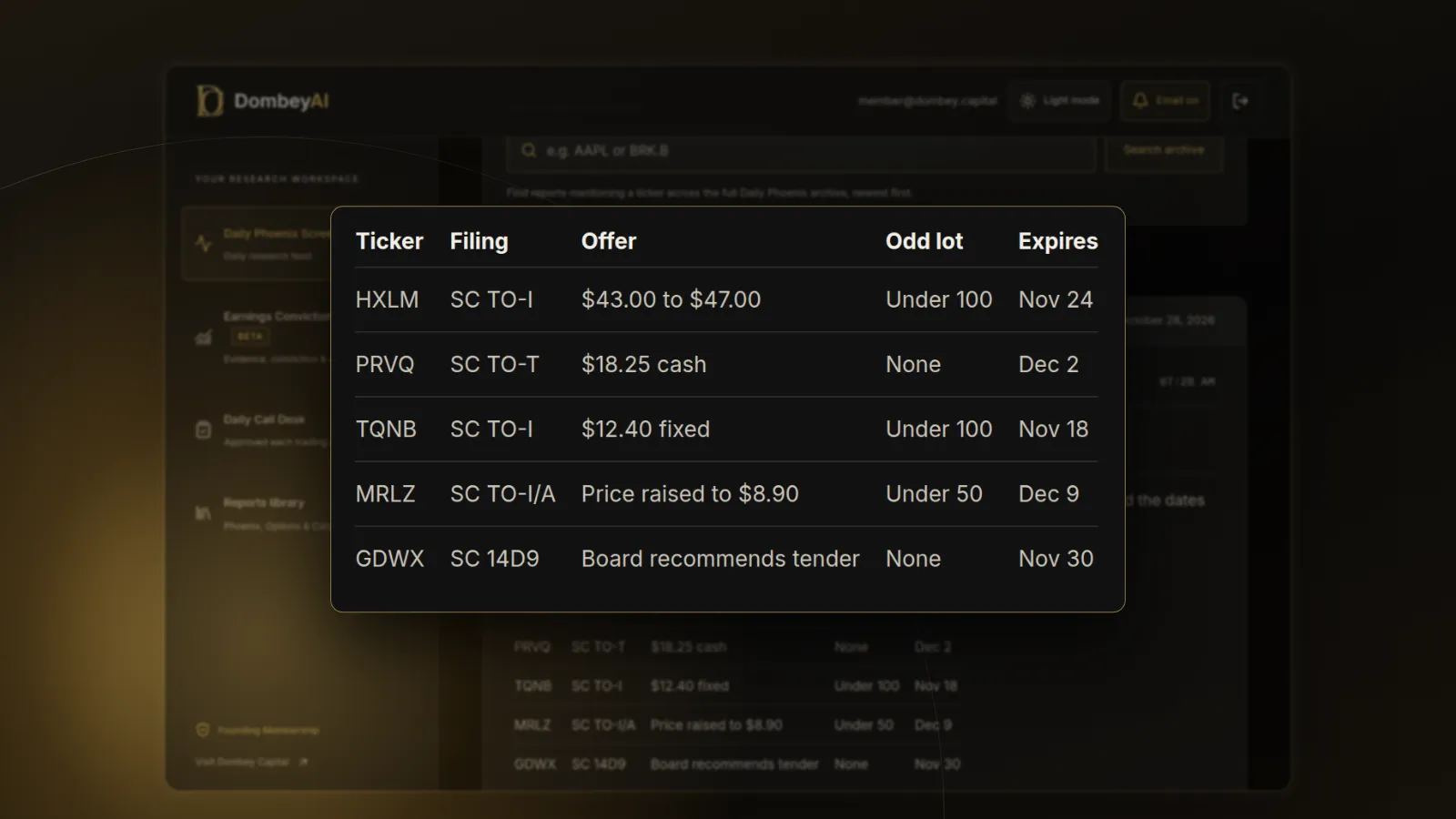


Full disclosure: Dombey Capital is our own research service and our top pick here, for the reasons below. The section on where it falls short is there so you can judge whether it fits your process.
Quick comparison
| Tool | Best for | Key features | Price (as of October 2026) |
|---|---|---|---|
| Dombey Founding MembershipTop pick | Tender offers read as dated catalysts | Weekly Phoenix Report, Daily Phoenix Screener, Biweekly Catalyst Briefing, valuation and execution analysis | Founding Membership $1,200/year; Standard Access $80/year or $8/month |
| SEC EDGAR | Free primary filings for every US offer | RSS by company, CIK or form type; full-text search since 2001 | Free |
| OddLotArbitrage.com | Free odd-lot tender list | US and Canadian offers, price limits, expiration, filing links, email and X notifications | Free; optional donations |
| Special Situations Digest | Broadest weekly list across markets | Tender offers, self-tenders and exchange offers in 25+ markets, searchable database, Excel, PDF and JSON | Free preview; Pro $300/year; Team custom |
| Odd Lot Special Situations Newsletter | Low-cost odd-lot and going-private ideas | Updated list of tenders with odd-lot provisions and going-private deals; past ideas free | $15/month |
| Special Situation Investments | Written pitches across special situations | Ideas on tender offers, odd-lot deals, mergers and spin-offs; member discussions; free merger arbitrage tracker | $49/month billed $590 yearly, or $75/month; free newsletter |
| sec-api.io | Tender filings in your own code | Query and real-time stream APIs; bulk datasets for SC TO-I, SC TO-T, SC TO-C, SC 14D9 and SC 13E3 | Free 100 calls; $49/month; $199/month; Enterprise custom |
| FindStox Odd Lot alerts | Email only when an odd-lot deal appears | Emails on new odd-lot buybacks, one-time payment | One-time payment; see the vendor's site |

How we compared these tools
We compared these tools from vendor documentation, pricing pages and public product pages read in October 2026, and from the SEC's rules as published in the eCFR. We did not run trials with any of them, and we make no judgment on any vendor's accuracy or speed beyond what the vendor states.
| Criterion | Weight | What it measures |
|---|---|---|
| Catalyst context | 30% | Whether the tool helps you judge the outcome: conditions, proration, financing, what happens after expiration |
| Coverage | 25% | Issuer and third-party offers, odd-lot terms, non-US markets, going-private deals |
| Timeliness and alerts | 20% | How and how often the tool tells you about a new or amended offer |
| Path to the source | 15% | How easily you reach the Schedule TO, the Offer to Purchase and amendments |
| Cost for the job | 10% | What it costs to follow tender offers across a working watchlist |
If you only care about odd-lot deals, the free odd-lot trackers move up and the broader products move down. If you build screens in code, sec-api.io moves up, because structured data matters more than written context.
Quick picks by job
Best for tender offers as dated catalysts: Dombey Founding Membership
Founding Membership is written research, not a feed. When a tender offer bears on a special situation in Dombey's coverage, the work sets out the terms, the conditions, the likely proration and what the stock may do after the offer closes. Each thesis is published before its catalyst and kept in the archive.
Best free primary source: SEC EDGAR
An RSS feed filtered to the SC TO-I and SC TO-T form types shows every new US tender offer filing at no cost, and full-text search finds phrases such as "odd lot" across offer documents.
Best free odd-lot tracker: OddLotArbitrage.com
OddLotArbitrage.com lists US and Canadian odd-lot tenders with price limits, expiration and a filing link, and sends notifications by email and on X.
Best for broad weekly coverage across markets: Special Situations Digest
Special Situations Digest tracks tender offers, self-tenders and exchange offers across 25+ markets in a weekly issue, with exports and a searchable database on its Pro plan.
Best low-cost odd-lot newsletter: Odd Lot Special Situations Newsletter
At $15 a month, it keeps an updated list of tenders with odd-lot provisions and going-private transactions, with past ideas free to read.
Best for written pitches across special situations: Special Situation Investments
Special Situation Investments publishes ideas on tender offers, odd-lot deals, merger arbitrage and spin-offs, with member discussions under each idea.
Best for tender filings in code: sec-api.io
sec-api.io offers query and streaming APIs over EDGAR and bulk datasets for tender offer and going-private forms.
Best for occasional email alerts only: FindStox
FindStox sends an email only when a new odd-lot buyback appears, for a one-time payment, for readers who want nothing else.
Full reviews
1. Dombey Founding Membership
What it does. Founding Membership is Dombey Capital's full research suite: the weekly Phoenix Report, weekly Options Research, the Biweekly Catalyst Briefing, and the DombeyAI Portal with the Daily Phoenix Screener and the Earnings Conviction Model, plus valuation and execution analysis and priority access. The Daily Phoenix Screener gives a view each trading morning of situations relevant to Dombey's coverage. Where a tender offer bears on a covered situation, the research reads the Schedule TO, the Offer to Purchase and the target's response and turns them into a dated thesis: what the offer pays, what could stop it, how much is likely to be accepted, and by when. You can see the published work in the research archive.
Best for. Readers who follow special situations and want a tender offer turned into a catalyst with dates and a view, not only a listing.
Pricing. Founding Membership is $1,200 a year, billed annually. Standard Access is the lower-cost option at $80 a year (about $6.67 a month) or $8 a month on monthly billing, and includes the Biweekly Catalyst Briefing and the complete public-research archive. The Public Archive is free.
Pros
- Interpretation of what an offer means for value and timing, which a list does not provide.
- Each thesis is published before its catalyst and kept in the archive, so you can compare the case with what happened.
- Standard Access is one of the lower-cost paid options here.
Cons
- It is not a tender feed or a complete list of odd-lot deals; you still need EDGAR or a tracker for notice.
- Coverage is limited to the situations Dombey writes about.
Verdict: Our top pick for readers who want tender offers read as dated catalysts. Pair it with a free tracker for notice on offers outside its coverage.
2. SEC EDGAR
What it does. EDGAR is where every US tender offer is filed. An issuer buying its own shares files Schedule TO-I under Rule 13e-4; a third-party bidder files Schedule TO-T; pre-commencement communications appear as SC TO-C; and the target responds on Schedule 14D-9. The Offer to Purchase, with the odd-lot terms, proration rules and conditions, is an exhibit to the Schedule TO. The SEC's RSS feeds let you follow latest filings by company, CIK or form type, and full-text search covers filings since 2001. Our guide on how to search SEC EDGAR filings covers the filters.
Best for. Anyone who wants the primary source with no cost and no filter in between.
Pricing. Free.
Pros
- Every US tender offer and amendment, with the full offer documents.
- A form-type RSS feed covers the whole market in one subscription.
- Full-text search can find "odd lot" or "Dutch auction" across offer documents.
Cons
- No summary of terms, no proration estimate and no odd-lot flag; you read each document.
- Offers filed only abroad, such as many Canadian or European buybacks, are not on EDGAR.
Verdict: Essential and free. Set up the form-type feeds before paying for anything else.
3. OddLotArbitrage.com
What it does. OddLotArbitrage.com runs a Tender Offer Tracker of odd-lot tenders and related situations, mostly in the US and Canada. Each tender entry shows the filing date, a recent price, the lower and upper limit prices, the site's maximum profit figure, the expiration date and a link to the filing on EDGAR or SEDAR+. Canadian entries add paid-up capital per share, which matters for tax. Going-private entries show the reverse split ratio and cash-out price. The site offers email notifications for new offers and significant changes, and posts on X. It states that its owners may hold positions in the stocks it documents.
Best for. Small holders and odd-lot readers who want a free, focused list with links to the filings.
Pricing. The site says notifications need no paid subscription; donations are optional.
Pros
- Free, with email and X notifications.
- Canadian offers, with paid-up capital for tax.
- Every entry links to the filing.
Cons
- Odd-lot focus only; most tender offers without odd-lot priority are outside its scope.
- No proration or conditions analysis beyond the listed figures.
Verdict: The best free starting point for odd-lot tenders. Read the linked filing before acting on any entry.
4. Special Situations Digest
What it does. Special Situations Digest is a weekly publication that tracks tender offers, self-tenders and exchange offers across 25+ markets. Its free page on odd-lot tender offers lists open situations, sorted by deadline and refreshed every Sunday. The Pro plan adds the full weekly digest, Excel, PDF and JSON downloads, a searchable situations database, a live feed of US SEC filings and the full issue archive.
Best for. Readers who want one weekly list of offers across many markets, not only US odd-lot deals.
Pricing. Free plan with a weekly preview of the first 10 situations each Sunday. Pro is $300 a year, billed yearly, with a 14-day free trial that needs a card and renews automatically. Team pricing is custom.
Pros
- The widest market coverage on this list.
- Exports in Excel and JSON for your own spreadsheet or code.
- A useful free preview.
Cons
- Weekly cadence; offers launched midweek wait for the next issue unless you use the filing feed.
- Breadth across 25+ markets means many offers will not be open to a US retail account.
Verdict: The strongest paid list for breadth. Pair it with EDGAR for same-day notice of US offers.
5. Odd Lot Special Situations Newsletter
What it does. The newsletter focuses on odd-lot tender offers and reverse stock splits that cash out small holders, with coverage of going-private transactions and other events. Subscribers get a constantly updated listing of going-private transactions, tenders with odd-lot provisions and other special situations. Past and inactive ideas are free; active ideas are for subscribers.
Best for. Readers who want a low-cost paid list of odd-lot and going-private ideas.
Pricing. $15 a month.
Pros
- Low price for a curated odd-lot list.
- Covers reverse split cash-outs as well as tenders.
- Free archive of past ideas shows the format before you pay.
Cons
- Narrow focus on small-holder situations.
- Active ideas are paywalled, so the free site is a sample only.
Verdict: A sensible paid add-on for odd-lot readers who want someone else to read the filings first.
6. Special Situation Investments
What it does. Special Situation Investments publishes written pitches across merger arbitrage, tender offers, odd-lot deals, spin-offs and other special situations, with member discussions under each idea. It also runs a free merger arbitrage tracker that lists deals with spreads, deal type and dated updates. For deal spreads more broadly, see our list of the best merger arbitrage data sources and tools.
Best for. Readers who want written ideas on tender offers alongside other special situations, and a community discussing them.
Pricing. Annual plan at $49 a month, billed $590 yearly. Monthly plan at $75 a month. A free occasional newsletter excludes the ideas and discussions.
Pros
- Written context on each idea, not only a listing.
- Covers tender offers next to mergers, spin-offs and liquidations.
- Free merger arbitrage tracker.
Cons
- Not a complete tender offer list; coverage follows the ideas the site chooses to write.
- Pitches include the author's upside estimates, which are opinions to check against the filing.
Verdict: A good fit for readers who want ideas and discussion; use a tracker alongside it for full coverage.
7. sec-api.io
What it does. sec-api.io turns EDGAR into APIs: a query API, a real-time filing stream, full-text search on higher plans, and bulk datasets. Its pricing page lists bulk datasets for tender offer and going-private forms, including SC TO-C, SC TO-T, SC TO-I, SC 14D9 and SC 13E3, and includes bulk datasets in all plans.
Best for. Developers who want tender offer filings in their own screens, alerts or models.
Pricing. Free with 100 API calls in total. Personal and Startups is $49 a month ($588 billed yearly), with the query API and real-time stream. Business Internal Use is $199 a month ($2,388 billed yearly) and adds full-text search. Enterprise and Institutions is custom.
Pros
- Structured access to every Schedule TO and 14D-9 without parsing EDGAR yourself.
- Real-time stream on the $49 plan.
Cons
- You need to write code.
- No odd-lot flag; your code must find the terms in the offer documents.
Verdict: The developer's choice for tender filings at scale.
8. FindStox Odd Lot alerts
What it does. FindStox sends an email when a new odd-lot buyback is announced. The vendor says it expects one to five opportunities a year and charges a one-time payment rather than a subscription, because alerts are infrequent. Its page also lists the risks: an offer can be withdrawn or amended, and the stock can move during the offer period.
Best for. Readers who want an occasional email and nothing else.
Pricing. A one-time payment; the amount is not shown on the page we read. See the vendor's site.
Pros
- No recurring fee.
- Emails only when there is something to read.
Cons
- Narrow: odd-lot buybacks only, and few of them by the vendor's own estimate.
- No list, database or analysis.
Verdict: A low-effort alert for odd-lot readers; free trackers cover the same deals with more detail.
Where Dombey falls short
Founding Membership does one part of this job, and its limits are real:
- Narrow coverage. It covers special situations in Dombey's research coverage. Most tender offers, and most odd-lot deals, will not appear in the research.
- Not a tracker or data terminal. There is no tender list, odd-lot alert, filing feed or API. Use EDGAR or one of the trackers above for those.
- Small team and pen-name author. The research is written by a small team, and the byline is a pen name. Read the Offer to Purchase yourself before acting on any summary.
- Short history. The publication's record is short next to trackers and newsletters that have run for years.
Free vs paid
Free tools cover notice well. An EDGAR RSS feed on SC TO-I and SC TO-T shows every new US offer, full-text search finds odd-lot language, and OddLotArbitrage.com lists odd-lot deals with links to the filings. The Special Situations Digest preview and the Special Situation Investments merger tracker add more at no cost.
Paid tools buy one of three things: breadth (Special Situations Digest Pro), curation (the Odd Lot Special Situations Newsletter, Special Situation Investments, FindStox), or structured data (sec-api.io). Founding Membership buys interpretation of tender offers as dated catalysts, with Standard Access as the lower-cost option for the Catalyst Briefing and archive.
How to choose
Start with the decision you need to make, then pick the cheapest tool that supports it. Our guide on how to evaluate a tender offer sets out the checks to run once you have found one.
| Your situation | Pick | Add later when |
|---|---|---|
| You want tender offers read as dated catalysts | Dombey Founding MembershipTop pick | You need notice on offers outside its coverage: add EDGAR RSS or OddLotArbitrage.com |
| You hold small positions and want odd-lot deals | OddLotArbitrage.com | You want a curated list: add the Odd Lot Special Situations Newsletter |
| You follow offers across many markets | Special Situations Digest | You want a written view on value: add Dombey Founding Membership, or Standard Access as the lower-cost option |
| You want ideas and discussion | Special Situation Investments | You want every offer, not only pitched ones: add a tracker |
| You build screens or alerts in code | sec-api.io | You only follow a few names: drop to EDGAR RSS |
| You want the primary documents only | SEC EDGAR | You want odd-lot flags: add OddLotArbitrage.com |
- If an offer has an expiration date, put it and your broker's earlier cutoff on your catalyst calendar.
- If you want filing alerts on other forms too, see the best SEC filing tools and EDGAR alerts.
- If you want a general research subscription rather than a tender list, see Seeking Alpha vs Motley Fool vs Morningstar vs Dombey.
The bottom line
Dombey's Founding Membership is our top pick for readers who want tender offers read as dated catalysts, with Standard Access as the lower-cost option. It is not a tracker, so pair it with SEC EDGAR, which is free and carries every US Schedule TO. For odd-lot deals, OddLotArbitrage.com is the free pick; for breadth across markets, Special Situations Digest; for tender filings in code, sec-api.io. Whatever you use, read the Offer to Purchase yourself, because the cutoff, the conditions and the deadline decide the result.