

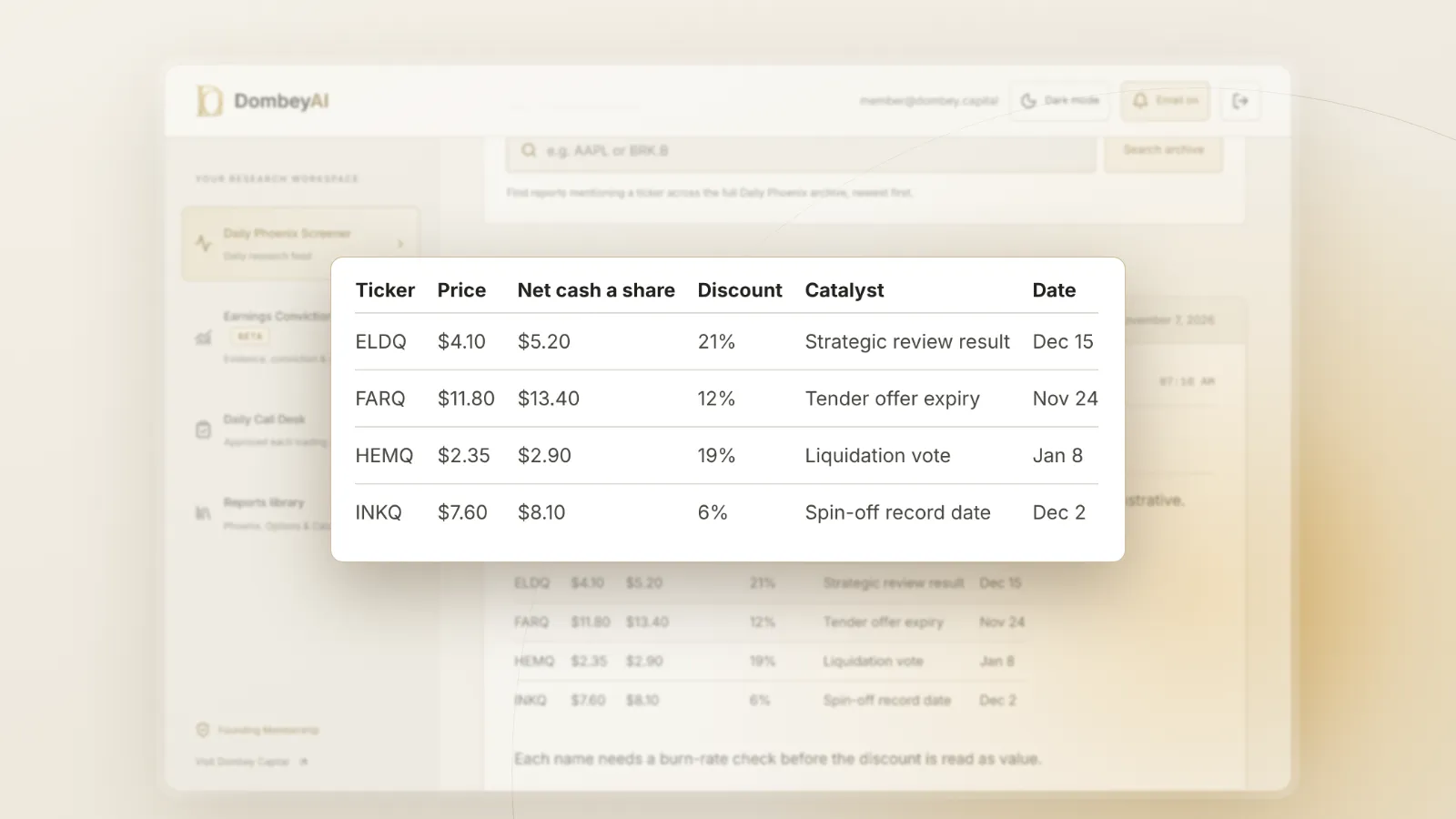


Full disclosure: Dombey Capital is our own research service and our top pick here, for the reasons below. The section on where it falls short is there so you can judge whether it fits your process.
Why investors look for a Capital IQ alternative
S&P Capital IQ is S&P Global Market Intelligence's company data platform, and its newer version is S&P Capital IQ Pro. The Capital IQ site is a login portal with a "Request Demo" button and a client services contact; no price is published. That model suits banks, funds and corporate development teams that buy seats under an institutional contract.
Individual investors and small teams usually leave, or never start, for three reasons:
- No published price. Without a list price, it is hard to judge value before a sales conversation.
- More than they need. Many individual investors mainly use financial statements, estimates, a screener and filings, which retail platforms cover.
- Data is not a view. A data platform gives the numbers; it does not tell you what a spin-off, tender offer or restructuring means for the stock.
The alternatives below cover those gaps in different ways.
Quick comparison
| Tool | Best for | Key features | Price (as of November 2026) |
|---|---|---|---|
| Dombey CapitalTop pick | Special situations and dated catalysts | Weekly Phoenix Report, Catalyst Briefing, DombeyAI Portal, dated public archive | Founding Membership $1,200/yr; Standard Access $80/yr or $8/mo; Public Archive free |
| Koyfin | Financials, estimates and charts in one place | 10Y financials and estimates on Plus, transcripts and filings, screener across 100K+ securities | Free; Plus $39/mo; Premium $79/mo; advisor plans higher |
| TIKR | Long financial history at a set price | Financials up to 30Y, estimates, transcripts, global coverage on paid plans | Free; Plus $24.95/mo; Pro $54.95/mo; Ultimate $119.95/mo |
| AlphaSense | Institutional document search | Broker research from 1,000+ firms, expert transcripts, filings, news | Through sales |
| Stock Rover | Screening and portfolio analytics | 800+ screening metrics, research reports, portfolio tools | See the vendor's pricing page |
| Simply Wall St | Visual company reports | Company reports, portfolios, screeners, S&P Global data | See the vendor's pricing page |
| Seeking Alpha Premium | A broad research subscription | Ratings, screeners, AI research tools, research library | $299/yr plus taxes |
| SEC EDGAR | Primary filings | Full-text search since 2001, RSS feeds, CSV export | Free |
How we compared these tools
We compared them from vendor documentation, pricing pages and public product pages, weighting the criteria that matter most for special situations and dated catalysts.
| Criterion | Weight | What it measures |
|---|---|---|
| Fit for special situations and catalysts | 30% | Whether the tool helps judge a spin-off, deal, tender or restructuring, not just report numbers |
| Depth of company data | 20% | Years of financials, estimates, transcripts and filings |
| Price transparency and value | 20% | Whether a price is published and what it buys |
| Access to primary documents | 15% | How easily you reach the filings behind the numbers |
| Screening and workflow | 15% | Screeners, alerts, watchlists and export |
If you weight data depth and screening above catalyst fit, Koyfin and TIKR move ahead of Dombey, which is research rather than a database.
Quick picks by job
Best for special situations and dated catalysts: Dombey Capital
Dombey publishes research on situations where an event can reset a stock's value: spin-offs, tender offers, stocks below net cash, restructurings and other catalysts. Each thesis is dated and priced on publication and kept in the archive. It replaces the judgment part of the work, not the data terminal.
Best for financials, estimates and charts in one place: Koyfin
Koyfin's Plus plan includes ten years of financials and estimates, transcripts and filings, and a stock and ETF screener. It is the closest everyday substitute for Capital IQ's public company tearsheets at a published price.
Best for long financial history at a set price: TIKR
TIKR sets data depth by plan, from five years of US financials on the free plan to 30 years on Ultimate, with transcripts and global coverage on paid plans.
Best for institutional document search: AlphaSense
AlphaSense searches broker research, expert transcripts, filings and news together. It is the institutional alternative for teams whose Capital IQ use is mostly reading and searching documents.
Best for screening and portfolio analytics: Stock Rover
Stock Rover describes screening thousands of stocks on more than 800 metrics and custom formulas, plus research reports and portfolio analytics.
Best for visual company reports: Simply Wall St
Simply Wall St turns company data into visual reports and lists S&P Global data among the features in all plans.
Best for a broad research subscription: Seeking Alpha Premium
Seeking Alpha Premium bundles ratings, screeners, AI research tools and a research library covering more than 4,000 stocks and ETFs.
Best for the primary documents: SEC EDGAR
Every US public company's filings are on EDGAR, free, with full-text search back to 2001.
Full reviews
1. Dombey Capital
What it does. Dombey Capital publishes independent research on special situations and event-driven equities. Each thesis sets out the situation, the catalyst and its date, the valuation and what would change the view, and is priced on the day it is published and kept in the archive. There are three access levels:
- Founding Membership ($1,200 a year, annual billing only): the weekly Phoenix Report, weekly Options Research, the Catalyst Briefing, the DombeyAI Portal with the Daily Phoenix Screener and the Earnings Conviction Model, valuation and execution analysis, and priority access.
- Standard Access ($80 a year, about $6.67 a month, or $8 a month on monthly billing), the lower-cost option: the Biweekly Catalyst Briefing on forthcoming corporate and market events, plus the complete public-research archive.
- Public Archive (free): published executive theses and public research.
Best for. Investors who use a data platform to find situations and want research on what the event means for the stock. Our explainer on what a special situation is shows the kind of cases covered.
Pricing. Founding Membership $1,200 a year. Standard Access $80 a year or $8 a month. Public Archive free. See the subscription options.
Pros
- Research on the situation, not only the numbers.
- Each thesis is dated and archived, so you can check later whether it held.
- Founding Membership includes the DombeyAI Portal; Standard Access is a low-cost entry point.
Cons
- Not a database: no financial statement history, Excel plug-in or private company data.
- Covers a short list of situations.
- The full list of limits is in the section on where Dombey falls short.
Verdict: Our top pick for investors whose work centers on special situations and dated catalysts. Pair it with a data platform.
2. Koyfin
What it does. Koyfin is a financial data and charting platform. Its pricing page lists two years of financials and one year of estimates on the free plan, and ten years of financials and estimates, transcripts and filings, and a stock and ETF screener on Plus. Its home page describes a screener across more than 100,000 global securities with more than 5,900 filter criteria.
Best for. Individual investors who want financials, estimates, charts and filings on one screen.
Pricing. Free at $0, Plus at $39 a month, Premium at $79 a month, Advisor Core at $209 a month and Advisor Pro at $299 a month. The pricing page says annual billing saves up to 30%.
Pros
- Published prices with a usable free plan.
- Ten years of financials and estimates from Plus.
- Broad screener and dashboards.
Cons
- Built for public securities; no private company or transaction database of the institutional kind.
- History is shorter than TIKR's top plan.
Verdict: The best all-round substitute for an individual investor's daily Capital IQ use.
3. TIKR
What it does. TIKR is a stock research platform with financials, estimates and transcripts. Its pricing page sets depth by plan: the free plan covers US stocks with five years of annual financials and 90 days of transcripts; Plus adds global coverage and ten years; Pro adds ten years of transcripts with audio and slides; Ultimate lists 30 years of financials and full transcript history.
Best for. Investors who want long financial history and estimates at a fixed monthly price.
Pricing. Free at $0; Plus $24.95 a month; Pro $54.95 a month; Ultimate $119.95 a month. The page lists a 14-day money-back guarantee for new users.
Pros
- Deep history on the top plan.
- Transcripts and estimates included.
- Low entry price for global coverage.
Cons
- Fewer charting and macro tools than Koyfin.
- Saved screens are limited on lower plans.
Verdict: The best value for long company history at a published price.
4. AlphaSense
What it does. AlphaSense is a market intelligence platform. Its pricing page lists two plans, Market Intelligence and Enterprise Suite, with equity research from more than 1,000 sell-side and independent firms, an Expert Transcript Library, regulatory filings and news. Enterprise Suite adds API and MCP access.
Best for. Institutional teams that use Capital IQ mostly to read and search documents.
Pricing. No price is published; the page directs visitors to sales. Market Intelligence is seat-based and Enterprise Suite usage-based.
Pros
- Broker research and expert transcripts in one search.
- Filings and news alongside.
- API access on the higher plan.
Cons
- No published price.
- Built for institutions, not individual budgets.
Verdict: The institutional choice when search, not spreadsheets, is the main job.
5. Stock Rover
What it does. Stock Rover is a research, screening and portfolio platform. Its home page describes screening thousands of stocks on more than 800 financial metrics and custom formulas, research reports on stocks and on 7,400 ETFs and 20,000 mutual funds, and portfolio analytics including risk analysis. It lists four tiers, Premium, Premium Plus, Ultimate and Ultimate Pro, each with a free trial.
Best for. Investors who want deep screening and portfolio tools together.
Pricing. See the vendor's pricing page.
Pros
- Large metric library and custom formulas.
- Portfolio analytics alongside research.
- Free trial on each tier.
Cons
- Prices were not shown on the pages we read.
- Focused on screening rather than document search.
Verdict: A strong choice for screening-heavy investors leaving an institutional platform.
6. Simply Wall St
What it does. Simply Wall St presents company data as visual reports. Its plans page compares Free, Premium and Unlimited tiers by the number of company reports per month (5, 30 or unlimited), portfolios and screeners, and lists S&P Global data, stock notes and alerts among the features in all plans. New accounts get seven days of Premium without a credit card.
Best for. Investors who want a quick visual read of a company before going to the filings.
Pricing. See the vendor's pricing page.
Pros
- Visual reports that are quick to scan.
- Free tier and a trial of Premium.
- Lists S&P Global data in all plans.
Cons
- Report limits on the lower tiers.
- Less suited to building your own models.
Verdict: A good first look at a company; not a substitute for the statements themselves.
7. Seeking Alpha Premium
What it does. Seeking Alpha is a broad investment research site. Its help center lists data-driven stock ratings and screeners, AI-powered research tools such as Virtual Analyst Reports and Earnings Call Insights, and a research library covering more than 4,000 stocks and ETFs in Premium.
Best for. Investors who want a broad research subscription with ratings and contributor analysis.
Pricing. $299 a year plus taxes where applicable, per the help center.
Pros
- Wide coverage and many contributor views.
- Screeners and ratings included.
Cons
- Not a company data platform in the Capital IQ sense.
- Quality varies across contributors.
Verdict: A reasonable add-on for ideas; not a data replacement.
8. SEC EDGAR
What it does. EDGAR is the SEC's filing system. Full-text search covers electronic filings since 2001, with filters by entity, form type, date and location, and results can be exported as CSV. RSS feeds follow a company's new filings or a form type.
Best for. Reading the primary documents behind every number a data platform shows.
Pricing. Free.
Pros
- The original source, free.
- Full-text search and alerts.
Cons
- No standardized financials or screener.
- You assemble history yourself.
Verdict: Essential alongside any platform. Our guide on how to search SEC EDGAR filings shows how to use it.
Where Dombey falls short
- Narrow coverage. Dombey covers special situations and catalyst-driven stocks, not the whole market.
- No data terminal. There is no financial statement database, Excel plug-in, private company data or transaction screen of the kind Capital IQ offers.
- Small team. Output is limited by how many situations a small team can research properly.
- Pen-name author. Research is published under the name James Whitfield, a pen name. Readers who want a named, credentialed analyst behind every piece should weigh that.
- Short history. The public record is young. The archive keeps every thesis with its date and price, but a short record says less than a long one.
Free vs paid
Much of the basic data is free. EDGAR holds every filing, Koyfin and TIKR have free plans with several years of financials, Simply Wall St's free tier includes five company reports a month, and Dombey's Public Archive is free.
What paid tools add:
- Longer history and estimates (Koyfin Plus, TIKR paid plans).
- Screening depth and portfolio analytics (Stock Rover).
- Search across broker research and expert calls (AlphaSense).
- Research on what an event means for the stock (Dombey Founding Membership, with Standard Access as the lower-cost option).
How to choose
| Your situation | Pick | Add later when |
|---|---|---|
| You focus on special situations and dated catalysts | Dombey CapitalTop pick | You need financial history: add Koyfin or TIKR |
| You want financials, estimates and charts together | Koyfin | You want 30 years of history: try TIKR Ultimate |
| You want long history at a low price | TIKR | You want research on events: add Dombey Founding Membership, or Standard Access as the lower-cost option |
| You work at a fund and mainly search documents | AlphaSense | You need private company data: ask S&P for a Capital IQ quote |
| You screen heavily and track portfolios | Stock Rover | You want transcripts: add TIKR |
| You want a quick visual read | Simply Wall St | You build your own models: move to Koyfin or TIKR |
| You want a broad research subscription | Seeking Alpha Premium | You need standardized data: add Koyfin |
- If you mainly need public company financials, start with Koyfin or TIKR before asking for a Capital IQ quote.
- If you mainly search documents at a fund, start with AlphaSense.
- If your question is what a spin-off, deal or restructuring means for the stock, start with Dombey Capital.
For more on data platforms, see our Koyfin alternatives, our Bloomberg Terminal alternatives and our list of the best stock research tools for individual investors. For a comparison of research services, see our Seeking Alpha vs Motley Fool vs Morningstar vs Dombey comparison.
The bottom line
Dombey Capital is our top pick among S&P Capital IQ alternatives for investors focused on special situations and dated catalysts, because it researches what an event means for the stock rather than supplying a database. For company data at a published price, Koyfin is the best all-round substitute and TIKR the best value for long history. AlphaSense is the institutional choice for document search, Stock Rover and Simply Wall St suit screening and quick reports, Seeking Alpha Premium is a broad subscription, and EDGAR is the free primary source to keep open whatever else you use.