

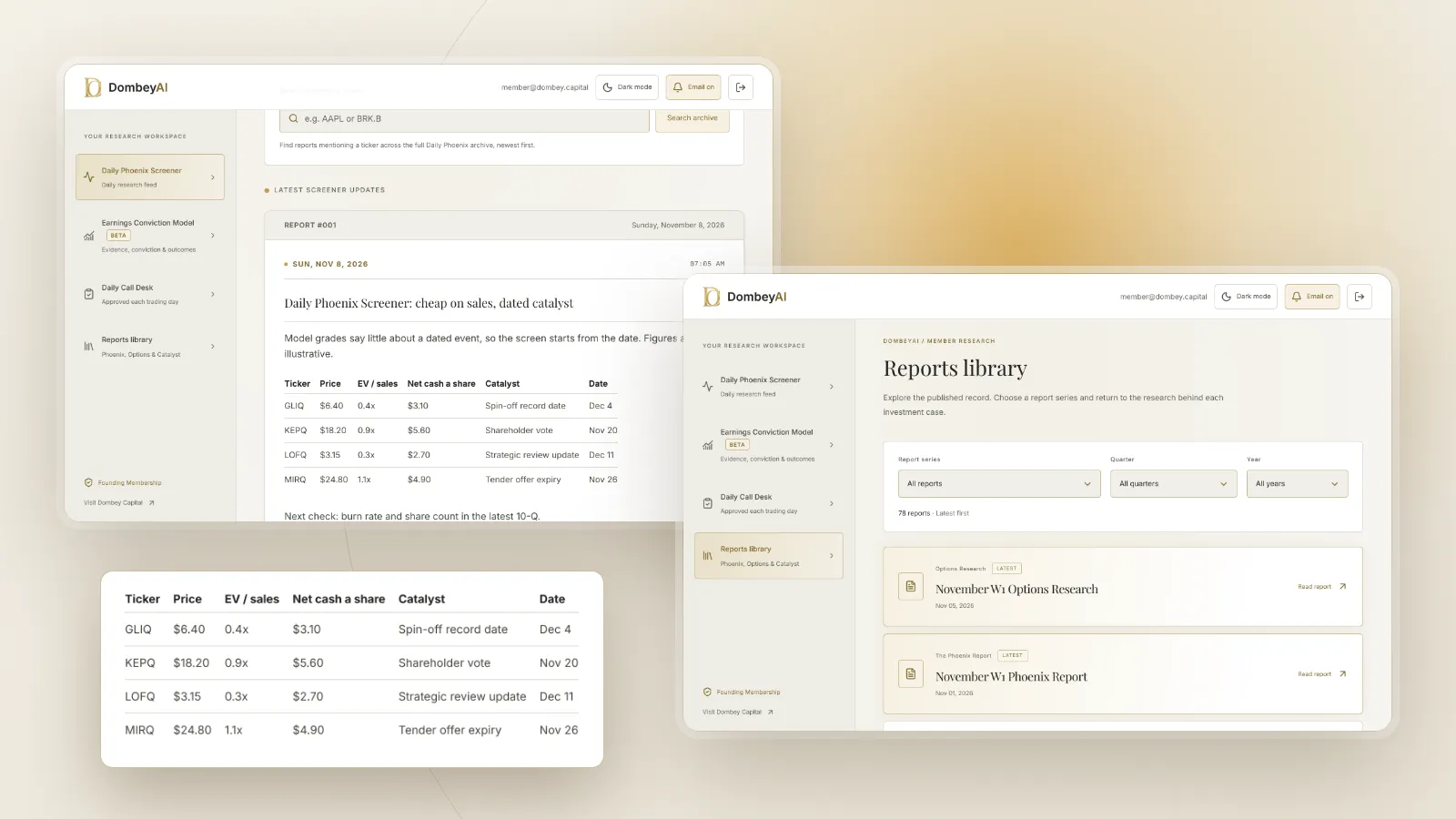


Full disclosure: Dombey Capital is our own research service and our top pick here, for the reasons below. The section on where it falls short is there so you can judge whether it fits your process.
What WallStreetZen does, and why people look elsewhere
WallStreetZen is a stock research site built around ratings. Its site describes Zen Ratings, which grade stocks from A (Strong Buy) to F (Strong Sell) using a model of 115 factors, plus a database of top analysts, a stock screener and industry ratings. As of November 2026, it promotes its Premium plan with a $1 trial, describing a 14-day trial and a 90-day money-back guarantee. The full price was not shown on the pages we read.
People look for alternatives for a few reasons: they want more written analysis than a grade, a different rating method, deeper financial data, analyst tracking, or research focused on a style the general rating model does not handle well. Name that need first.
| What you use WallStreetZen for | Closest replacement here | What you give up |
|---|---|---|
| A quick quant-style grade | Seeking Alpha Premium | WallStreetZen's simpler layout |
| Following top analysts | TipRanks | Zen Ratings |
| A view on fair value | Morningstar Investor | Factor-based grades |
| Visual company snapshots | Simply Wall St | Analyst database |
| Screening on fundamentals | Stock Rover | Ready-made grades |
| Clean financial statements | Stock Analysis | Ratings |
| The original numbers | SEC EDGAR | Any summary |
| Research on events with a date | Dombey CapitalTop pick | Grades on every stock |

Quick comparison
| Tool | Best for | Key features | Price (as of November 2026) |
|---|---|---|---|
| Dombey CapitalTop pick | Investors in special situations and dated catalysts | Founding Membership: weekly Phoenix Report, weekly Options Research, Catalyst Briefing, DombeyAI Portal with the Daily Phoenix Screener and Earnings Conviction Model; Standard Access: Biweekly Catalyst Briefing and public-research archive | Founding Membership $1,200/year; Standard Access $80/year or $8/month; Public Archive free |
| Seeking Alpha Premium | Quant-style ratings with written analysis | Data-driven stock ratings and screeners, AI research tools, analysis on over 4,000 stocks and ETFs | $299/year |
| TipRanks | Analyst and expert tracking | Premium stock analysis, expert access, smart portfolio; Ultimate adds expert and research firm rankings | Premium $30/month, Ultimate $50/month as shown with a promotion; 30-day money-back guarantee on yearly plans |
| Morningstar Investor | Fair value estimates and analyst reports | Fair value and moat ratings, screener with 200+ data points, portfolio tools, 7-day free trial | $249/year or $34.95/month |
| Simply Wall St | Visual company reports | Free, Premium and Unlimited plans; company reports, screeners, portfolios; 7-day Premium trial | See the vendor's pricing page (shown at checkout) |
| Stock Rover | Screening and due diligence data | Screener with 300+ metrics, research reports on higher plans, brokerage integration, 14-day free trial | $29 to $149/month billed annually; $34 to $199/month billed monthly |
| Stock Analysis | Low-cost financial statements | Data on 150,000+ global stocks and funds, up to 100 alerts, follow up to 25 analysts on Pro | Free; Pro $79/year or $9.99/month; 60-day money-back guarantee |
| SEC EDGAR | The original filings | Every public company filing; full-text search | Free |
How we compared these tools
We compared these services from vendor documentation, pricing pages and public product pages, read on the publish date. We did not subscribe to each service for this article, and we make no claims about the performance or accuracy of any rating.
| Criterion | Weight | What it measures |
|---|---|---|
| Fit for dated events | 25% | Whether the tool helps when a stock's value depends on a spin-off, deal, vote, filing or report date |
| Depth of due diligence | 25% | Financial history, filings access and the reasoning behind any rating |
| Rating transparency | 15% | Whether the service explains how its grades or fair values are built |
| Free plan usefulness | 15% | What you can do without paying |
| Price and terms | 20% | List prices, trials and refund terms from the vendor's own pages |
The weights favor event fit and due diligence depth because those matter most for special situations, where a general rating model is weakest. If you mainly want a quick grade on large companies, weight rating transparency and price more heavily, and Seeking Alpha Premium and TipRanks move up the order.
Quick picks by job
Best for special situations and dated catalysts: Dombey Capital
A rating system applies one model to every stock. Dombey starts from an event with a date, such as a spin-off distribution, a shareholder vote, a tender offer deadline or an earnings report, and publishes a thesis before it. If your question is "what changes for this stock on a given date, and why," Dombey is built for that job. It does not grade every stock, so keep a data tool next to it.
Best like-for-like rating tool: Seeking Alpha Premium
Seeking Alpha Premium includes data-driven stock ratings and screeners from its Quant System, AI research tools and a research library on more than 4,000 stocks and ETFs for $299 a year. See Seeking Alpha alternatives for the wider field.
Best for analyst and expert tracking: TipRanks
TipRanks is built around tracking what analysts and other experts say. Premium lets you follow up to 5 experts; Ultimate adds expert and research firm rankings and unlimited alerts. Our TipRanks alternatives piece covers its category.
Best for fair value estimates: Morningstar Investor
Morningstar Investor pairs a fair value estimate and moat rating with analyst reports, for $249 a year.
Best for visual company reports: Simply Wall St
Simply Wall St presents company data as visual reports and offers screeners and portfolio tools. Its plans page lists Free, Premium and Unlimited, with prices shown at checkout and a 7-day Premium trial with no card required.
Best for screening and due diligence data: Stock Rover
Stock Rover pairs a 300+ metric screener with portfolio management. Premium Plus adds research reports for 7,000+ stocks, valuation charts and historical screening.
Best for low-cost financial statements: Stock Analysis
Stock Analysis Pro covers financial statements and analyst follows for $79 a year.
Best for the original numbers: SEC EDGAR
Every rating starts from reported numbers. EDGAR holds the 10-K, 10-Q, 8-K and proxy for every US public company, free. Our guide on how to search SEC EDGAR filings shows how.
Full reviews
1. Dombey Capital
What it does. Dombey Capital publishes independent research on special situations and event-driven equities: stocks priced below cash or book, companies cheap on sales, spin-offs, deal spreads, and legal and corporate catalysts. It is written research, not a rating system. Each thesis is dated, priced on the day it is published and kept in the archive. There are three access levels:
- Founding Membership ($1,200 a year, annual billing only): the weekly Phoenix Report, weekly Options Research, the Catalyst Briefing, the DombeyAI Portal with the Daily Phoenix Screener and the Earnings Conviction Model, valuation and execution analysis, and priority access.
- Standard Access ($80 a year, about $6.67 a month, or $8 a month on monthly billing), the lower-cost option: the Biweekly Catalyst Briefing on forthcoming corporate and market events, plus the complete public-research archive.
- Public Archive (free): published executive theses and public research.
Best for. Investors whose process starts from a dated event. If you are new to the style, what is a special situation covers the basics.
Pricing. Founding Membership $1,200 a year. Standard Access $80 a year or $8 a month. Public Archive free. See the subscription options.
Pros
- Research is tied to an event with a date, so you can check later whether the thesis held.
- The reasoning is written out, not reduced to a grade.
- Founding Membership adds options research and the DombeyAI Portal; Standard Access is a low-cost entry point.
Cons
- No grade on every stock; coverage is narrow by design.
- No broad data terminal.
- A short published history compared with long-established services.
Verdict: The pick for investors who want written analysis of dated events rather than a model grade.
2. Seeking Alpha Premium
What it does. Seeking Alpha Premium adds data-driven ratings and screeners built on its Quant System, AI research tools such as Virtual Analyst Reports and Earnings Call Insights, and a research library on more than 4,000 stocks and ETFs. It costs $299 a year plus applicable taxes.
Best for. Investors who want a rating and written contributor analysis in one place.
Pros
- Quant ratings plus a large library of written analysis.
- Screeners built on the ratings.
- AI tools that summarize earnings calls.
Cons
- Contributor quality varies.
- Ratings are a model output; the reasoning still needs checking.
Verdict: The closest like-for-like swap for WallStreetZen's ratings.
3. TipRanks
What it does. TipRanks tracks analysts and other experts. As of November 2026, its plans page shows Premium at $30 a month and Ultimate at $50 a month, both displayed with a promotion, and a 30-day money-back guarantee on yearly plans. Ultimate adds stock risk factor analysis, expert and research firm rankings and unlimited email alerts.
Best for. Investors who want to see who is saying what about a stock.
Pros
- Expert and research firm rankings on Ultimate.
- Smart portfolio research and daily expert insights.
Cons
- Annual pricing was not clearly stated on the plans page.
- Following experts is not the same as checking their reasoning.
Verdict: The pick for analyst tracking. See also TipRanks vs Seeking Alpha.
4. Morningstar Investor
What it does. Morningstar Investor includes Morningstar's ratings for stocks and funds, analyst reports, a screener with more than 200 data points, portfolio tools and alerts. It costs $249 a year or $34.95 a month, with a 7-day free trial.
Best for. Investors who want a fair value estimate with a written report behind it.
Pros
- Fair value and moat ratings with analyst reports.
- Portfolio tools that show allocation, fees and overlap.
Cons
- Coverage of small and unusual companies is thinner.
- Fair values move with assumptions you should test yourself.
Verdict: The pick for fair value estimates.
5. Simply Wall St
What it does. Simply Wall St turns company data into visual reports, with screeners and portfolio tools. Its plans page lists Free, Premium and Unlimited. Free allows 5 company reports a month, Premium 30 and Unlimited no limit. Prices appear at checkout. New accounts get a 7-day Premium trial with no card required.
Best for. Investors who want a quick visual summary of a company.
Pros
- Easy-to-read visual reports.
- Useful free plan for occasional checks.
Cons
- Prices are not shown on the plans page.
- Visual summaries can hide the detail in the filings.
Verdict: The pick for visual snapshots. See Simply Wall St alternatives.
6. Stock Rover
What it does. Stock Rover combines screening, research and portfolio tracking. Its plans page lists Premium at $29, Premium Plus at $49, Ultimate at $79 and Ultimate Pro at $149 a month on annual billing, or $34 to $199 on monthly billing, with a 14-day free trial.
Best for. Investors who do their own due diligence and want deep screens.
Pros
- Screener with 300+ metrics on Premium.
- Research reports for 7,000+ stocks on Premium Plus.
- Brokerage integration.
Cons
- Takes time to learn.
- Some features sit on higher plans.
Verdict: The pick for data-led due diligence.
7. Stock Analysis
What it does. Stock Analysis offers financial statements and data on 150,000+ global stocks and funds. Pro costs $79 a year or $9.99 a month, with a 60-day money-back guarantee.
Best for. Investors who mainly need clean statements.
Pros
- Low price and long refund window.
- Follow up to 25 analysts on Pro.
Cons
- No proprietary ratings.
- One data download a day on Pro.
Verdict: The budget pick for financial data.
8. SEC EDGAR
What it does. EDGAR is the SEC's filing system, with every public company filing and full-text search.
Best for. Checking any rating or figure at its source.
Pros
- Free and complete for US filers.
- The primary source behind every number above.
Cons
- No ratings, charts or standardized data.
Verdict: Keep it next to any tool on this list.
Where Dombey falls short
- Narrow coverage. Dombey covers special situations, not every stock. If you want a grade on any ticker you type in, Dombey is the wrong tool.
- No data terminal. There is no broad screener or rating database like WallStreetZen's. Keep a data tool as well.
- Small team. Research comes from a small team, so the number of situations covered at once is limited.
- Pen-name author. Research is published under a pen name, so you judge it on the written reasoning.
- Short history. The archive is younger than long-established services.
For a wider comparison of research services, see Seeking Alpha vs Motley Fool vs Morningstar vs Dombey. Rating-focused readers may also want our Zacks alternatives comparison.
Free vs paid
Free tools cover more than most people expect. Simply Wall St and Stock Analysis have free plans, EDGAR is free, and Dombey's Public Archive is free. Paying makes sense when you want unlimited reports, deeper screens, ratings across many stocks or written research on events. Within Dombey, Founding Membership includes the full research set and the DombeyAI Portal, and Standard Access at $80 a year is the lower-cost option with the Biweekly Catalyst Briefing.
How to choose
| Your situation | Pick | Add later when |
|---|---|---|
| You follow spin-offs, deals and other dated events | Dombey CapitalTop pick | You want grades on every stock |
| You want a quick rating plus written analysis | Seeking Alpha Premium | You want event research |
| You follow analysts and experts | TipRanks | You want to check the filings |
| You want a fair value estimate | Morningstar Investor | You need deeper screens |
| You want visual summaries | Simply Wall St | You need full statements |
| You do your own screening | Stock Rover | You want ratings |
| You want statements on a budget | Stock Analysis | You want screens |
The bottom line
Dombey Capital is our top pick for investors in special situations and dated catalysts, because it gives written research on events rather than a grade from a general model. For a like-for-like WallStreetZen replacement, Seeking Alpha Premium is the closest, with quant ratings and written analysis for $299 a year. TipRanks is the analyst-tracking pick, Morningstar Investor the fair value pick, and Stock Rover and Stock Analysis cover the data side. Whichever you choose, check any grade against the filings on EDGAR.