

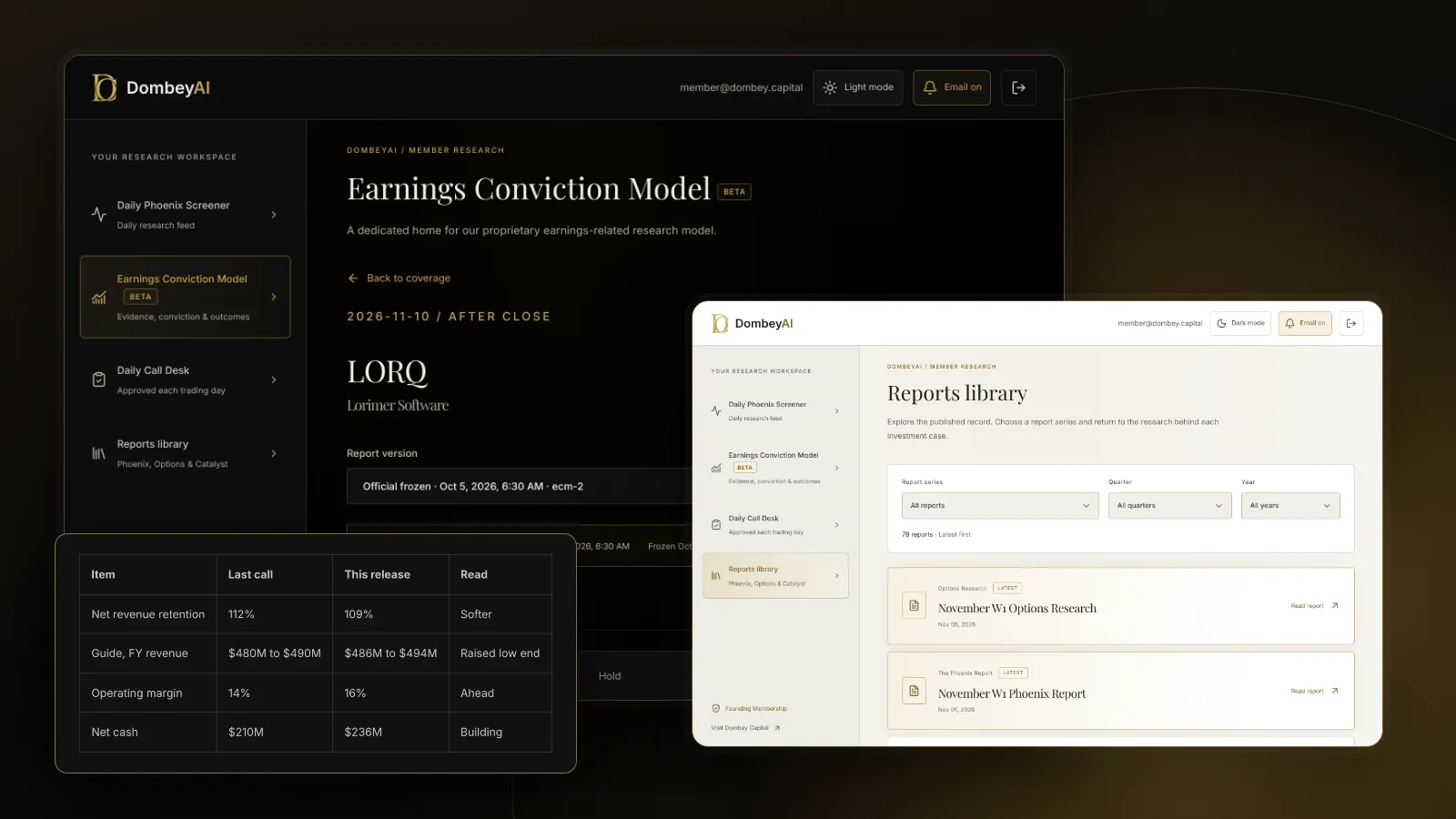


Full disclosure: Dombey Capital is our own research service and our top pick here, for the reasons below. The section on where it falls short is there so you can judge whether it fits your process.
Why investors look for a Quartr alternative
Quartr is built around company events. Its home page describes live coverage of earnings calls, capital markets days and conferences across more than 65 markets, and it reports covering more than 16,000 companies. Quartr Pro lists live earnings calls, live transcripts, filings and slide presentations, AI chat, transcript and slide search, and watchlists, on desktop and mobile. The Quartr API offers the same content as data. Quartr also promotes a free mobile app.
Both Pro and the API are priced through the sales team: the pricing page says "Contact sales" rather than showing a figure. That suits firms buying seats, but individual investors often want a published price.
Investors look elsewhere for four main reasons:
- Price clarity. They want a plan with a listed monthly or annual price.
- Data in one place. They want transcripts next to financial statements, charts and estimates rather than in a separate app.
- Programmatic access. They want transcripts or audio through an API at a published rate.
- The question behind the call. A transcript records what management said. It does not say what the report means for the stock or the situation around it.
| What you need | Best fit here | What you give up |
|---|---|---|
| A view on what the report means | Dombey CapitalTop pick | A call player and transcript library |
| Transcripts next to charts and financials | Koyfin | Live call audio |
| Long transcript history at a set price | TIKR | Broker research |
| Search across transcripts and broker research | AlphaSense | A published price |
| AI tools in a broad research service | Seeking Alpha Premium | A dedicated call app |
| Transcripts and audio through an API | EarningsCall | A research interface |
| Free recent transcripts | The Motley Fool | Depth and history |
| The primary documents behind each call | SEC EDGAR | Transcripts and audio |

Quick comparison
| Tool | Best for | Key features | Price (as of November 2026) |
|---|---|---|---|
| Dombey CapitalTop pick | Earnings inside special situations research | Founding Membership: weekly Phoenix Report, weekly Options Research, Catalyst Briefing, DombeyAI Portal with the Daily Phoenix Screener and Earnings Conviction Model; Standard Access: Biweekly Catalyst Briefing and public-research archive | Founding Membership $1,200/year (annual only); Standard Access $80/year or $8/month; Public Archive free |
| Koyfin | Transcripts next to charts and financials | Press releases, filings and transcripts from the Plus plan; charts, screener and dashboards | Free plan; Plus from $39/month; Premium from $79/month |
| TIKR | Long transcript history at a set price | Transcript history by plan; audio and slides on Pro and Ultimate; global data on paid plans | Free (US, 90 days of transcripts); Plus $24.95, Pro $54.95, Ultimate $119.95 per month |
| AlphaSense | Searching transcripts with broker and expert research | Broker and independent research from 1,000+ firms, Expert Transcript Library, filings and transcripts | See the vendor's pricing page (through sales) |
| Seeking Alpha Premium | AI earnings tools in a broad research service | Earnings Call Insights among AI research tools | $299/year |
| EarningsCall | A transcript and audio API | 9,000+ companies; basic and enhanced transcripts; live and historical audio; mobile apps | API $60 to $155/month |
| The Motley Fool | Free recent transcripts | Transcripts of recent calls for covered companies with one-line summaries | See the vendor's page |
| SEC EDGAR | The documents behind the call | Full-text search of 20+ years of filings, latest filings in real time, 8-K earnings releases | Free |
How we compared these tools
We compared these tools from vendor documentation, pricing pages and public product pages, read on the publish date. We did not subscribe to each service for this article, and we make no claims about the accuracy or completeness of any tool's transcripts or data beyond what each vendor states.
| Criterion | Weight | What it measures |
|---|---|---|
| Fit for event-driven work | 25% | Whether the tool helps judge what a report means for a stock with a dated catalyst |
| Transcript and call coverage | 25% | Live calls, transcripts, audio, slides and history |
| Context around the call | 20% | Financials, filings and estimates next to the transcript |
| Cost | 20% | Price for an individual investor, from the vendor's own pages |
| Access | 10% | Desktop, mobile, API and ease of setup |
The weights favor event-driven fit, because a transcript is raw material and the work is in reading it against the situation. If you mainly want to listen to calls live across many markets, weight call coverage more heavily, and Quartr itself and EarningsCall move up.
Quick picks by job
Best for earnings inside special situations research: Dombey Capital
Dombey researches the report as part of a wider situation, such as a company trading below cash, a pending deal or a spin-off, and publishes the view before the catalyst. Founding Membership includes the weekly Phoenix Report and the Earnings Conviction Model in the DombeyAI Portal; Standard Access is the lower-cost option with the Biweekly Catalyst Briefing.
Best for transcripts next to charts and financials: Koyfin
Koyfin adds press releases, filings and transcripts from its Plus plan, so you can read a call with the financial statements and charts on the same platform.
Best for long transcript history at a set price: TIKR
TIKR states transcript history by plan, from 90 days on the free tier to full history on Ultimate, with audio and slides on Pro and Ultimate.
Best for institutional transcript search: AlphaSense
AlphaSense combines transcripts and filings with broker research from more than 1,000 firms and an Expert Transcript Library, for teams that search across all of it.
Best for AI tools inside a broad research service: Seeking Alpha Premium
Seeking Alpha Premium lists Earnings Call Insights among its AI-powered tools, alongside its wider research and ratings, at $299 a year.
Best for an earnings call API: EarningsCall
EarningsCall sells transcripts, enhanced transcripts and audio through an API at published monthly prices, and offers mobile apps.
Best free source of recent transcripts: The Motley Fool
The Motley Fool lists transcripts of the most recent earnings calls for the companies it covers, each with a one-line summary.
Best for the primary documents: SEC EDGAR
EDGAR holds the earnings release furnished on Form 8-K, the 10-Q and 10-K, and full-text search across more than 20 years of filings, all free.
Full reviews
1. Dombey Capital
What it does. Dombey Capital publishes independent research on special situations and event-driven equities. Earnings reports enter that research where they matter to a situation: a company below net cash reporting its cash burn, a target in a pending deal reporting results before the vote, or a spin-off reporting its first standalone quarter. Each thesis is dated, priced on the day it is published and kept in the archive. There are three access levels:
- Founding Membership ($1,200 a year, annual billing only): the weekly Phoenix Report, weekly Options Research, the Catalyst Briefing, the DombeyAI Portal with the Daily Phoenix Screener and the Earnings Conviction Model, valuation and execution analysis, and priority access.
- Standard Access ($80 a year, about $6.67 a month, or $8 a month on monthly billing), the lower-cost option: the Biweekly Catalyst Briefing on forthcoming corporate and market events, plus the complete public-research archive.
- Public Archive (free): published executive theses and public research.
Best for. Investors who want to know what an earnings report means for a stock with a catalyst, rather than to read every call. Our explainer on preparing for an earnings catalyst shows the kind of reasoning involved.
Pricing. Founding Membership $1,200 a year. Standard Access $80 a year or $8 a month. Public Archive free. See the subscription options.
Pros
- Research on the report in the context of the wider situation.
- Each thesis is dated and archived, so you can check later whether it held.
- Founding Membership adds the Earnings Conviction Model; Standard Access is a low-cost entry point.
Cons
- No live call audio, transcript library or slide archive.
- Covers a short list of situations, not every company that reports.
- The full list of limits is in the section on where Dombey falls short.
Verdict: Our top pick for investors who follow earnings inside special situations. Pair it with a transcript source.
2. Koyfin
What it does. Koyfin is a financial data and charting platform. Its Plus plan and above include press releases, filings and transcripts along with premium news, next to the platform's charts, screener and dashboards. Its home page describes an equity screener covering more than 100,000 global securities with more than 5,900 filter criteria.
Best for. Investors who want to read a call with the financial statements and price history on the same screen.
Pricing. The pricing page lists Free at $0, Plus at $39 a month and Premium at $79 a month, with advisor plans above that, and says annual billing saves up to 30%. Check the vendor's pricing page for the billing basis of each figure.
Pros
- Transcripts, filings and press releases sit next to charts and financials.
- Published prices with a free plan to start.
- Strong charting and screening for the price.
Cons
- Transcripts start at the Plus plan; the free plan does not list them.
- No live call audio is described on the pricing page.
Verdict: The best all-round substitute for an individual investor who reads transcripts alongside the numbers.
3. TIKR
What it does. TIKR is a stock research platform with financials, estimates and transcripts. Its pricing page sets transcript history by plan, and lists audio and slides on its higher tiers.
Best for. Investors who want years of transcript history at a fixed monthly price.
Pricing. Free at $0 with US data and 90 days of transcripts; Plus at $24.95 a month with global data and one year of transcripts; Pro at $54.95 a month with ten years of transcripts, audio and slides; Ultimate at $119.95 a month with full history.
Pros
- Clear transcript history by plan.
- Audio and slides on Pro and Ultimate.
- A free tier for US companies.
Cons
- Longer history needs the higher plans.
- The free plan is limited to US data.
Verdict: The best value for transcript history at a published price.
4. AlphaSense
What it does. AlphaSense is a market intelligence platform. Its pricing page lists two plans, Market Intelligence and Enterprise Suite, with broker and independent research from more than 1,000 sell-side and independent firms and an Expert Transcript Library in both. Its FAQ lists earnings call transcripts among the regulatory filings it covers, and the Enterprise Suite adds API and MCP access.
Best for. Institutional teams that search transcripts alongside broker research and expert calls.
Pricing. No price is published. The vendor asks prospective users to contact sales; Market Intelligence is seat-based and Enterprise Suite is usage-based.
Pros
- Transcripts, filings, broker research and expert transcripts in one search.
- Built for teams, with API access on the higher plan.
Cons
- No published price.
- More than most individual investors need.
Verdict: The institutional choice when transcripts are one of many document types you search.
5. Seeking Alpha Premium
What it does. Seeking Alpha is a broad investment research site with contributor analysis, news and quant ratings. Its help center lists Earnings Call Insights among the AI-powered research tools included with Premium.
Best for. Investors who already want a broad research subscription and would use AI summaries of earnings calls inside it.
Pricing. The help center states that Premium is $299 a year plus applicable taxes. The subscription page advertised an introductory first month at $4.95 when we checked.
Pros
- Earnings call tools come with a wide research and ratings service.
- A published annual price.
Cons
- Not a dedicated call or transcript product; the vendor's pages we read did not set out transcript coverage.
- Much of the subscription is unrelated to earnings calls.
Verdict: A reasonable choice if you want Seeking Alpha anyway; not a direct Quartr replacement.
6. EarningsCall
What it does. EarningsCall provides transcripts, audio, slide decks and event data for more than 9,000 public companies across NYSE, Nasdaq and OTC markets, through an API that returns JSON. It offers basic transcripts and enhanced transcripts with speaker labels and word-level timestamps, live and historical audio, and mobile apps for iOS and Android.
Best for. Developers and analysts who want transcripts or audio as data.
Pricing. API plans are Starter at $60 a month (basic transcripts and earnings calendar), Premium at $69 (adds enhanced transcripts), Ultimate at $129 (adds audio) and Ultimate+ at $155 (adds real-time notifications), with a discount for annual billing.
Pros
- Published API prices.
- Enhanced transcripts and audio for programmatic work.
- Mobile apps alongside the API.
Cons
- Built for data use rather than reading research.
- US-listed coverage, not the multi-market reach Quartr describes.
Verdict: The straightforward choice when you want earnings call content in code.
7. The Motley Fool
What it does. The Motley Fool publishes transcripts of the most recent earnings calls for the companies it covers. Each listing carries a one-line summary of the call's main themes.
Best for. Quick reading of a recent call for a widely followed company.
Pricing. See the vendor's page. The transcript listing sits alongside promotions for the company's paid services.
Pros
- Recent transcripts with a short summary.
- Simple to browse by date.
Cons
- Limited to companies The Motley Fool covers.
- Not built for history, search or audio.
Verdict: A useful free check for a recent call; not a research platform.
8. SEC EDGAR
What it does. EDGAR is the SEC's filing system. Its search tools include company search, full-text search across more than 20 years of filings and a latest-filings feed. Earnings releases are typically furnished on Form 8-K under Item 2.02, and the 10-Q or 10-K follows with full financial statements.
Best for. Reading the documents behind the call and checking what management said against what the company filed.
Pricing. Free.
Pros
- The primary source for releases and reports.
- Full-text search and real-time filing feeds.
Cons
- No transcripts or audio.
- Raw documents with no analysis.
Verdict: Essential alongside any transcript tool. Our guide on reading an earnings release shows how to use it.
Where Dombey falls short
- Narrow coverage. Dombey covers special situations and catalyst-driven stocks. It does not follow every company that reports.
- No transcript library. There is no call player, transcript archive, slide search or API of the kind Quartr, TIKR or EarningsCall offer.
- Small team. Output is limited by how many situations a small team can research properly.
- Pen-name author. Research is published under the name James Whitfield, a pen name. Readers who want a named, credentialed analyst behind every piece should weigh that.
- Short history. The public record is young. The archive keeps every thesis with its date and price, but a short record says less than a long one.
Free vs paid
You can cover the basics for free. Company investor relations sites host webcasts and slides, EDGAR holds the releases and reports, The Motley Fool lists recent transcripts, TIKR's free plan includes 90 days of US transcripts, Koyfin has a free plan, Quartr's mobile app is free, and Dombey's Public Archive is free.
What paid tools add:
- Transcripts next to financials (Koyfin Plus and above, TIKR).
- Long transcript history with audio and slides (TIKR Pro and Ultimate).
- Search across broker and expert research (AlphaSense).
- Transcripts and audio as data (EarningsCall).
- Research on what the report means for a situation (Dombey Founding Membership, with Standard Access as the lower-cost option).
How to choose
| Your situation | Pick | Add later when |
|---|---|---|
| You follow earnings inside special situations | Dombey CapitalTop pick | You want to read calls yourself: add TIKR or Koyfin |
| You want transcripts with charts and financials | Koyfin | You want longer history with audio: try TIKR Pro |
| You want years of transcripts at a set price | TIKR | You want research on the event: add Dombey Founding Membership, or Standard Access as the lower-cost option |
| You work at a fund and search many document types | AlphaSense | You want live call coverage across markets: look at Quartr Pro |
| You already want a broad research service | Seeking Alpha Premium | You need transcript history: add TIKR |
| You build models or tools on call content | EarningsCall | You need non-US coverage: ask Quartr about its API |
| You only need the occasional recent call | The Motley Fool and EDGAR | You read calls every week: move to Koyfin or TIKR |
- If you mainly listen to calls live, start with company webcasts and Quartr's free app before paying for anything.
- If you read transcripts against the financials, start with Koyfin or TIKR.
- If you search transcripts with broker research at a fund, start with AlphaSense.
- If your question is what a report means for a stock with a catalyst, start with Dombey Capital.
For a wider list of transcript sources, see our guide to the best earnings call transcript tools; for dates, see the best earnings calendar and catalyst tools; and for a comparison of institutional search platforms, see our AlphaSense alternatives. For a broader comparison of research services, see our Seeking Alpha vs Motley Fool vs Morningstar vs Dombey comparison.
The bottom line
Dombey Capital is our top pick among Quartr alternatives for investors who follow earnings as part of special situations research, because it researches what a report means for the stock rather than hosting the call. For transcripts at a published price, Koyfin suits readers who want charts and financials alongside, and TIKR suits those who want long history with audio and slides. AlphaSense is the institutional search choice, EarningsCall is the API, and Seeking Alpha Premium, The Motley Fool and SEC EDGAR fill in the rest, with EDGAR worth keeping open whatever else you use.