



Full disclosure: Dombey Capital is our own research service and our top pick here, for the reasons below. The section on where it falls short is there so you can judge whether it fits your process.
Why press release monitoring matters
For event-driven investors, the press release is often the catalyst. A merger agreement, a tender offer, a guidance change, a CEO departure, a strategic review or an FDA decision usually reaches the market as a release first. The SEC filing may come at the same time or days later: most material events require a Form 8-K within four business days.
Monitoring has two jobs. The first is catching the release quickly. The second is reading it well: working out whether it changes the timeline, the terms or the value. Free tools handle much of the first job. The second takes judgment, which is where research comes in. Our guide on reading an 8-K for catalysts covers the filing side.
Quick comparison
| Tool | Best for | Key features | Price (as of November 2026) |
|---|---|---|---|
| Dombey CapitalTop pick | What a release means for a special situation | Weekly Phoenix Report, Catalyst Briefing, DombeyAI Portal, dated archive | Founding Membership $1,200/yr; Standard Access $80/yr or $8/mo; Public Archive free |
| SEC EDGAR | The filing behind the news | RSS by company or form type, full-text search since 2001 | Free |
| PR Newswire | Wire releases by industry | RSS feeds by industry and subject, browsable release list | See the vendor's page |
| Koyfin | Releases beside financials | Press releases, filings, transcripts and premium news on Plus | Free; Plus $39/mo; Premium $79/mo |
| TIKR | Custom company newsfeeds | 5 custom newsfeeds on Plus, unlimited on Pro | Free; Plus $24.95/mo; Pro $54.95/mo; Ultimate $119.95/mo |
| AlphaSense | Institutional search across releases and research | Press releases, filings, broker research, news | Through sales |
| Google Alerts | Low-cost topic alerts | Email alerts with frequency, source, language and region options | Free |
| Company IR email alerts | Direct releases from one company | Email notice of releases and events | Free |

How we compared these tools
We compared them from vendor documentation, pricing pages and public product pages, weighting the criteria that matter most for special situations and dated catalysts. We did not measure delivery speed.
| Criterion | Weight | What it measures |
|---|---|---|
| Help judging what a release means | 30% | Whether the tool helps interpret a release for a catalyst, not only deliver it |
| Coverage of material news | 25% | Whether it catches releases and the related filings |
| Filtering and alert control | 20% | Company, form, industry and keyword filters |
| Cost | 15% | Published price and what it buys |
| Link to primary documents | 10% | How easily you reach the filing or full release |
If you weight raw coverage and alert control above interpretation, EDGAR, Koyfin and TIKR move ahead of Dombey, which does not deliver releases at all.
Quick picks by job
Best for judging what a release means for a special situation: Dombey Capital
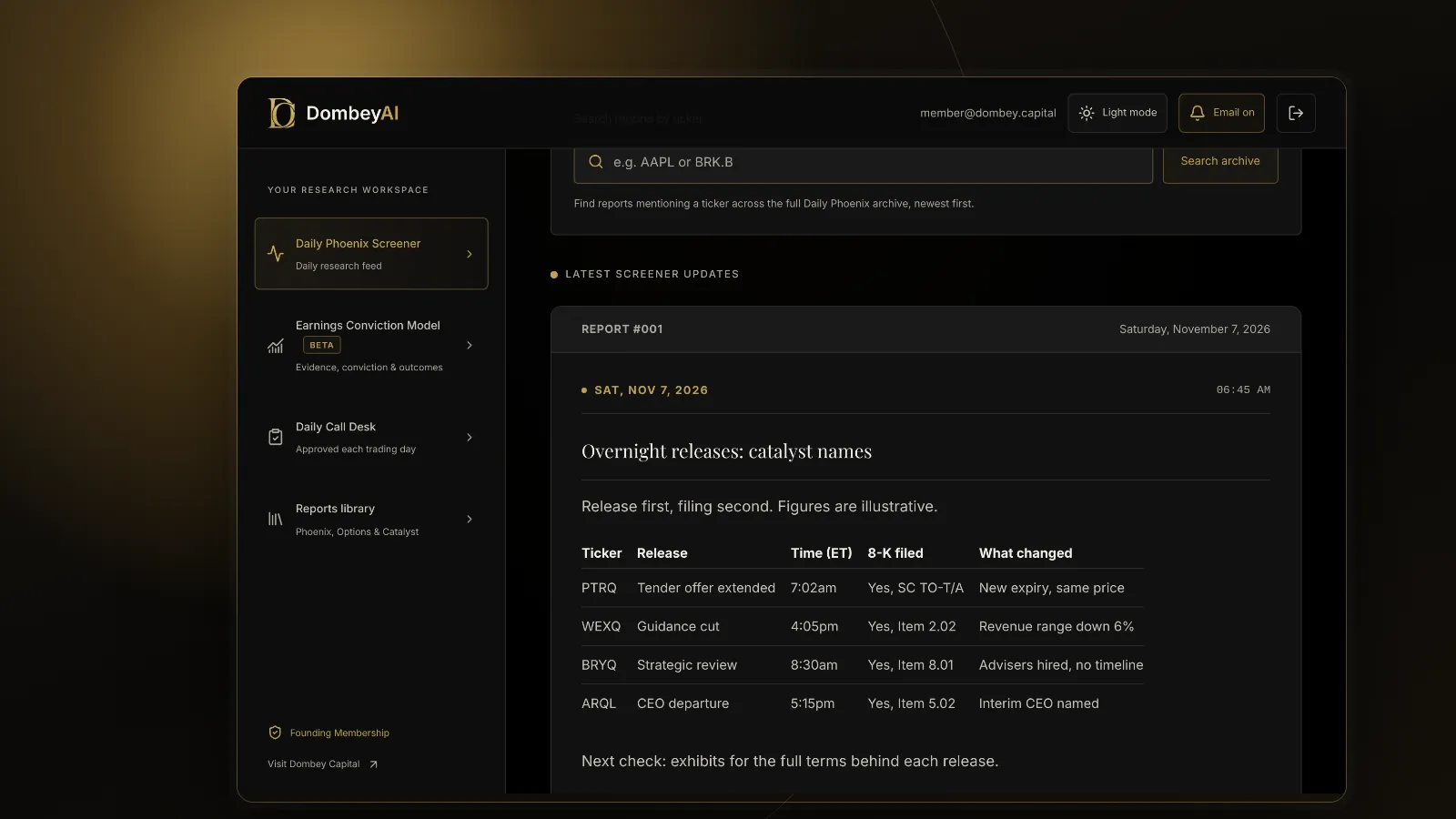
Dombey researches the situations where a release can reset a stock's value: deals, tender offers, spin-offs, restructurings and stocks below net cash. The Catalyst Briefing tracks forthcoming events, and each thesis is dated and archived. Use it alongside a feed, not instead of one.
Best free source for the filing behind the news: SEC EDGAR
EDGAR RSS feeds follow a company's new filings, which can be narrowed by form type, or the latest filings across all companies filtered by company, CIK or form.
Best for wire releases by industry: PR Newswire
PR Newswire publishes RSS feeds for its main news feed and by industry and subject, and a browsable list of releases.
Best for releases beside the financials: Koyfin
Koyfin Plus lists press releases, filings and transcripts and premium news next to its charts and financials.
Best for custom company newsfeeds: TIKR
TIKR's paid plans include custom newsfeeds, five on Plus and unlimited on Pro and Ultimate.
Best for institutional search: AlphaSense
AlphaSense searches press releases with filings, broker research and news in one place.
Best low-cost topic alerts: Google Alerts
Google Alerts emails new search results for any topic, which can catch coverage of a release beyond the wire.
Best for one company you follow closely: Company IR email alerts
Most investor relations sites let you subscribe to releases and event notices by email, straight from the company.
Full reviews
1. Dombey Capital
What it does. Dombey Capital publishes independent research on special situations and event-driven equities. Releases enter the research when they change a situation: a signed merger agreement, a tender offer's terms, a spin-off's record date or a guidance cut at a company below net cash. Each thesis is dated and priced on publication and kept in the archive. There are three access levels:
- Founding Membership ($1,200 a year, annual billing only): the weekly Phoenix Report, weekly Options Research, the Catalyst Briefing, the DombeyAI Portal with the Daily Phoenix Screener and the Earnings Conviction Model, valuation and execution analysis, and priority access.
- Standard Access ($80 a year, about $6.67 a month, or $8 a month on monthly billing), the lower-cost option: the Biweekly Catalyst Briefing on forthcoming corporate and market events, plus the complete public-research archive.
- Public Archive (free): published executive theses and public research.
Best for. Investors who already see the releases and want research on what they mean for a stock with a catalyst. Our explainer on hard and soft catalysts shows the kind of distinction involved.
Pricing. Founding Membership $1,200 a year. Standard Access $80 a year or $8 a month. Public Archive free. See the subscription options.
Pros
- Research on the event, not only delivery of it.
- The Catalyst Briefing keeps forthcoming events in one place.
- Each thesis is dated and archived, so you can check later whether it held.
Cons
- Not a news feed: no real-time release alerts.
- Covers a short list of situations.
- The full list of limits is in the section on where Dombey falls short.
Verdict: Our top pick for investors who need to judge releases inside special situations. Pair it with EDGAR alerts or a feed.
2. SEC EDGAR
What it does. EDGAR is the SEC's filing system. Its RSS feeds follow a single company's new filings, which can be narrowed by filing type, or the latest filings across all companies filtered by company, CIK or form type, including or excluding ownership forms. Full-text search covers filings since 2001, with filters and CSV export.
Best for. Catching the 8-K, tender offer documents or merger proxy that carries the details a release leaves out.
Pricing. Free.
Pros
- The primary source, free.
- Feeds by company and form type.
- Exhibits often hold the full agreement.
Cons
- Not every release is filed.
- Feeds need a reader or email service to become alerts.
Verdict: The first monitor to set up. Our guide on searching SEC EDGAR filings covers the details.
3. PR Newswire
What it does. PR Newswire is a press release distribution service. Its RSS page offers a feed of its main news feed and feeds by industry, such as Health, Energy, and Financial Services and Investing, and by subject. Its news release pages are browsable by industry and subject, with a public company filter and a search box.
Best for. Following releases across an industry rather than one company.
Pricing. See the vendor's page. The RSS page does not state a price for the feeds.
Pros
- Industry and subject feeds.
- Public company filter on the release list.
Cons
- Covers only releases sent through this wire; companies use several services.
- Industry feeds can be high volume.
Verdict: A useful free-to-read feed for sector monitoring; pair it with company-level alerts.
4. Koyfin
What it does. Koyfin is a financial data and charting platform. Its pricing page lists limited news on the free plan and press releases, filings and transcripts and premium news on Plus, with higher plans including everything in Plus.
Best for. Reading a release next to the company's financials, estimates and price chart.
Pricing. Free at $0, Plus at $39 a month, Premium at $79 a month, with advisor plans above. The page says annual billing saves up to 30%.
Pros
- Releases in context with financials.
- Published prices.
Cons
- The pricing page does not mention news alerts.
- Press releases are on paid plans.
Verdict: The best choice when you want to read releases with the numbers on the same screen.
5. TIKR
What it does. TIKR is a stock research platform with financials, estimates and transcripts. Its pricing page lists custom newsfeeds: five on Plus and unlimited on Pro and Ultimate.
Best for. Building company or watchlist newsfeeds alongside financials.
Pricing. Free at $0 (US stocks, no custom newsfeeds listed); Plus $24.95 a month; Pro $54.95 a month; Ultimate $119.95 a month.
Pros
- Custom newsfeeds at a low published price.
- Financials and transcripts included.
Cons
- Newsfeed limits on Plus.
- Built for research rather than alerting.
Verdict: Good value if you want newsfeeds and fundamentals in one subscription.
6. AlphaSense
What it does. AlphaSense is a market intelligence platform. Its pricing page lists news, regulatory filings and equity research from more than 1,000 sell-side and independent firms in both plans, and its FAQ mentions press releases among company disclosures.
Best for. Institutional teams searching releases together with filings, transcripts and broker research.
Pricing. No price is published; the page directs visitors to sales.
Pros
- Releases, filings and research in one search.
- API access on Enterprise Suite.
Cons
- No published price.
- More than most individual investors need.
Verdict: The institutional choice for searching releases in context.
7. Google Alerts
What it does. Google Alerts emails you when new Search results match a topic. You can set how often you get alerts, the types of sites, language, region and how many results to receive.
Best for. Catching coverage of a company or topic beyond the wire, at no cost.
Pricing. Free.
Pros
- Free and quick to set up.
- Catches news coverage and blog posts as well as releases.
Cons
- Not built for markets; results can be slow or noisy.
- Email delivery only, per the help page.
Verdict: A useful backstop, not a primary monitor.
8. Company IR email alerts
What it does. Most public companies' investor relations sites let you subscribe to press releases, SEC filings and event notices by email.
Best for. A short list of companies you follow closely, especially during a pending deal or tender.
Pricing. Free.
Pros
- Straight from the company.
- Usually includes event and webcast notices.
Cons
- One company at a time.
- Formats and reliability vary by company.
Verdict: Worth setting up for every position with a live catalyst.
Where Dombey falls short
- Narrow coverage. Dombey covers special situations and catalyst-driven stocks, not every company's news.
- No news feed. There are no real-time alerts, wire feeds or release search of the kind EDGAR, Koyfin or AlphaSense offer.
- Small team. Output is limited by how many situations a small team can research properly.
- Pen-name author. Research is published under the name James Whitfield, a pen name. Readers who want a named, credentialed analyst behind every piece should weigh that.
- Short history. The public record is young. The archive keeps every thesis with its date and price, but a short record says less than a long one.
Free vs paid
You can build a working monitor for free: EDGAR RSS feeds by company and form type, PR Newswire industry feeds, Google Alerts and company IR email alerts. Dombey's Public Archive is free too.
What paid tools add:
- Releases next to financials (Koyfin Plus).
- Custom newsfeeds (TIKR Plus and Pro).
- Search across releases, filings and research (AlphaSense).
- Research on what a release means for a situation (Dombey Founding Membership, with Standard Access as the lower-cost option).
How to choose
| Your situation | Pick | Add later when |
|---|---|---|
| You follow special situations and need to judge releases | Dombey CapitalTop pick | You want alerts: add EDGAR feeds |
| You want a free primary-source monitor | SEC EDGAR | You want releases that are not filed: add IR alerts |
| You follow a whole industry | PR Newswire feeds | You want to read releases with financials: add Koyfin |
| You read releases against the numbers | Koyfin | You want custom newsfeeds: try TIKR |
| You want newsfeeds with fundamentals | TIKR | You want research on events: add Dombey Founding Membership, or Standard Access as the lower-cost option |
| You work at a fund and search many document types | AlphaSense | You need event research: add Dombey |
| You follow a handful of names casually | Google Alerts and IR alerts | You trade around releases: add EDGAR feeds |
- If you need to catch every material filing, start with EDGAR.
- If you need to read releases with the numbers, start with Koyfin or TIKR.
- If your question is what a release changes for a stock with a catalyst, start with Dombey Capital.
For related tools, see our reviews of Benzinga Pro alternatives, the best SEC filing tools and EDGAR alerts and the best earnings calendar and catalyst tools. For a comparison of research services, see our Seeking Alpha vs Motley Fool vs Morningstar vs Dombey comparison.
The bottom line
Dombey Capital is our top pick among press release monitoring tools for investors who need to judge what a release means for a special situation, because it researches the event rather than delivering the headline. For catching releases, start with free EDGAR RSS feeds and add PR Newswire industry feeds, Google Alerts and company IR alerts as needed. Koyfin is the best paid choice for reading releases beside the financials, TIKR adds custom newsfeeds at a low price, and AlphaSense is the institutional search option.