

What a decision journal is for
Investing gives noisy feedback. A well-reasoned position can lose money because of an event nobody could foresee, and a careless one can make money because the market rose. If you judge decisions only by results, you learn the wrong lessons from both.
Memory makes this worse. Once you know how a position turned out, it becomes hard to recall what you actually believed when you bought it. Psychologists call this hindsight bias: the outcome feels more predictable after the fact than it was. Confirmation bias compounds it, because you remember the evidence that fit the result and forget the rest.
A decision journal solves the problem in the simplest way possible. It fixes your reasoning in writing at the time, with a date, so the later review compares the outcome with what you really thought, not with what you now think you thought.
What to record in each entry
Keep entries short enough that you actually write them. A useful entry fits on half a page:
- Date, time and price. When you decided and at what price.
- The decision. Buy, sell, add, trim, hold or pass, with the size.
- The thesis in one or two sentences. What you think the market is missing.
- Key evidence. Three or four facts the decision rests on, with where you found them.
- Expected outcome, range and date. For example: "Spin-off completes by March; parent trades between $38 and $46 by June."
- Probability. How likely you think the thesis is to be right, as a number.
- What would change your mind. The evidence that would make you exit or reverse.
- Alternatives considered. What you could have done instead and why you did not.
- State of mind. A word or two on mood, energy and time pressure.
The last item looks odd but earns its place. Reviews often show that rushed or tired decisions perform worse, and you cannot see that without having written it down.
If you already write formal theses, the journal entry can point to one. Our guide on how to write a dated investment thesis covers the longer document; the journal is the short record of the decision itself.
Quick reference: entry fields and why they matter
| Field | Example | Why it matters at review |
|---|---|---|
| Decision and size | Buy 2% position at $41.20 | Shows whether sizing matched conviction |
| Thesis | Market ignores $9 of net cash a share | Tests whether the stated edge was real |
| Key evidence | 10-Q balance sheet, tender terms | Shows which sources proved reliable |
| Expected outcome and date | Tender completes by Feb 15 at $48 | Lets you score timing as well as direction |
| Probability | 70% | Builds a calibration record |
| What would change my mind | Financing condition not met | Tests whether you acted on your own exit rule |
| State of mind | Rushed, end of day | Links decision quality to conditions |
How to review a decision journal
Reviews happen at two speeds.
At each outcome. When the expected date passes or the thesis resolves, reread the entry before looking at the result in detail. Then answer four questions in writing:
- Was the evidence accurate and complete at the time?
- Did the outcome happen for the reasons I gave, for other reasons or not at all?
- Was my probability reasonable given what I knew?
- Did I follow my own exit rule?
This is close to a post-mortem, and our guide on how to run an investment post-mortem gives a fuller template.
On a schedule. Once a quarter, read across all entries. Single outcomes tell you little; patterns tell you a lot. Look for:
- Calibration. Of all the decisions you rated 70%, how many worked? If the answer is 45%, your confidence is running ahead of your accuracy.
- Situation types. Are you consistently better at one kind of setup, such as tender offers, and worse at another, such as turnarounds?
- Timing. Do theses work but take longer than you said?
- Behavior. Do you sell winners early and hold losers? That pattern is the disposition effect, and the journal makes it visible.
A worked example
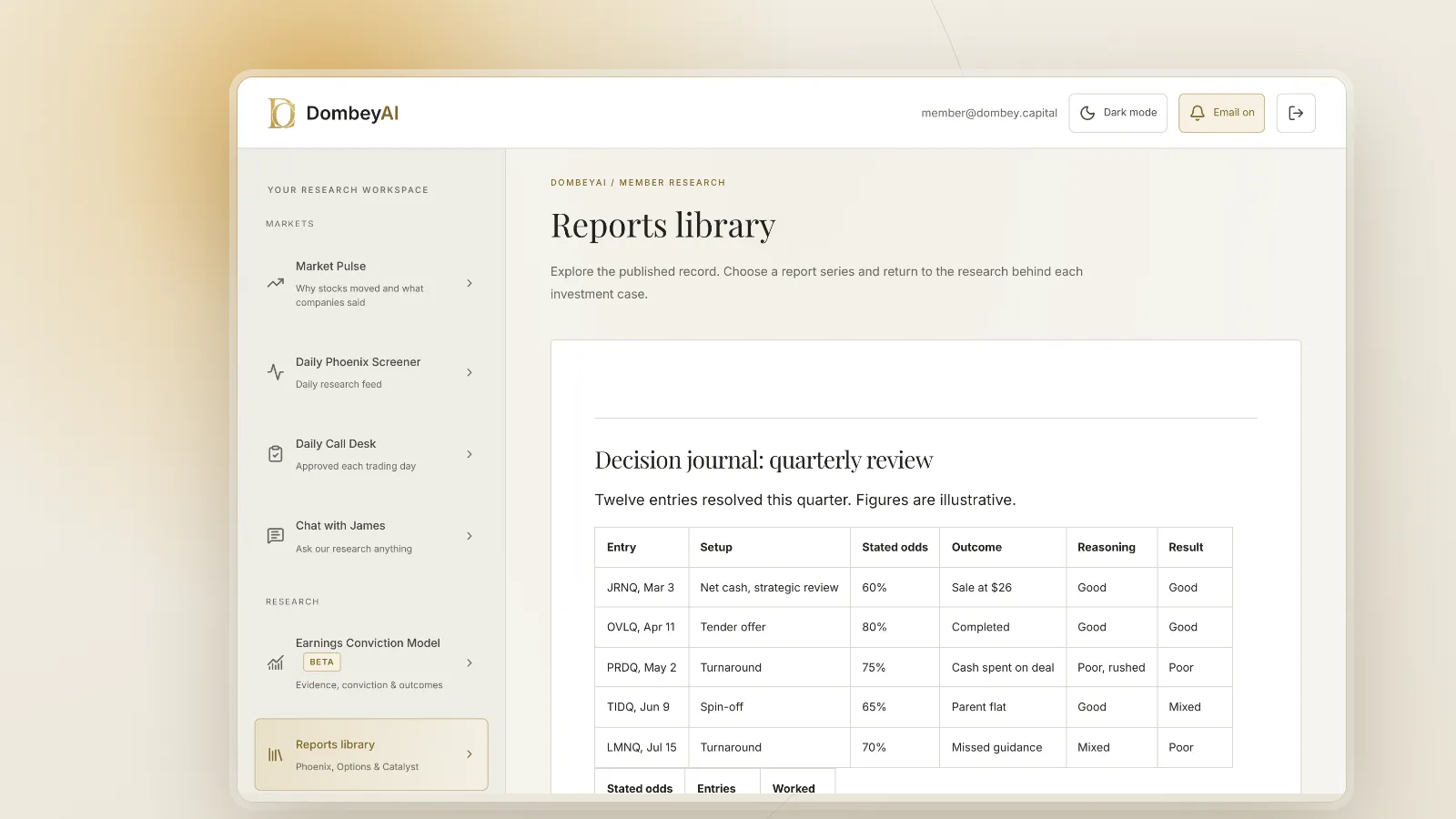
Across a year of entries like these, the investor may find that net cash setups work when the work is thorough and fail when entries are marked "rushed." That pattern only appears because both decisions were written down at the time.
How a journal fits with other tools
A decision journal works best alongside a few related habits:
- A pre-mortem before the decision, which imagines the position has failed and asks why. Its conclusions go in the "what would change my mind" field.
- An investment checklist, which makes sure the evidence field is complete.
- Base rates, which anchor the probability field to how often similar situations work out rather than to how good the story feels.
The tools themselves can be simple. A spreadsheet, a notes app or a paper notebook all work. The research and data platforms in our list of the best stock research tools for individual investors can supply the evidence, but the journal should be somewhere you control and cannot edit without leaving a trace. A dated file or an append-only document works well.
Where this goes wrong
Decision journals fail in predictable ways:
- Writing after the fact. An entry written a week later is already shaped by what happened in that week. If you miss the moment, mark the entry as late.
- Vague entries. "Looks cheap, good management" cannot be scored. Every thesis needs a measurable outcome and a date.
- Recording only trades. Skipping passes and holds leaves out most decisions. A choice not to sell is a decision too.
- No probability. Without a number, you cannot check calibration, which is one of the most useful results a journal produces.
- Never reviewing. A journal that is not read is a diary. Put the quarterly review in your calendar.
- Judging on one outcome. One loss does not prove a process is bad. Patterns across twenty or thirty entries are where the lessons are.
- Editing old entries. Once an entry is written, add notes below it rather than changing it.
Verdict: A decision journal costs a few minutes per decision and is one of the few ways an individual investor can measure the quality of their own judgment rather than the luck of their results.
The bottom line
A decision journal records your reasoning at the moment of decision, before the outcome can reshape your memory of it. Keep entries short and specific, with a dated expected outcome, a probability and an exit rule. Review each entry when it resolves and the whole journal on a schedule, scoring reasoning and result separately. The payoff is not any single lesson but a record that shows where your judgment is reliable and where it is not.