

A short definition
For a bet that pays b dollars for each dollar risked if it wins, and loses the stake if it fails:
f = (b x p - q) / b
Here p is the probability of winning, q is the probability of losing (1 minus p), and f is the fraction of capital to commit. If f is zero or negative, there is no edge, and the formula says to stay out.
A coin that lands heads 60% of the time, paying even money, gives f = (1 x 0.6 - 0.4) / 1 = 0.2. Kelly says to bet 20% of capital on each flip. Bet less and capital grows more slowly. Bet more and it also grows more slowly, with deeper swings, because losses compound against a larger stake.
Real history
The formula came out of information theory and reached investing through gambling.
| Year | Who | What happened |
|---|---|---|
| 1956 | John L. Kelly Jr., Bell Labs | Published "A New Interpretation of Information Rate" in the Bell System Technical Journal, linking the growth rate of a gambler's capital to the information in a private signal |
| 1962 | Edward Thorp | Published Beat the Dealer, which applied card counting and Kelly-style bet sizing to blackjack |
| Late 1960s onward | Edward Thorp | Applied the same sizing ideas to warrants, convertibles and other securities, and wrote on the Kelly criterion in investing |
| Ongoing | Practitioners | Widespread use of fractional Kelly, typically a quarter to a half, because the full fraction is very sensitive to errors in the inputs |
The common thread is that Kelly is a sizing rule for repeated decisions with a measurable edge. It says nothing about finding the edge.
Why Kelly maximizes growth
Capital compounds by multiplication, not addition. A 50% loss followed by a 50% gain leaves you at 75% of where you started. So the right target for repeated bets is not the highest expected gain per bet, it is the highest expected logarithm of the result, which is the long-run growth rate.
Kelly is the fraction that maximizes that growth rate. Two properties follow:
- Overbetting is worse than underbetting. At twice the Kelly fraction, the expected growth rate falls to roughly zero. Beyond that, capital tends to shrink even though every bet has a positive expected value.
- Full Kelly is volatile. In the standard continuous model, a full Kelly bettor has about a 50% chance of seeing capital fall to half its starting value at some point.
This is why most practitioners scale down. Half Kelly keeps about three quarters of the growth rate with half the volatility.
| Fraction of Kelly | Share of maximum growth rate | Volatility of capital |
|---|---|---|
| Quarter | About 44% | A quarter |
| Half | About 75% | Half |
| Full | 100% | Full |
| Double | About 0% | Double |
The growth figures come from the standard approximation in which the growth rate is proportional to c times (2 minus c), where c is the fraction of Kelly used.
Using Kelly for an event-driven position
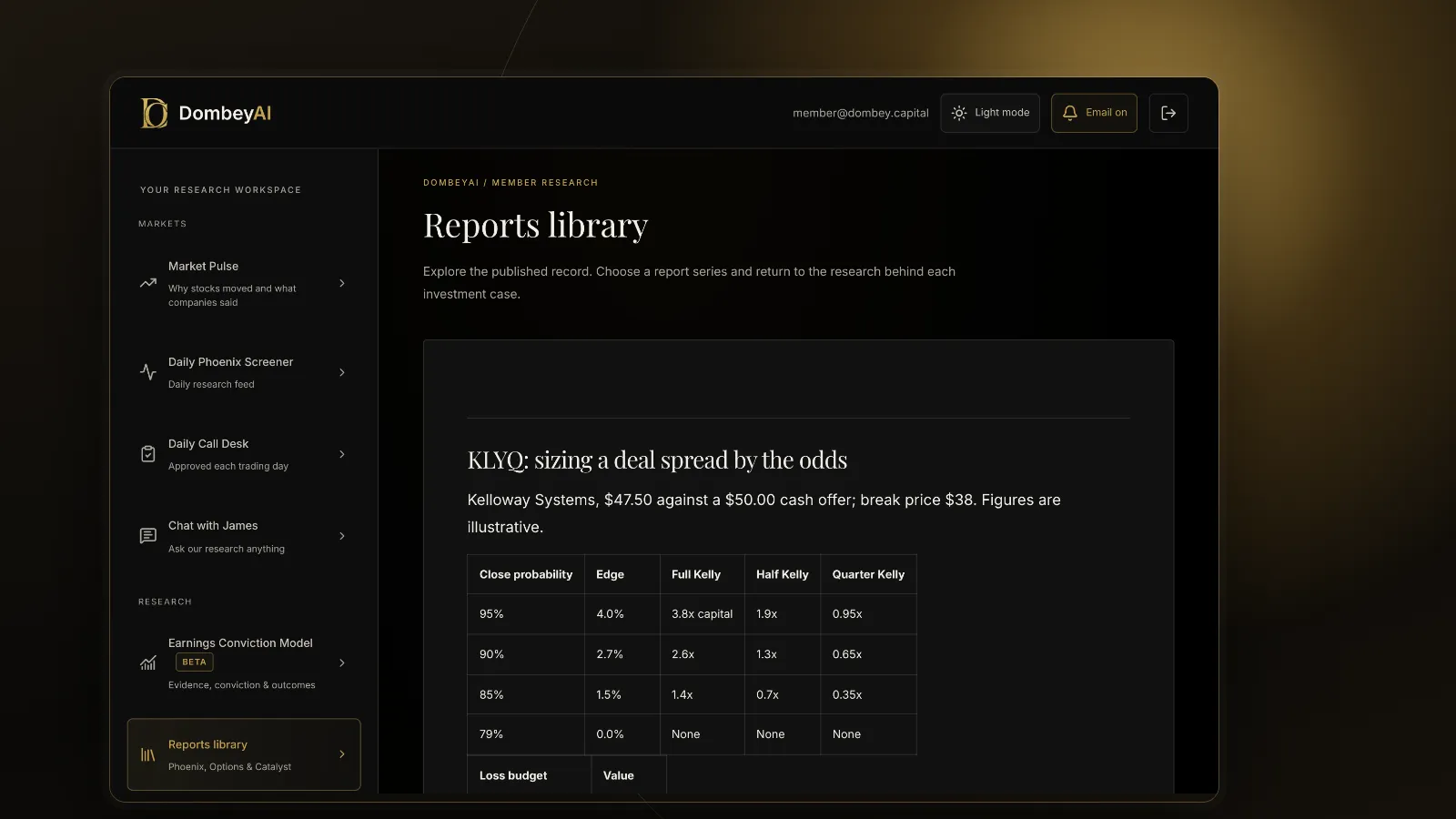
Kelly is easiest to apply when outcomes are discrete, which is why it suits event-driven situations: a merger closes or breaks, a drug is approved or rejected, a vote passes or fails. The general form for two outcomes is:
f = p / L - q / G
where G is the percentage gain if the event goes your way and L is the percentage loss if it does not.
Plugging in: f = 0.90 / 0.20 - 0.10 / 0.053, which is about 4.5 - 1.9 = 2.6. Kelly suggests a position of 260% of capital, which is leverage. The number is a warning, not a target. It comes from a high probability and a small gain, and if the true probability is 85% instead of 90%, the Kelly fraction drops sharply. If it is 79%, the edge is gone.
This sensitivity is the main lesson. In merger arbitrage, the difference between 90% and 80% is often a matter of judgment about an antitrust review. The guide on how to size a position before a binary event uses a fixed loss budget as the main rule and a fraction of Kelly as a check, for exactly this reason.
Where the probability comes from
Kelly needs a number for p. In investing there are three common sources, each with weaknesses:
- Base rates. How often similar situations have worked out in the past. The outside view is the most honest starting point, but every situation has differences.
- Market-implied odds. Option prices and deal spreads imply probabilities. See implied probabilities from option prices. Using the market's own probability gives zero edge by definition, so your estimate must differ for a reason you can state.
- Your own analysis. The most useful and the most error-prone. A probability-weighted valuation forces you to write the scenarios down.
Writing the probability in a decision journal before sizing, and checking it afterward, is the only way to learn whether your estimates are calibrated. Kelly assumes they are.
Kelly for a portfolio
Real portfolios hold several positions at once, and their outcomes are often linked. The single-bet formula overstates the right size for each position when outcomes are correlated, because a shared risk, such as a market selloff or a regulatory change, can cause several to fail together.
A practical approach:
- Compute the Kelly fraction for each position on its own.
- Scale each to a quarter or a half.
- Cap the total exposure to any shared risk, such as all deals in front of one regulator.
- Check the result against the loss you can accept if the worst plausible outcome happens to several positions at once.
The research platforms in our list of the best stock research tools for individual investors can supply the inputs, such as deal terms and historical moves, but none of them supplies the probability. That stays your job.
Where this goes wrong
The common failures:
- Treating estimates as facts. The formula assumes p is known. In markets it is a judgment.
- Ignoring fat tails. The two-outcome model assumes a fixed loss. Real losses can be larger than the case you modeled.
- Ignoring correlation. Sizing each position on its own overstates the safe total.
- Using full Kelly. The drawdowns are hard to live through, and an investor who abandons the method after a drawdown loses the long-run benefit.
- Forgetting the margin of safety. Fractional Kelly is a sizing version of a margin of safety: it leaves room for being wrong.
The bottom line
The Kelly criterion is the fraction of capital that maximizes long-run growth given a known probability and payoff: the edge divided by the odds. It shows that overbetting does more damage than underbetting, and that full Kelly is volatile even when the inputs are right. In investing the probability is an estimate, so most practitioners use a quarter to a half of the Kelly fraction and treat it as a ceiling. Use it as a check on a loss-based sizing rule, not as the rule itself.