

A short definition
Psychologists describe three forms of overconfidence:
- Overestimation: thinking your ability or results are better than they are.
- Overplacement: thinking you are better than others, sometimes called the better-than-average effect.
- Overprecision: being too sure your estimates are right, so ranges are too narrow.
For investors, overprecision does the most damage. A view that a stock is worth $40 is not the problem. Believing the value sits between $38 and $42 when it could reasonably be anywhere from $25 to $55 is. That false precision then drives position size and the decision to act.
Real examples
| Year | Study | What it found |
|---|---|---|
| 1981 | Ola Svenson, driver skill survey | A large majority of US students rated themselves above the median driver in skill |
| 1982 | Lichtenstein, Fischhoff and Phillips, calibration research | People's stated confidence consistently exceeded their actual accuracy on general-knowledge questions |
| 1999 | Terrance Odean, "Do Investors Trade Too Much?" | Stocks investors bought did worse than the stocks they sold, before costs |
| 2000 | Brad Barber and Terrance Odean, "Trading Is Hazardous to Your Wealth" | Households that traded most earned noticeably less after costs than those that traded least |
| 2001 | Barber and Odean, "Boys Will Be Boys" | Men traded considerably more than women, and the extra trading reduced their net results |
| 2005 | Ulrike Malmendier and Geoffrey Tate | Overconfident chief executives' investment was more sensitive to internal cash flow |
| 2013 | Ben-David, Graham and Harvey | Chief financial officers' 80% confidence ranges for market returns contained the outcome far less than 80% of the time |
The pattern holds across students, households, chief executives and finance chiefs. Expertise does not remove it.
How it shows up in investing
Trading too often. Each trade implies you know something the person on the other side does not. Frequent trading reflects a belief in an edge that is often not there, and costs add up.
Concentration and size. Confidence in a thesis leads to larger positions. That is fine when the confidence is earned, and dangerous when it is not. Our explainer on the Kelly criterion shows how sensitive the right size is to the probability you assume.
Narrow ranges. A model with a single value per share, or a bull and bear case only a few dollars apart, hides how uncertain the inputs are.
Faith in your own research. Information you dug up yourself feels more reliable than it is. Combined with confirmation bias, it leads to reading new evidence as support.
Rewriting history. After an outcome, hindsight bias makes it feel predictable, which inflates confidence for the next decision.
Where it hides in models and research
Overconfidence is not only a trading problem. It also enters the research itself, often in ways that look like rigor.
Spreadsheet precision. A model that forecasts revenue to the nearest thousand dollars five years out looks careful. The detail can make the output feel more certain than the inputs justify. A model is only as good as its two or three most important assumptions, and those deserve a range, not a point.
The illusion of knowledge. Reading more about a company raises confidence faster than it raises accuracy. After a certain point, extra detail mostly confirms what you already think. Ask which new fact would actually change your estimate, and look for that one.
The illusion of control. Tracking a stock every day, listening to every call and checking every filing can feel like influence over the outcome. It is not. The event will resolve on its own terms.
Staying inside your field. Confidence earned in one industry does not transfer. An investor who knows banks well can be badly calibrated on biotech. Our explainer on the circle of competence covers how to mark the edge.
A useful habit is to write, next to each key input, how you would know if it were wrong, and what the value would be then.
Overconfidence in event-driven investing
Special situations make overconfidence easy to measure, because the outcome is usually a dated event with a clear result: the deal closes or breaks, the drug is approved or not, the vote passes or fails.
The error is not the view that the deal will close. It is the precision of 95% and the size that followed from it. Our explainer on merger arbitrage covers how spreads price that probability, and our guide on sizing a position before a binary event shows how to size for a wrong call.
How to check your own overconfidence
Write odds, not opinions. "Likely to close" cannot be scored. "80% likely to close by March 31" can. Our guide to writing a dated investment thesis sets out a format.
Start from a base rate. Before setting your own probability, find how often similar situations ended each way. Our explainer on base rates and the outside view covers how to find a reference class.
Run a pre-mortem. Imagine the position has failed and write down why. A pre-mortem brings out risks that confidence pushes aside.
Widen your ranges. If your bear and bull values are close together, ask what would have to be true for each to be wrong by half. Then set them again.
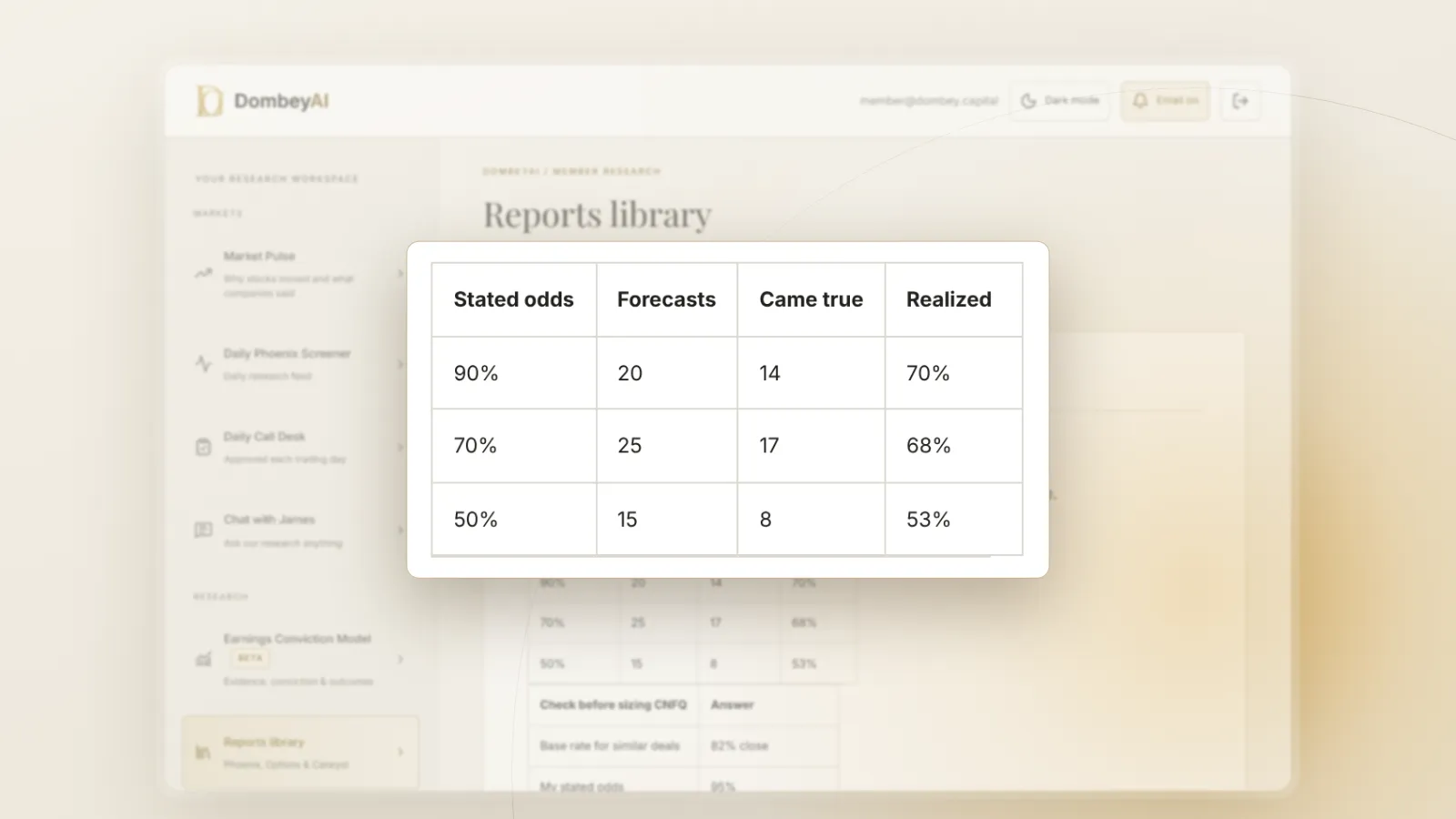
Keep score. A decision journal lets you compare stated confidence with outcomes over time. Group forecasts by stated probability and check the hit frequency in each group.
| Stated probability | Forecasts made | Came true | Read |
|---|---|---|---|
| 90% | 20 | 14 | Overconfident: 70% realized |
| 70% | 25 | 17 | About right: 68% realized |
| 50% | 15 | 8 | About right |
The table is illustrative. The point is to compare what you said with what happened.
Tools and process
A checklist and a written record matter more than software. Research tools help by putting filings, history and base-rate data in front of you before you decide. Our comparison of the best stock research tools for individual investors covers the options. Keep your thesis, odds and outcome in one place so the record is easy to score.
Where this goes wrong
Overcorrecting. Doubt can become paralysis. An investor who never commits misses the cases where the evidence really is strong. The aim is calibrated confidence, not low confidence.
Scoring too few forecasts. A handful of outcomes says little about calibration. You need dozens of scored forecasts before the record means much.
Confusing luck with skill. A run of good outcomes can come from favorable markets. Look at whether your reasons held up, not only whether the price rose.
Applying a fix only after losses. Overconfidence peaks after success. That is when a written check matters most.
The bottom line
Overconfidence bias leads investors to overrate their knowledge and the precision of their forecasts, and research shows it in households, finance chiefs and chief executives alike. It does the most damage through position size and narrow ranges. Write explicit odds, start from base rates, run a pre-mortem and score your forecasts over time. The goal is confidence that matches your record.