

What a sunk cost is
A sunk cost is a cost already paid that no future choice can change. The price you paid for a stock, the hours you spent building the model, the fees on the trade: all are gone whether you sell, hold or buy more. Economics says only future costs and benefits belong in a decision. People rarely behave that way.
The classic study, by Hal Arkes and Catherine Blumer in 1985, found that people who paid full price for a season of theater tickets attended more plays than people given a discount, even though the money was spent either way. The ticket price was sunk, but it still drove behavior.
Investors carry the same instinct into their portfolios. The purchase price feels like a reference point, so a stock below it feels like a debt the market owes you. The market does not know or care what you paid.
How it shows up in a portfolio
The fallacy rarely announces itself. It hides behind reasonable-sounding words.
| What you hear yourself say | What it often means | The question to ask instead |
|---|---|---|
| "I'll sell when it gets back to what I paid" | The cost basis is setting the exit | What is it worth, and when could the market see that? |
| "I've owned it too long to give up now" | Holding period is being treated as an investment | Has the thesis changed since I bought? |
| "I'll buy more to bring my average down" | The average cost has become the goal | Would I buy this many shares at this price with no position? |
| "I spent three weeks on this model" | Research effort is driving conviction | What does the model say if I update every input today? |
| "Selling now would lock in the loss" | The loss is already real in the account | Is this the best use of this capital from here? |
The last line is the most common. A paper loss and a realized loss leave you with the same amount of money. Selling only changes where the remaining capital sits.
Why it is so hard to resist
Three forces push in the same direction.
Loss aversion. People feel a loss more than an equal gain. Selling turns a loss on screen into a loss in the record, so holding feels safer even when it is not. The disposition effect, the habit of selling winners too early and holding losers too long, is the measurable result.
Anchoring. The purchase price becomes the number every new price is compared with. Anchoring bias explains why that number is so sticky, even when the business has changed.
Identity and effort. A thesis you wrote and defended feels like part of you. Dropping it can feel like admitting the work was wasted. Confirmation bias then filters the news so the thesis survives longer than it should.
Sunk costs in special situations
Event-driven positions are especially exposed, because they come with a story and a date.
A merger arbitrage position bought for a spread can turn into a different bet when a regulator opens a deeper review. The original spread is history. The position should now be judged on the new odds, the new timeline and the price you would get if the deal broke. Deal breaks cover what that downside usually looks like.
A stock bought below net cash can see that cash burned faster than planned. If the original margin of safety is gone, the reason to own it is gone too, however long you have waited for a catalyst.
A restructuring play can change shape when the plan of reorganization arrives. If the old equity is being wiped out, past research on the operating business is no longer relevant to the shares.
In each case the catalyst moved, so the thesis needs a fresh look. Holding because "the catalyst is still coming" can be valid. Holding because you have already waited a year is not.
A worked example
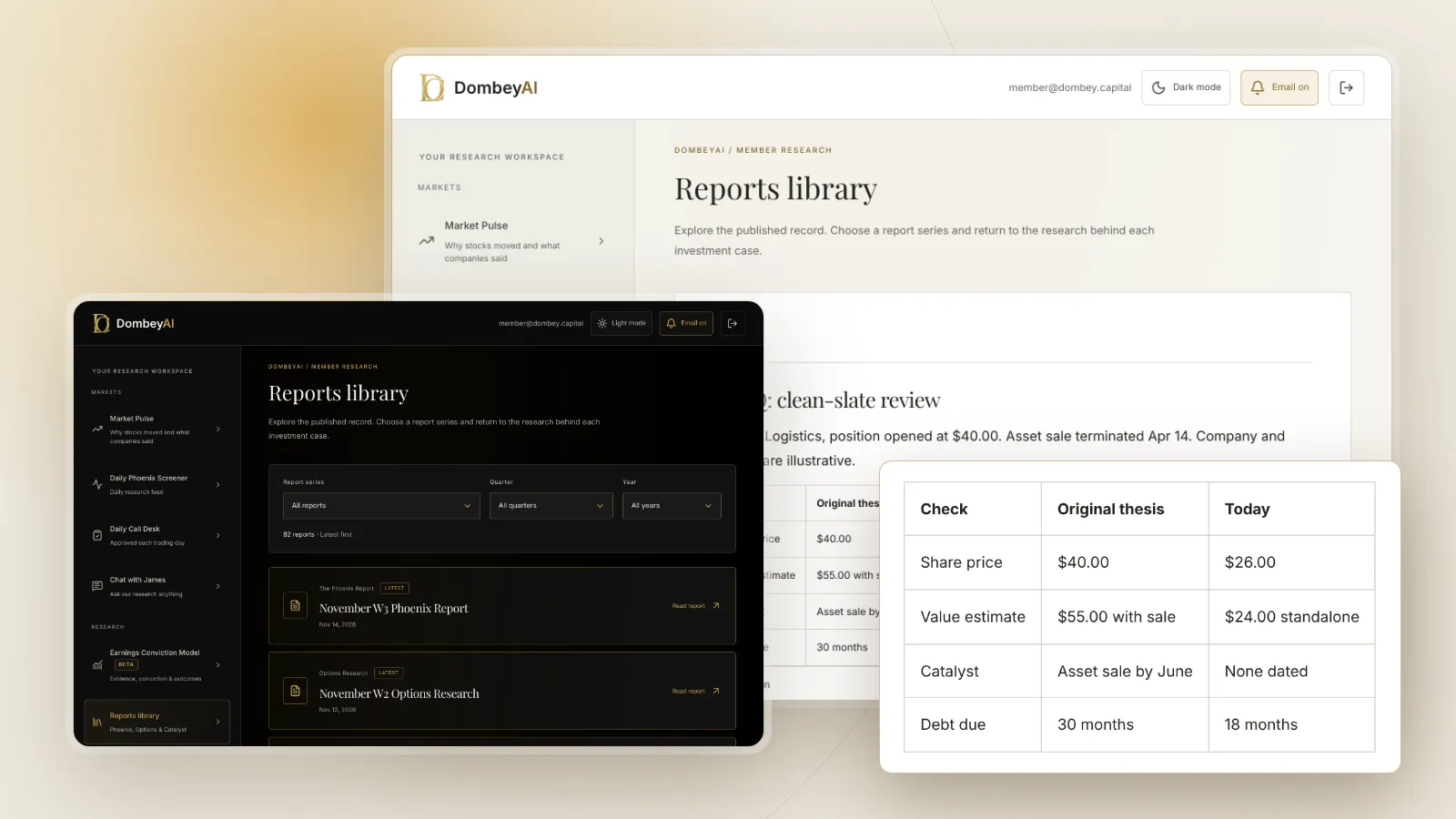
The sunk cost reading: "I'm down $14,000. I'll hold until it gets back to $40, and maybe add at $26 to bring my average to $33."
The clean-slate reading: "I have $26,000 in this stock. If I held $26,000 in cash, would I buy Company A at $26 when my best estimate is $24 and there is a refinancing risk? No. Unless a new buyer appears or the refinancing looks secure, this capital belongs somewhere else."
Both readers lost the same $14,000. Only the second is making a decision about the next dollar.
Tools that keep the past out of the decision
The clean-slate test. For every position, ask: if this were cash today, would I buy it at this price, at this size? If the answer is no, the burden is on holding. Some investors hide the cost basis column during reviews so it cannot anchor them.
A dated thesis. Write down, before you buy, what you expect to happen, by when, and what would prove you wrong. How to write a dated investment thesis walks through the format. The exit conditions are set while you are objective, so you are not inventing them after a loss.
A pre-mortem. Before entry, imagine the position has failed and list why. A pre-mortem brings out the risks you would otherwise explain away later.
A decision journal. Record why you bought, why you held and why you sold. Decision journals let you spot whether you keep holding broken theses for the same reasons. Reviewing closed positions with an investment post-mortem closes the loop.
Opportunity cost made concrete. Keep a short list of ideas you would buy with fresh capital. When a broken position is compared with a specific alternative, holding it for old reasons becomes harder to defend. A good research tool for keeping that list is one of the trade-offs covered in the best stock research tools for individual investors.
Use this list as a decision guide:
- If the thesis is intact and the price fell, re-underwrite it with today's numbers and size it as a new position.
- If the thesis is broken but the stock is cheap on a new thesis, write the new thesis down as if it were a new idea, with new exit conditions.
- If the thesis is broken and you cannot write a new one, the position has no reason to exist.
- If you are adding mainly to lower the average cost, stop and run the clean-slate test first.
Dombey's published research dates each thesis and its exit conditions before the catalyst; see the research archive.
Where this goes wrong
The clean-slate test can be misused. Not every loss is a broken thesis.
- Selling on noise. A stock can fall for reasons that have nothing to do with value: index selling, a sector rout, forced selling by a fund. Treating every drop as a reason to cut confuses volatility with being wrong.
- Ignoring real future costs. Taxes, trading costs and bid-ask spreads are future costs and do belong in the decision. Selling a small position in an illiquid stock can cost more than it saves.
- Overcorrecting. Some investors, burned by holding too long, start selling every position at the first sign of trouble. That is a different error, and it can be just as costly.
- Patience is not a fallacy. Some special situations take longer than planned for good reasons: a court calendar slips, a regulator extends a review. If the odds and the value are intact, waiting is a valid choice.
The line is whether the reason for holding comes from the future or the past.
The bottom line
The sunk cost fallacy is letting what you already paid decide what you do next. In a portfolio it shows up as waiting to get back to break-even, averaging down to fix the average, or defending research because of the hours behind it. The purchase price is a fact about your history, not about the stock. Judge each position as if you were buying it today, set exit conditions before the loss, and let only future value and alternatives drive the decision.