

A short definition
Traditional data arrives on a schedule: a 10-Q every quarter, an earnings release, a price every second. It is precise and official, and everyone sees it at the same time. Alternative data fills the gaps between those dates. It is collected from outside the company, often daily or weekly, and it measures activity indirectly: transactions, visits, downloads, shipments, hires.
The trade-off is precision for timing. A card panel will not match reported revenue to the dollar, but it can show the direction a month before the report.
Real examples
Much alternative data is commercial, but plenty of it is public and free.
| Dataset | Who publishes it | What it can show |
|---|---|---|
| Federal contract awards | USAspending.gov and agency announcements | New awards and obligations to government contractors, before they show in revenue |
| Clinical trial registrations | ClinicalTrials.gov | Trial start dates, enrollment, primary completion dates and status changes for drug developers |
| Patent grants and applications | US Patent and Trademark Office | Research direction and the timing of protection for key products |
| Airport checkpoint counts | Transportation Security Administration | Daily US air travel volumes, relevant to airlines and travel businesses |
| Company job postings | Companies' own career pages | Hiring or cuts by function and location, ahead of headcount disclosures |
| App store rankings and reviews | Apple and Google app stores | Relative popularity and complaints for consumer apps |
Commercial datasets add scale: card and receipt panels covering millions of consumers, foot traffic from phone location data, ship tracking, and satellite images of factories, parking lots or storage tanks.
What it is used for
| Use | Question it answers | Typical data |
|---|---|---|
| Nowcasting revenue | Is this quarter's revenue tracking above or below estimates? | Card panels, web traffic, app usage |
| Trend change | Is demand slowing before management says so? | Job postings, reviews, search interest |
| Event tracking | Has the contract been awarded, the trial enrolled, the plant restarted? | Government records, registries, satellite images |
| Competitive share | Is the company gaining or losing ground to rivals? | App rankings, web traffic, card panels |
| Management checks | Does activity match what the company is telling investors? | Hiring data, shipping data, store counts |
For event-driven investing, the third row is often the most useful. A dated catalyst usually leaves a trail in public records before it is announced as material. Government contract awards as catalysts and clinical trial readouts show how those records connect to stock moves.
A worked example
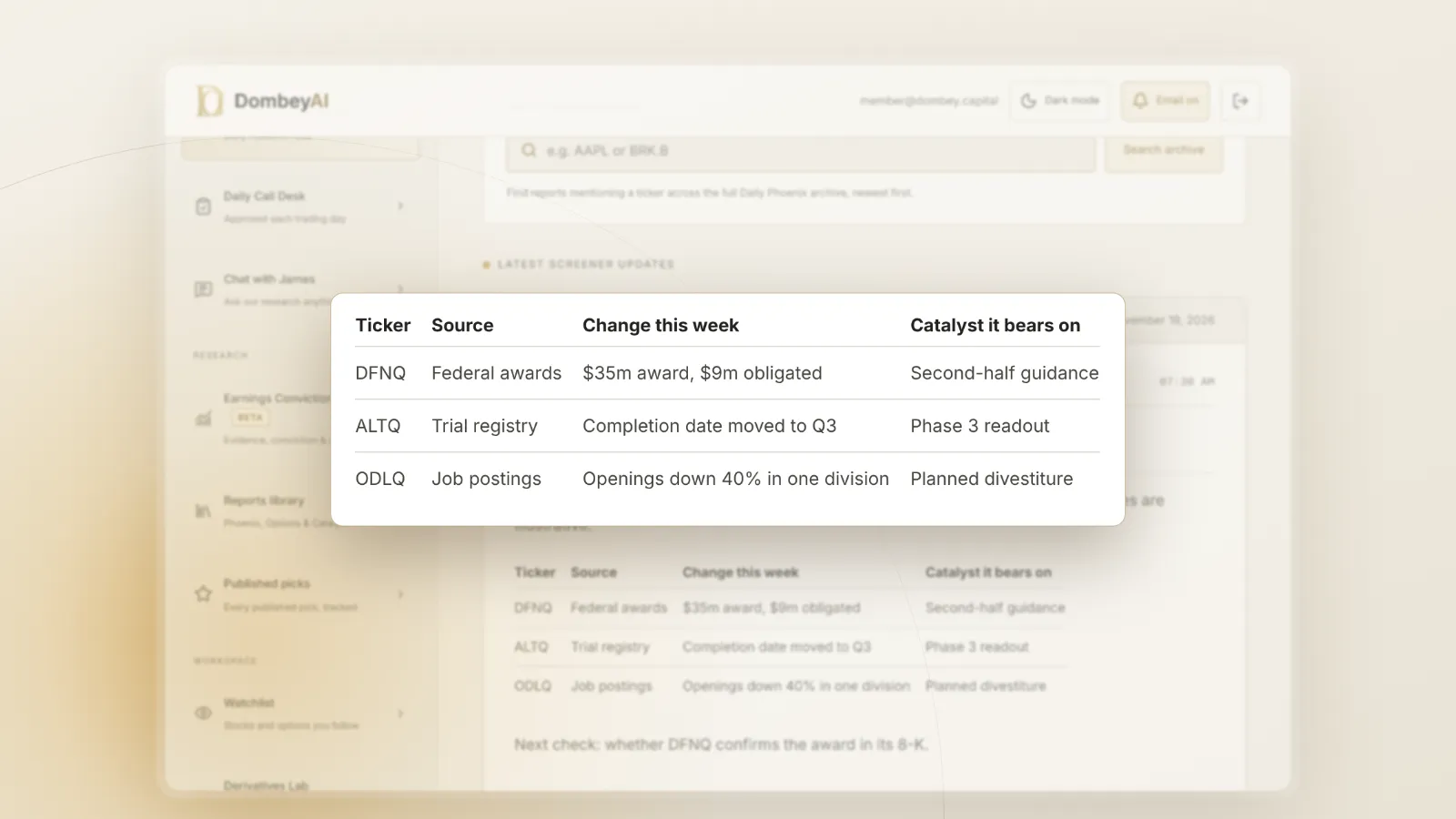
The data does not tell the investor what the company will report. It does show that the key contract exists, its size and the money committed so far. That narrows the range for the year and gives a dated fact to test against management's next statement. The investor should still wait for the company's own disclosure to confirm the revenue timing, because obligated funds and recognized revenue are not the same thing.
How to use it well
Start from the question. Decide which number or event matters for the stock, then look for data that measures it. Browsing datasets for patterns produces false signals.
Check coverage. A card panel may over-represent certain regions, ages or income levels. Web traffic misses in-store sales. Know what the data cannot see.
Calibrate against reported results. Compare the dataset's past readings with the company's past reported figures. If it would not have tracked the last eight quarters, it is unlikely to track the next one.
Combine with primary sources. Alternative data is a lead, not a conclusion. Confirm it with filings, which remain the authoritative record. Primary versus secondary sources in equity research explains why the order matters. Scuttlebutt research, talking to customers and suppliers, is the older version of the same idea.
Record the reading before the result. Write down what the data suggests before the company reports, so you can judge later whether it helped. How to write a dated investment thesis covers the format.
For a comparison of tools that bring some of this data together, see Quiver Quantitative alternatives and the best stock research tools for individual investors. Dombey's published research uses public records such as contract and trial registries to date catalysts; see the research archive.
Alternative data in special situations
Special situations suit alternative data better than most strategies, because the question is usually narrow and dated. Will the plant restart before the refinancing deadline? Has the regulator received the filing? Is the company still hiring for the division it says it will sell?
| Situation | Question | Public data that can help |
|---|---|---|
| Pending merger | Is integration planning under way, or are key staff leaving? | Job postings at both companies |
| Drug developer before a readout | Is the trial still on schedule? | Registry status and completion date changes |
| Government contractor | Has the award been made and funded? | Federal award and obligation records |
| Spin-off | Is the new company building its own functions? | Job postings under the new name, new domain registrations |
| Turnaround | Are customers coming back? | App rankings, review counts, web traffic |
Each answer is a clue to check against the next filing, not a conclusion on its own.
Where this goes wrong
- Panel bias. A dataset built from one bank's cardholders or one app's users may not represent the company's customers. A shift in the panel can look like a shift in demand.
- Crowded signals. When many funds use the same dataset, its information is priced in before the report. The surprise that moves the stock is then the gap between the data and the result, which is harder to forecast.
- Mistaking activity for profit. Web visits, downloads and foot traffic measure activity. They say little about margins, pricing or costs.
- Overfitting. With enough datasets, something will correlate with past results by chance. Without a clear reason why the data should drive the number, treat the link as unproven.
- Legal and ethical risk. Data gathered in breach of a confidentiality duty or privacy law can expose its users. In 2021 the SEC charged an app analytics provider and its founder with misleading customers about how its data was derived, the first such case against an alternative data firm. Ask where data comes from and what consents it rests on.
The bottom line
Alternative data is information about a company that comes from outside its filings, prices and analyst estimates. Its value is timing: it can show the direction of revenue, the existence of a contract or a change in hiring before the official record does. Much of it is public and free, especially for event-driven work. Start from a specific question, check what the data covers, confirm with filings, and treat any reading as an estimate rather than a fact.