

What the Russell indexes are
The Russell US indexes are built from one ranked list of US companies. The main pieces are:
- Russell 3000E: the broadest index, roughly the 4,000 largest eligible US companies.
- Russell 3000: roughly the 3,000 largest, the core broad-market benchmark.
- Russell 1000: roughly the 1,000 largest, the large-cap and mid-cap segment.
- Russell 2000: roughly the next 2,000, ranks 1,001 to 3,000, the best-known US small-cap benchmark.
- Russell Microcap: the smallest 1,000 Russell 2000 stocks plus the next 1,000 smaller eligible companies.
The counts are not exact round numbers, because of the banding rule explained below. As of the April 30, 2026 rank day, FTSE Russell listed 1,027 securities in the Russell 1000 and 1,996 in the Russell 2000.
Companies are ranked by total market capitalization, counting all share classes. Once a company is in, its weight in the index is based on the shares available to the public, its float. That distinction matters: ranking decides membership, float decides how many shares index funds need to hold.
How membership is decided
Reconstitution is rules-based. There is no committee choosing members on judgment, which is the main difference from S&P 500 inclusion, where a committee has discretion.
A company has to pass eligibility screens before it is ranked. It must be treated as a US company under FTSE Russell's country rules, trade on an eligible US exchange, and meet a minimum price of $1. Unrestricted shareholders must hold more than 5% of the voting rights, a rule covered in our piece on dual-class share collapses.
Eligible companies are then ranked by size on rank day. The breakpoints between large, mid and small caps are reset at each reconstitution, so a company can change index without its own value changing at all, simply because the companies around it grew or shrank.
The banding rule
If membership followed rank alone, hundreds of companies near the cutoff would flip between the Russell 1000 and Russell 2000 every cycle. To reduce that turnover, FTSE Russell applies a band around the breakpoint. An existing member whose cumulative market capitalization stays within 2.5% on either side of the breakpoint keeps its current index. It moves only if its size takes it outside the band.
The practical result is that a company can be larger than some Russell 1000 members and still sit in the Russell 2000, or the reverse. When you estimate whether a stock will move, check where it falls relative to the band, not just the breakpoint.
The 2026 calendar
FTSE Russell moved the Russell US indexes to a twice-yearly reconstitution in 2026. The June cycle also reassesses style membership (growth and value). The December cycle updates style probabilities for new additions and for companies that move between the Russell 1000 and Russell 2000.
| Date | Event | What to check |
|---|---|---|
| April 30, 2026 | June rank day | Market capitalization of companies near the breakpoints |
| May 22, 2026 | June preliminary lists | Additions, deletions and moves between indexes |
| June 26, 2026 | June changes take effect after the close | Closing auction volume |
| October 30, 2026 | December rank day | Companies near the cutoffs and the band |
| November 13, 2026 | December preliminary lists | Reason for each change |
| November 20, 27 and December 4, 2026 | Updated lists | Names added or removed since the first list |
| December 11, 2026 | December changes take effect after the close | Closing auction volume and price |
Between reconstitutions, eligible IPOs are added each quarter, and takeovers, spin-offs and delistings are handled as they occur. Put the rank day and the effective date in your catalyst calendar once FTSE Russell publishes them, and check its own timetable each cycle rather than assuming the dates repeat.
Why prices can move
Funds that track the Russell indexes must hold the new members in the right weights after the close on the effective date. Their trades do not depend on price or value. When the shares they must buy or sell are large compared with a stock's normal daily volume, the price may have to move to find the other side.
The scale is large. FTSE Russell reported that at the June 2026 reconstitution, $219.9 billion of US stocks traded in the closing moments on the NYSE and $334.0 billion on Nasdaq. Most of that trading is concentrated in one closing auction.
There are three kinds of change, and they create different pressure:
- Additions from outside the indexes. Newly eligible companies, often recent IPOs or companies that grew past the lower cutoff, gain buyers with no matching seller.
- Deletions. Companies that fall below the lower cutoff or fail an eligibility screen lose their tracking holders. Our article on index deletions and forced selling covers that case in depth.
- Migrations. Companies that move between the Russell 1000 and Russell 2000 are sold by one group of index funds and bought by another.
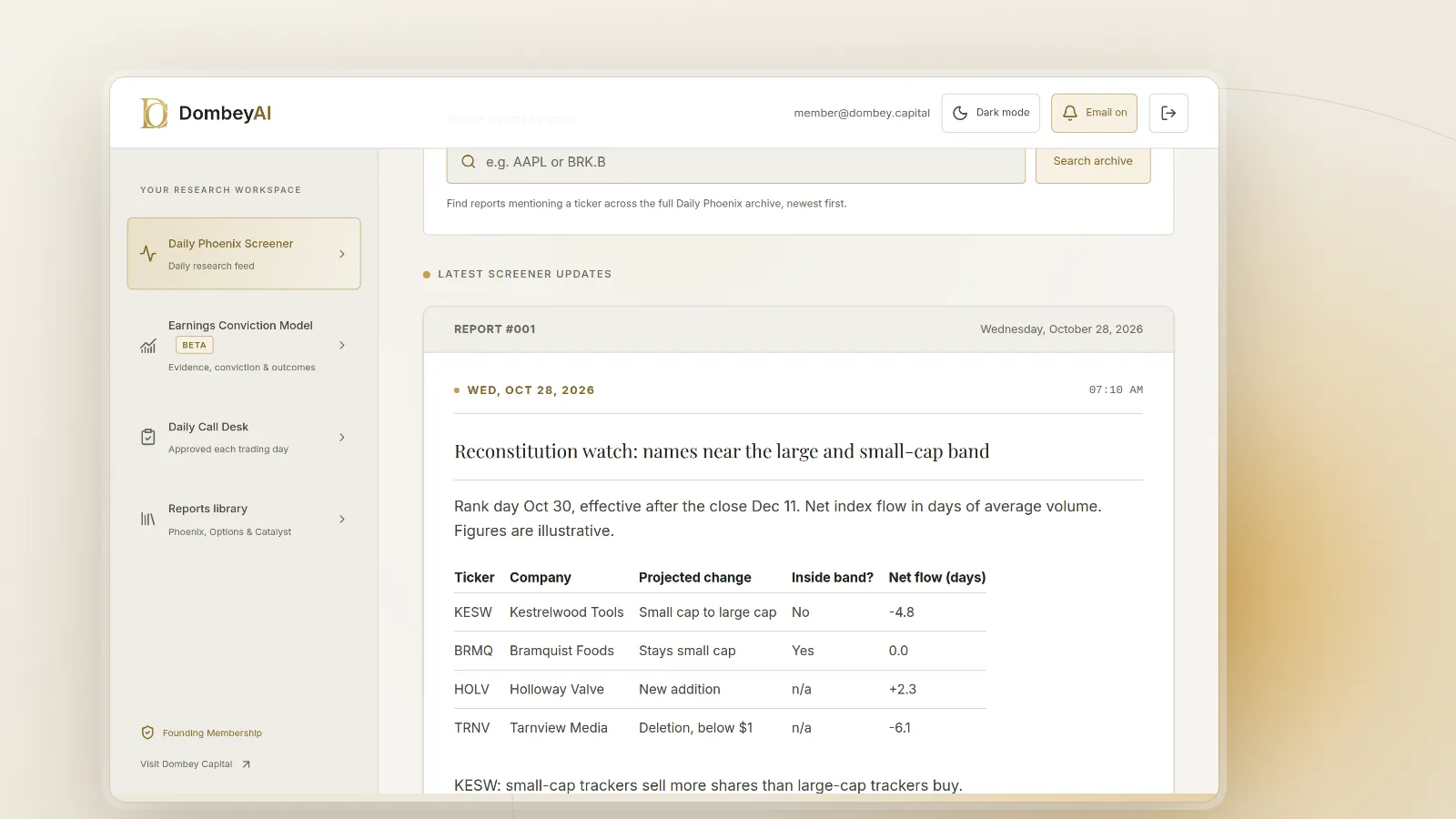
Migrations are the least intuitive. A company moving up from the Russell 2000 is typically among the largest weights in the small-cap index and among the smallest in the large-cap one. Small-cap funds may have to sell more shares than large-cap funds buy, so a promotion can bring net selling. A company moving down can see the opposite. This is one reason small caps misprice events more often: thinner trading means the same flow moves the price further.
The days-of-volume test is the same one used for short interest and days to cover. It tells you how crowded the trade is likely to be.
How to read a reconstitution change
Start with the reason for the change, then size the flow, then look at the business. A quick decision guide:
- If the stock is near the breakpoint but inside the band, expect it to stay in its current index, whatever its rank.
- If the stock is moving from the Russell 2000 to the Russell 1000, estimate both sides of the flow before assuming the move brings net buying.
- If the stock is a new addition from outside the indexes, check its float, since a small float can mean a small index weight even for a large company.
- If the stock is a deletion because it fell below $1 or failed a voting-rights test, treat the business problem as the main story and the index flow as secondary.
- If the change was widely expected before rank day, assume part of the effect is already in the price.
The flow is the reason a price can move on a known date, which makes reconstitution a hard catalyst: fixed date, forced participants. It is not a reason the business is worth more or less. Dombey's published research separates index flows from changes in value before treating either as a setup; see the research archive.
Where this goes wrong
Reconstitution is predictable, and that cuts both ways. The common mistakes:
- Treating the list as news. Traders and banks publish estimates of the lists soon after rank day. By the time the preliminary list is out, much of the expected flow may already be in the price.
- Ignoring the other side of a migration. A promotion to the Russell 1000 sounds positive, but the selling from small-cap funds can outweigh the buying.
- Using the breakpoint instead of the band. A company just past the cutoff often stays put because of banding. Estimates that ignore the band get the move wrong.
- Assuming the effect lasts. Forced trades end at the close on the effective date. A move driven only by flows can reverse once the trackers are done.
- Mistaking a symptom for a cause. A deletion after a long decline, a delisting notice or a reverse stock split to stay above $1 is a business story. The index change is the last step, not the reason.
- Overlooking liquidity. Spreads widen and closing auctions can show large imbalances. Trading costs can absorb whatever gap the flows open.
For daily coverage of stocks that move on events like these, see Dombey's market coverage.
The bottom line
The Russell reconstitution resets the Russell US indexes from a ranked list of US companies, twice a year from 2026. Rank day sets membership, the preliminary lists make it public, and index funds trade at the close on the effective date. The flows can move prices when they are large compared with normal volume, but they are widely anticipated, they run in both directions for migrations, and they do not change what a business earns. Check the band, size the flow in days of volume, and value the company as if the index did not exist.