

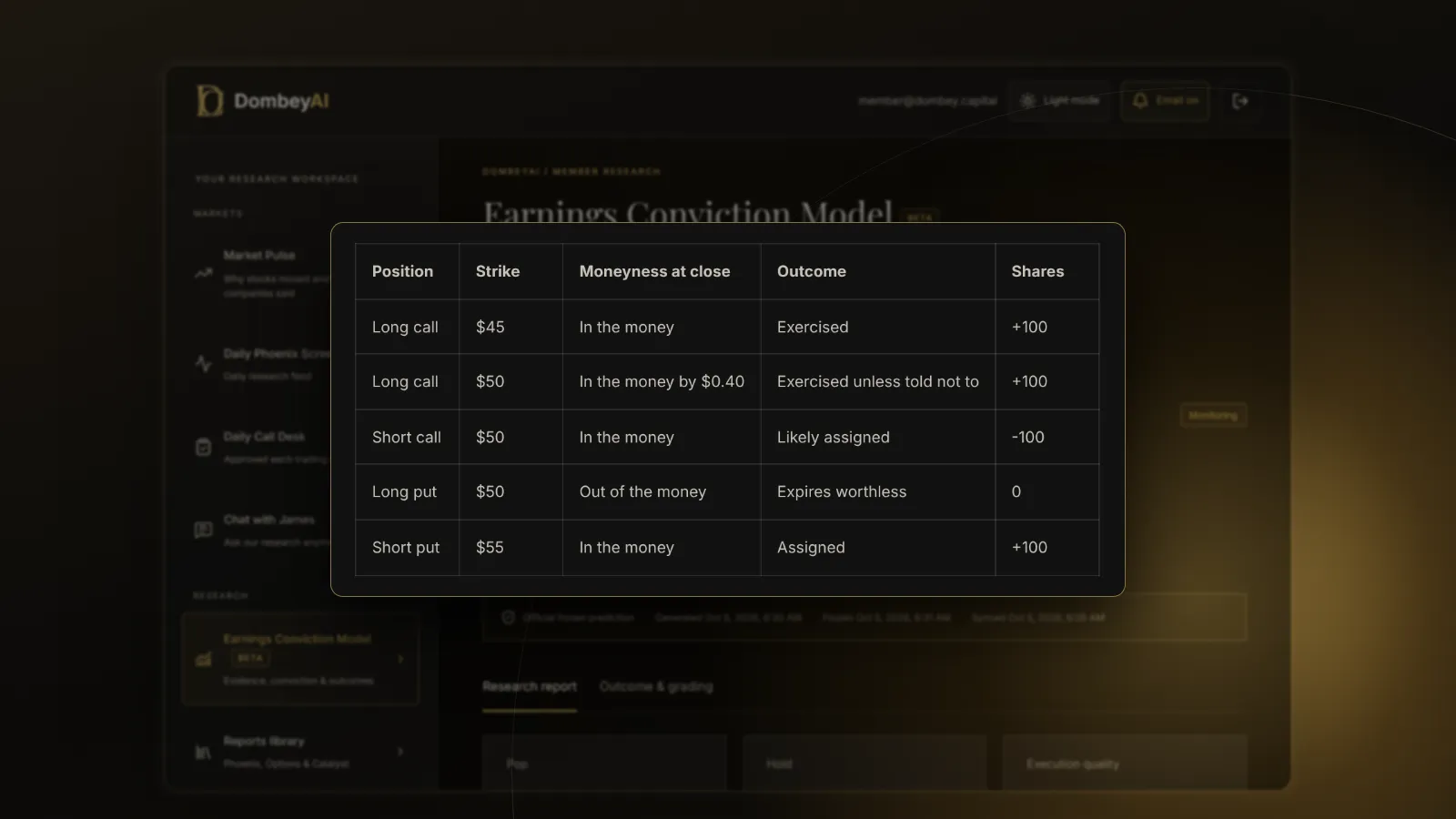
What expiration means
An option gives its buyer a right, and its seller an obligation, until a set date. After that date the contract no longer exists. Expiration is the point where every open contract is either converted into a stock position (or a cash payment) or cancelled.
Standard monthly equity options expire on the third Friday of the month. Many stocks and ETFs also list weekly expirations, and some indexes list options expiring every trading day. If the exchange is closed on a scheduled expiration Friday, expiration usually moves to the prior trading day. Trading in most equity options stops at the 4:00 p.m. ET close on expiration day, and holders then have a short window, set by their broker, to send exercise instructions.
Our guide on how to read an option chain shows where the expiration date and strike appear.
The outcomes at a glance
What happens depends on whether you are long or short, and on where the stock closes relative to the strike. Moneyness at the close decides it; our explainer on option moneyness covers the terms.
| Position | Stock closes above strike | Stock closes below strike |
|---|---|---|
| Long call | Exercised: you buy 100 shares per contract at the strike | Expires worthless: premium lost |
| Short call | Assigned: you sell 100 shares per contract at the strike | Expires worthless: premium kept |
| Long put | Expires worthless: premium lost | Exercised: you sell 100 shares per contract at the strike |
| Short put | Expires worthless: premium kept | Assigned: you buy 100 shares per contract at the strike |
A stock that closes exactly at the strike is a special case covered below under pin risk.
Automatic exercise
The OCC runs a process called exercise by exception. At expiration, any standard equity option that is in the money by at least $0.01, based on the closing price, is exercised automatically unless the clearing firm instructs otherwise on behalf of the customer.
That means you do not have to do anything to exercise an in-the-money option you hold at expiration. It also means you can end up owning, or short, a block of stock you did not plan for.
Holders can override the default:
- Do not exercise. Tell your broker not to exercise an option that is slightly in the money, for example if fees or a late price move make exercise unattractive.
- Exercise anyway. Tell your broker to exercise an option that is slightly out of the money, for example if news after the close moved the stock.
Brokers set their own cutoff times for these instructions, earlier than the OCC deadline. Many brokers also close positions on their own near expiration when the account lacks the cash or margin to take delivery.
How assignment works
Assignment is the other side of exercise. When a holder exercises, the OCC picks a clearing member with a short position in that series, using a random process, and assigns the exercise to it. The clearing firm then picks one of its customers who is short that series, by a random or first-in, first-out method that it discloses.
A few points about assignment:
- American-style options can be assigned before expiration. Most US equity options are American-style. Early assignment is most likely on calls just before an ex-dividend date and on deep in-the-money options with little time value left.
- You learn of assignment after the fact. Notices typically arrive the next business day.
- Assignment is not personal. It is random within the rules, so two traders with the same short position can have different outcomes.
Sellers of cash-secured puts plan for assignment, as our explainer on how a cash-secured put works shows. Sellers of uncovered calls face the larger risk, because assignment leaves them short stock.
Settlement and the stock position
For stock-settled options, exercise and assignment create a stock trade at the strike price. That trade settles on the normal stock settlement cycle, which in the US is now one business day.
The size of the position surprises some option traders. One contract usually covers 100 shares, so ten $50 calls become $50,000 of stock. A small option position can turn into a large stock position, with the margin to match. If the account cannot support it, the broker may liquidate at the open on the next trading day.
Contracts that have been changed by a corporate action, such as a special dividend, a spin-off or a merger, can deliver something other than 100 shares. These are covered in our explainer on adjusted options. Options on a company being acquired for cash can end up settling into cash, as described in what happens to options when a company is acquired.
Index options and cash settlement
Many broad index options work differently. They are often European-style, which means they can only be exercised at expiration, and they settle in cash: the holder receives the difference between the settlement value and the strike, times the multiplier.
Some index options settle on a special opening quotation on expiration morning, and trading in that series stops the day before. Others settle on the close. Check the contract specifications before holding an index option into its last day.
Where this goes wrong
Expiration day is routine for most contracts, but these situations cause trouble:
- Pin risk. When the stock closes very near the strike, a short option holder cannot know whether they will be assigned until the next business day. Our explainer on pin risk covers it in full.
- After-hours news. A stock can move after 4:00 p.m. ET, while holders can still send exercise instructions. An option that closed out of the money may be exercised by a holder reacting to the news, leaving the short side assigned unexpectedly.
- Spreads with one leg assigned. If one leg of a spread is assigned and the other expires, the position is no longer hedged over the weekend.
- Forgetting about the stock. An exercised long call in a small account can trigger a margin call or forced sale.
- Event timing. An earnings report or a deal vote scheduled just after expiration can change the value of an early exercise decision.
How expiration fits a catalyst plan
Expiration dates set the time limit on any option position around an event. When you choose a contract for a catalyst, the expiration needs to fall after the event, with enough room for the result to show in the price. Our guide on choosing an option strike and expiry for a catalyst walks through that choice, and dated event coverage is on our market page.
The bottom line
At expiration, in-the-money equity options are exercised automatically if they are in the money by $0.01 or more, and out-of-the-money options expire worthless. Exercise on the long side means assignment on the short side, chosen at random, and both turn into stock trades at the strike. Most surprises come from stocks closing near the strike, moves after the close and stock positions larger than the account can hold. If you do not want the stock, close the option before the end of its last trading day.