

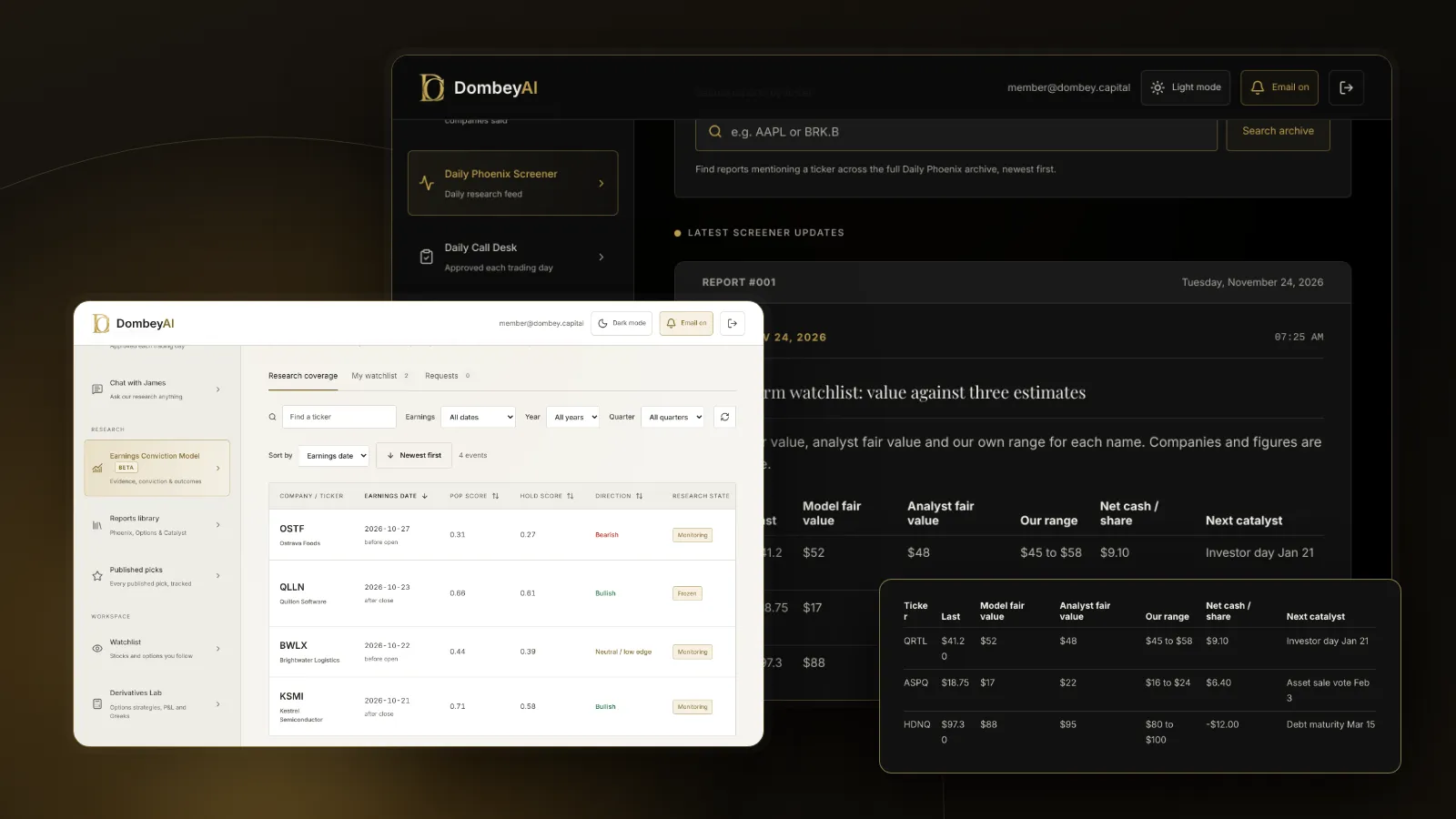


Full disclosure: Dombey Capital is our own research service and our top pick here, for the reasons below. The section on where it falls short is there so you can judge whether it fits your process.
Quick comparison
| Tool | Best for | Key features | Price (as of November 2026) |
|---|---|---|---|
| Dombey Founding MembershipTop pick | Written research on special situations and dated catalysts | Weekly Phoenix Report, weekly Options Research, Catalyst Briefing, DombeyAI Portal with the Daily Phoenix Screener and Earnings Conviction Model | Founding Membership $1,200/year (annual only); Standard Access $80/year or $8/month; Public Archive free |
| Stock Rover | Building your own screens and tracking portfolios | Screeners, ranked and equation-based screening, fair value and ratings on Premium Plus, research reports on 7,000+ stocks, brokerage-linked portfolios | Free plan; Premium $29/month billed annually or $34 monthly; Premium Plus $49/month annually or $70 monthly; 14-day trial |
| Morningstar Investor | Analyst fair values and ratings on stocks and funds | Fair value and competitive advantage ratings, reports and commentary, screener with 200+ data points, portfolio tools | $249/year or $34.95/month; 7-day trial |
How we compared these tools
We compared these tools from vendor plan pages and public product pages, read on November 24, 2026. We did not run trials of the paid plans.
The job is long-term stock research: finding candidates, judging what a business is worth and following a portfolio for years. For readers of this site, special situations and dated catalysts matter too, so we weighted valuation support and screening depth above broad fund coverage.
| Criterion | Weight | What it measures |
|---|---|---|
| Valuation support | 25% | Fair value estimates, how they are made, and how transparent they are |
| Screening depth | 25% | Number of metrics, custom formulas, saved screens |
| Portfolio tracking | 15% | Brokerage linking, performance and allocation analysis |
| Written research | 15% | Analyst reports and commentary |
| Cost | 20% | Price of the plan you need, trial and free options |
If you weight written analyst research and fund coverage most, for example because much of your money is in mutual funds and ETFs, Morningstar Investor moves up and may come out ahead.
We gave no weight to claims about the accuracy of either vendor's ratings or to investment results. We make no such claims.
Quick picks by job
Best for special situations and dated catalysts: Dombey Founding Membership
Founding Membership is written research, not a screening platform. It includes the weekly Phoenix Report, weekly Options Research, the Catalyst Briefing and the DombeyAI Portal with the Daily Phoenix Screener and the Earnings Conviction Model, plus valuation and execution analysis and priority access. It suits readers who want ideas with a dated catalyst and the valuation work already done. Standard Access, at $80 a year, is the lower-cost option with the Biweekly Catalyst Briefing and the public research archive.
Best for building your own screens: Stock Rover
Stock Rover's plans page lists 15 screeners on Premium, 30 on Premium Plus and 120 on Ultimate, with ranked and equation-based screening from Premium Plus. History runs from 5 years of fundamentals on Premium to 10 on Premium Plus and 20 on Ultimate. It suits investors who want to define their own criteria, such as stocks below net cash per share or with rising margins, and track the results.
Best for analyst fair values and ratings: Morningstar Investor
Morningstar Investor gives each covered stock a fair value estimate and a rating of its competitive advantage, with reports and commentary across thousands of securities. Its screener uses more than 200 data points, and portfolio tools show allocation, performance, fees and overlap between holdings. It suits investors who want a second opinion on value from an analyst.
Full reviews
1. Dombey Founding Membership
Dombey publishes written research on special situations: stocks priced below cash, below book or cheap on sales, and legal and corporate catalysts. Each thesis is published before its catalyst and kept in the archive. Founding Membership is $1,200 a year, annual billing only; Standard Access is $80 a year, about $6.67 a month, or $8 a month on monthly billing; the Public Archive is free.
Pros
- Research tied to dated catalysts, published before the event
- Includes the DombeyAI Portal with the Daily Phoenix Screener and Earnings Conviction Model
- Free Public Archive to judge the work first
Cons
- Not a screener or portfolio tracker
- Narrow coverage, focused on special situations
- Short public history
Verdict: The top pick for readers who want special situations research written for them, used alongside a screening or ratings tool.
2. Stock Rover
Stock Rover is a research and portfolio platform. Its plans page lists four paid tiers. Premium, at $34 a month or $29 a month billed annually ($348 a year), includes 10 years of price history, 5 years of fundamentals, 15 screeners and brokerage-linked portfolios. Premium Plus, at $70 a month or $49 a month billed annually ($588 a year), adds unlimited scores, fair value, ratings and warnings, research reports on more than 7,000 stocks and 10 years of fundamentals. Ultimate, at $99 a month or $79 a month annually, adds analyst detail, insider metrics and option metrics, and Ultimate Pro, at $199 a month or $149 a month annually, raises the limits further. Paid plans have a 14-day trial with no payment details, and a free plan covers basic research. The page also showed a 30% discount on first annual or two-year terms through November 30.
Pros
- Deep screening, including equation-based screens
- Portfolio tracking linked to brokerages
- Fair values and research reports on Premium Plus
- Free plan and a trial without a card
Cons
- Fair values come from models rather than analyst coverage
- The most useful valuation features start at Premium Plus
- More set-up work than a ratings service
Verdict: The better of the two for investors who build their own screens and track a portfolio closely.
3. Morningstar Investor
Morningstar Investor costs $249 a year, which Morningstar puts at $20.75 a month, or $34.95 billed monthly, with a seven-day trial for new users. It provides Morningstar's ratings on fair value and competitive advantage for stocks, reports, commentary and news on thousands of securities, pre-filtered lists and custom screens with more than 200 data points, and portfolio tools for allocation, performance, fees and stock overlap.
Pros
- Analyst fair value and competitive advantage ratings
- Strong coverage of funds and ETFs as well as stocks
- Simple pricing and a low annual cost
Cons
- Screening is less flexible than Stock Rover's
- Monthly billing costs much more over a year than the annual plan
- Ratings are one firm's view, and they can lag fast-moving events
Verdict: The better choice for long-term investors who want an analyst's fair value on each stock and fund.
Where Dombey falls short
Dombey is not a screener, a ratings database or a portfolio tracker. You cannot screen the market on your own criteria or rate every stock you own in it. Coverage is narrow, centered on special situations and dated catalysts. The team is small, the author writes under a pen name and the public history is short. If you want broad coverage and your own screens, use Stock Rover or Morningstar Investor, with or without Dombey.
Free vs paid
Stock Rover's free plan covers basic research on individual stocks, and SEC EDGAR is free for filings. Our list of the best stock screeners for value investors includes free options. Paid plans earn their cost when you use fair values, longer histories or many screens every week.
A fair value from any service is a starting point; the margin of safety guide explains how to use one. Dombey's Public Archive is free; Founding Membership at $1,200 a year adds the weekly Phoenix Report, weekly Options Research and the DombeyAI Portal, and Standard Access at $80 a year is the lower-cost option.
How to choose
| Your situation | Pick | Add later when |
|---|---|---|
| You want special situations research done for you | Dombey Founding MembershipTop pick | You want your own screens: Stock Rover |
| You build screens and track a linked portfolio | Stock Rover Premium Plus | You want an analyst's view: Morningstar Investor |
| You want fair values on stocks and funds | Morningstar Investor | You want deeper screens: Stock Rover |
| You are on a tight budget | Stock Rover's free plan, EDGAR and Dombey's Public Archive | You screen weekly |
For more options, see our lists of Stock Rover alternatives and Morningstar alternatives, and our comparison of GuruFocus vs Morningstar. For written research rather than tools, our guide to the best stock picking services compares the main options.
Where this goes wrong
Fair values from any source depend on assumptions about growth, margins and discount rates. A model-based fair value can be wrong for unusual companies such as holding companies, spin-offs and businesses with large one-off items, and an analyst's fair value can lag fast-changing events. Use either as one input, check the assumptions, and do not treat a rating as a decision.
The bottom line
Our top pick is Dombey's Founding Membership for written research on special situations and dated catalysts, with a free archive to judge it first. Between the two tools, Stock Rover is the better fit for long-term investors who build their own screens and track a portfolio linked to their brokerage, with plans from $29 a month billed annually and a free plan. Morningstar Investor is the better fit for those who want analyst fair values and competitive advantage ratings on stocks and funds, at $249 a year. Try each before paying for a full year.