

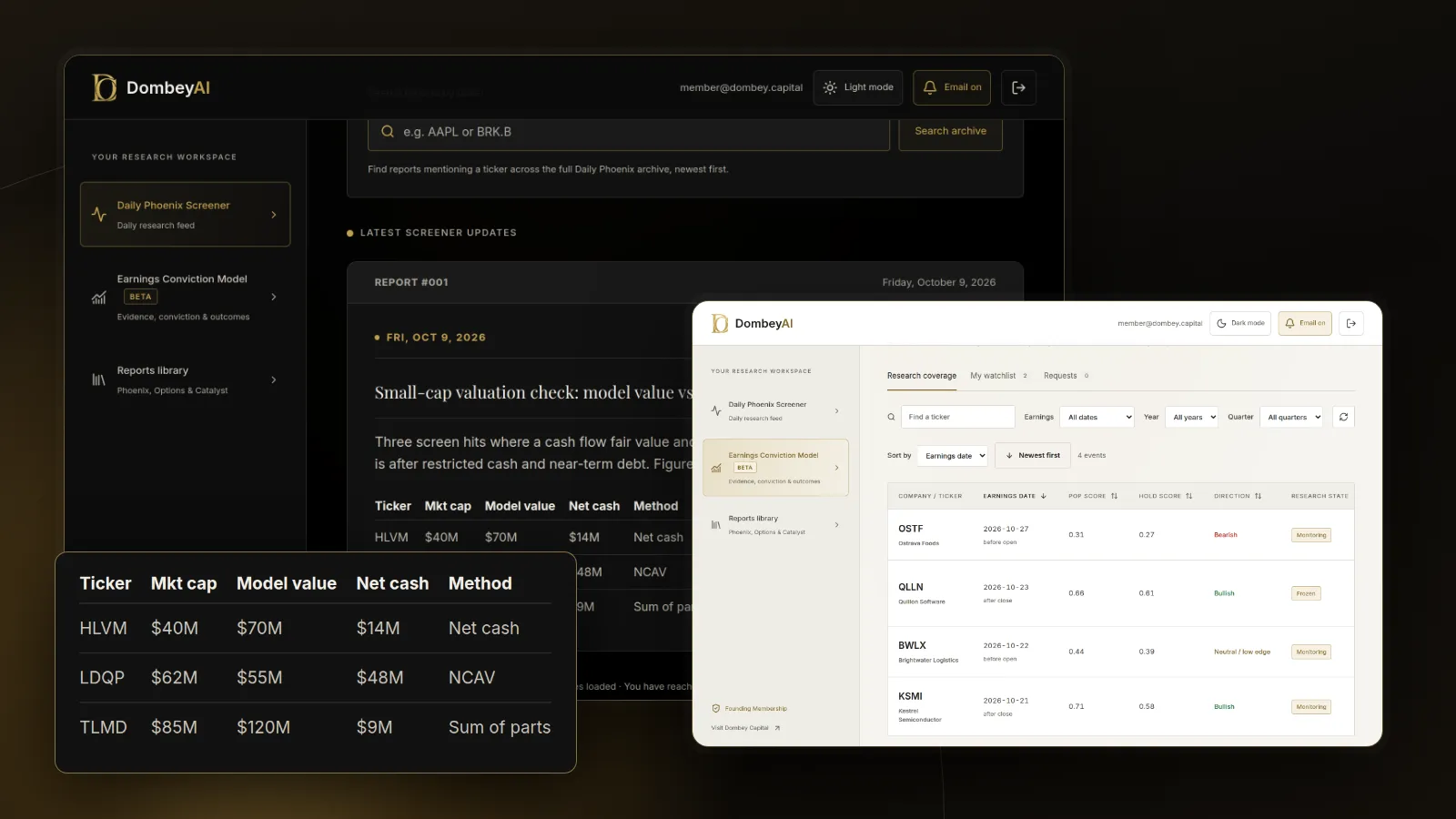


Full disclosure: Dombey Capital is our own research service and our top pick here, for the reasons below. The section on where it falls short is there so you can judge whether it fits your process.
Quick comparison
| Tool | Best for | Key features | Price (as of October 2026) |
|---|---|---|---|
| Dombey CapitalTop pick | Small caps in special situations with a dated catalyst | Weekly Phoenix Report, weekly Options Research, Biweekly Catalyst Briefing, valuation and execution analysis, DombeyAI Portal with the Daily Phoenix Screener and Earnings Conviction Model | Founding Membership $1,200/year; Standard Access $80/year or $8/month; Public Archive free |
| Simply Wall St | A quick published fair value with the method documented | Cash flow fair value, Snowflake summary, 120,000 stocks in 90 markets, Snowflake Screener, Narratives with your own fair value | Free plan; see the vendor's pricing page for Premium and Unlimited |
| Stock Rover | Building and testing your own valuation screens | Fair value, scores and ratings from Premium Plus, 400+ to 800+ metrics, up to 20 years of fundamentals, equation-based and historical screening | Free plan; Premium $34/month or $348/year; Premium Plus $70/month or $588/year; Ultimate $99/month or $948/year; Ultimate Pro $199/month or $1,788/year |
How we compared these tools
We compared these tools from vendor documentation, pricing pages and public product pages, read on October 9, 2026. We did not run trials of the paid plans. Where a vendor page did not state a fact, we left it out or said so.
The job is valuation research on small caps. That job differs from large-cap valuation in three ways. Analyst coverage is thin, so any model fed by consensus estimates has less to work with. Many small caps lose money or hold most of their value in cash and assets, which a cash flow model handles badly. And a small cap's price often closes on an event, such as a sale, a tender, a spin-off or a financing, rather than on slow growth. Our criteria reflect that.
| Criterion | Weight | What it measures |
|---|---|---|
| Fit for small caps | 25% | Whether the method still works with thin estimates, losses or asset-heavy balance sheets |
| Method transparency | 20% | Whether you can see the inputs and the reasoning behind the value |
| Catalyst and scenario context | 20% | Whether the value is tied to a dated event and a downside case |
| Self-serve screening | 20% | Whether you can find and rank cheap small caps yourself |
| Cost and friction | 15% | Price of the plan you would need and the limits of the free tier |
If you weight self-serve screening and cost above catalyst context, Stock Rover moves ahead of the others for your process, and Simply Wall St becomes the cheaper first look. If you only value steady, profitable companies, a cash flow model fits better and Simply Wall St gains ground.
We gave no weight to claims about the accuracy of any fair value or to investment performance, because no vendor publishes evidence we could check, and we make no such claims.
Quick picks by job
Best for small caps with a dated catalyst: Dombey Capital
Dombey's Founding Membership is written research: the weekly Phoenix Report, weekly Options Research, the Biweekly Catalyst Briefing, valuation and execution analysis, and the DombeyAI Portal. It is for readers who want an analyst to choose the valuation method that fits each situation, such as net cash per share for a cash shell or a sum of the parts for a company mid-separation, and to tie that value to a dated catalyst.
Best for a quick published fair value: Simply Wall St
Simply Wall St shows a fair value estimate "based on future expected cash flows" on each company page, alongside its Snowflake summary. The method is set out in a model document the company publishes, which few vendors do. It is the fastest way to see where a cash flow model lands before you build your own.
Best for building your own valuation screens: Stock Rover
Stock Rover adds fair value, scores and ratings on Premium Plus, along with equation-based and historical screening. That lets you write your own value ratio, such as enterprise value to sales with a cash floor, and see how long a stock has passed it. It suits readers who want to own the method.
Full reviews
1. Dombey Capital
What it does. Dombey publishes independent research on special situations and event-driven equities: stocks priced below cash or book, cheap on sales, or facing a legal or corporate catalyst. Many are small caps. Each situation comes with valuation and execution analysis, and every thesis is published before its catalyst, priced on the day and kept in the archive.
Best for. Readers who value small caps on assets and events rather than on long cash flow forecasts, and who want the reasoning written out.
Pricing. Founding Membership is $1,200 a year, billed annually only, and includes the weekly Phoenix Report, weekly Options Research, the Biweekly Catalyst Briefing, the DombeyAI Portal with the Daily Phoenix Screener and Earnings Conviction Model, valuation and execution analysis, and priority access. Standard Access is the lower-cost option at $80 a year (about $6.67 a month) or $8 a month on monthly billing, and includes the Biweekly Catalyst Briefing and the complete public-research archive. The Public Archive is free.
Pros
- The method is chosen per situation, so a cash-rich small cap is valued on net cash and a breakup on its parts, not forced through one model.
- Each value is tied to a dated event and a downside, which is where small-cap valuation usually goes wrong.
- Theses are published before the catalyst and kept in the archive, so you can compare the case with the outcome.
Cons
- It does not value any ticker you type in; coverage is a short list of situations.
- There is no self-serve screener of the whole market and no financial statements database.
Verdict: Our top pick for small caps in special situations with a dated catalyst. Pair it with a data or screening tool for everything else.
2. Simply Wall St
What it does. Simply Wall St is a visual research platform covering 120,000 stocks across 90 markets, with financial data from S&P Global Market Intelligence. Each company page shows a Snowflake summary and a fair value estimate. The Snowflake Screener filters for growth, value or dividend criteria and alerts you when a new stock fits. Narratives let you write your own thesis and set your own fair value, and portfolio tools sync with more than 2,000 brokers.
How its fair value works. Simply Wall St's published model document describes a two-stage free cash flow to equity model for most companies. Years 1 to 10 use levered free cash flow estimates, mainly analyst consensus; if estimates are missing, the last estimate or reported figure is extended. Growth fades toward a terminal rate equal to the 10-year government bond rate. The discount rate is a cost of equity from a five-year average bond rate, an equity risk premium and a bottom-up beta bounded between 0.8 and 2. Banks and insurers use an excess returns model, steady dividend payers a dividend discount model and REITs an AFFO model. A price 20% below fair value scores one point as moderately undervalued, and 40% below scores a second point.
Best for. Readers who want a documented cash flow value as a first look, especially on profitable companies with analyst coverage.
Pricing. The Free plan gives 5 company reports a month, 1 portfolio of 10 holdings and the top 4 results per screener. Premium gives 30 reports a month, 3 portfolios and unlimited screener results. Unlimited removes the report and portfolio limits. The plans page did not show prices when we read it, so see the vendor's pricing page. New accounts get 7 days of Premium access with no credit card required.
Pros
- The fair value method is published in detail, including the discount rate and terminal growth, so you can see what drives the number.
- Global coverage of 120,000 stocks, useful for small caps listed outside the US.
- Narratives let you replace the model's value with your own and keep the reasoning next to it.
- A usable free plan and a 7-day trial with no card.
Cons
- The cash flow model depends on analyst estimates, which many small caps lack, so the value can rest on one extended figure.
- A two-stage cash flow model fits loss-making, asset-heavy or event-driven small caps poorly.
- The free plan's 5 reports a month and top 4 screener results are tight for small-cap hunting.
Verdict: The best quick fair value check, as long as you treat it as one model's view and not a price target.
3. Stock Rover
What it does. Stock Rover is a research, screening and portfolio platform. Premium covers more than 8,500 stocks, 7,000 ETFs and 40,000 funds with 400+ metrics and 5 years of fundamentals. Premium Plus adds 700+ metrics, 10 years of fundamentals, "Unlimited Scores, Fair Value, Ratings & Warnings", research reports on 7,000+ stocks, and "Equation-Based, & Historical Screening". Ultimate reaches 800+ metrics, 20 years of fundamentals, 120 screeners and insider metrics.
Best for. Readers who want to build their own valuation rules, run them across the market and check how a ratio has held over time.
Pricing. A free plan covers basic research on individual stocks. Premium is $34 a month or $348 a year. Premium Plus is $70 a month or $588 a year. Ultimate is $99 a month or $948 a year. Ultimate Pro is $199 a month or $1,788 a year. Two-year billing is cheaper still, and every paid plan has a 14-day free trial.
Pros
- Equation-based screening lets you write a value rule that suits small caps, such as market value below net cash or below a share of tangible book.
- Historical screening shows how long a stock has looked cheap, which separates a lasting value trap from a recent dislocation.
- Up to 20 years of fundamentals on Ultimate for checking a ratio across a full cycle.
- Data export from Premium, for readers who finish valuations in a spreadsheet.
Cons
- Fair value, equation screening and historical screening start on Premium Plus, not the entry plan.
- The pages we read do not explain how its fair value is calculated, so you cannot judge the method from them.
- The pages we read do not state coverage by country or by market value, so confirm the small caps you follow are included.
Verdict: The best choice for readers who want to design and test their own small-cap valuation screens.
Where small-cap valuation goes wrong
The three tools fail in different places, and knowing where saves money.
- If the company loses money, a cash flow model has little to project. Value it on net cash, burn and runway instead, as in our guide on finding stocks trading below net cash.
- If most of the value sits in current assets, use net current asset value or tangible book rather than a fair value built on forecasts.
- If the company has separable businesses, a single model hides the parts. A sum of the parts shows what each is worth.
- If the price depends on one event, a point estimate misleads. Build a base and worst case around the date.
Where Dombey falls short
We hold our own product to the same standard, and for this comparison its limits are real.
- Narrow coverage. Dombey covers a short list of special situations. It will not value most of the small caps a screener would show you.
- No broad stock data terminal. There is no fair value calculator, no financial statements database, no charting and no whole-market screener. You will still need Simply Wall St, Stock Rover or EDGAR.
- Small team. A small team limits how many situations it can follow at once.
- Pen-name author. Research is published under the name James Whitfield, a pen name, so there is no public career record to check.
- Short history. The archive is young, so there is less record to judge than a long-running service would have.
Free vs paid
| Tool | Free tier for small-cap valuation | What paying adds |
|---|---|---|
| Simply Wall St | 5 company reports a month, top 4 screener results, 1 portfolio | 30 or unlimited reports, unlimited screener results, more portfolios |
| Stock Rover | Basic research on individual stocks | Fair value, scores, equation and historical screening from Premium Plus; up to 20 years of fundamentals |
| Dombey | Public Archive of published research | Founding Membership adds the weekly reports, valuation and execution analysis and the DombeyAI Portal; Standard Access, the lower-cost option, adds the Catalyst Briefing |
How to choose
| Your situation | Pick | Add later when |
|---|---|---|
| You follow small caps with a dated catalyst and want written valuation | Dombey CapitalTop pick | You want your own screens: add Stock Rover Premium Plus |
| You want a quick fair value on many profitable companies | Simply Wall St | You want to change the method: add Stock Rover |
| You want to write and test your own value rules | Stock Rover Premium Plus | You want catalyst research: add Dombey |
| You follow small caps listed outside the US | Simply Wall St | You want event analysis: add Dombey |
| You want to spend nothing yet | Simply Wall St Free plus SEC EDGAR | You hit the 5-report limit |
- If most of your small caps are profitable and covered by analysts, start with Simply Wall St.
- If most of them lose money or trade near cash, start with Stock Rover's equation screens and the balance sheet.
- If you want the method chosen and the event dated for you, choose Dombey and keep one self-serve tool beside it.
For the data platforms behind this work, see Koyfin vs TIKR vs Stock Rover, and for screening alone, see the best stock screeners for value investors.
The bottom line
Dombey Capital is our top pick for valuing small caps in special situations with a dated catalyst, provided you accept that it is written research on a short list and not a calculator. Simply Wall St gives the fastest documented fair value, but its cash flow model leans on analyst estimates that small caps often lack. Stock Rover gives the most control, with fair value and equation-based and historical screening from Premium Plus. For small caps, the method matters more than the tool: check that the model fits the business, and confirm the inputs in the latest filing.