

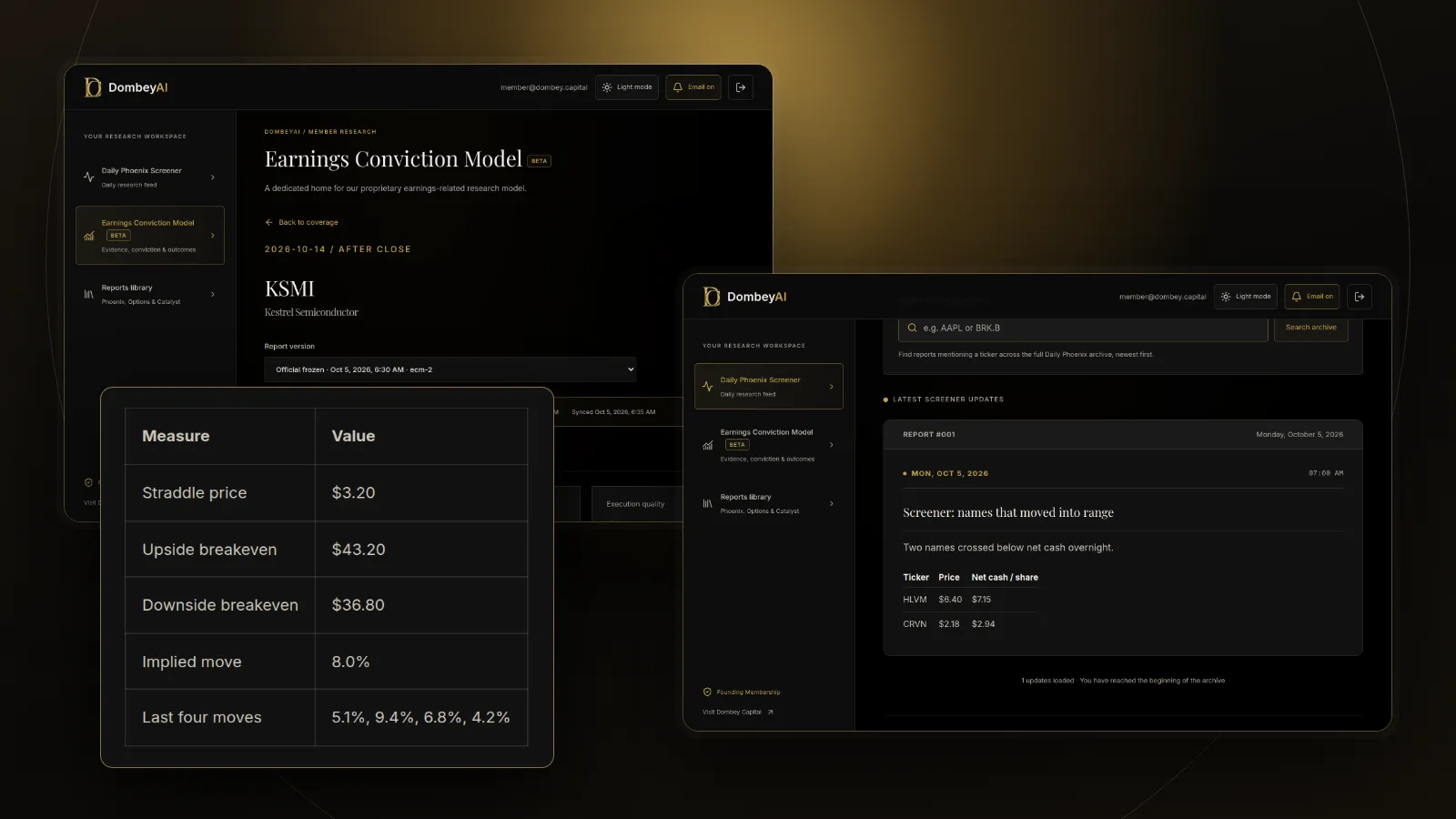
How a straddle works
A call gains value when the stock rises. A put gains value when the stock falls. Holding both at the same strike means one side gains whichever way the stock goes, while the other side loses at most what was paid for it.
The position has two forms:
- Long straddle. You buy the call and the put. You pay the combined premium up front. You need a large move in either direction.
- Short straddle. You sell the call and the put. You receive the combined premium. You need the stock to stay near the strike.
Most straddles use the at-the-money strike, the one closest to the current share price. At that strike the call and put are worth about the same, so the position starts with no strong lean up or down.
A standard equity option contract covers 100 shares, so a straddle quoted at $3.20 costs $320 per contract, before commissions.
Breakevens, maximum loss and maximum gain
For a long straddle held to expiration, the arithmetic is simple.
| Measure | Long straddle | Short straddle |
|---|---|---|
| Cash at the start | Pays call premium plus put premium | Receives call premium plus put premium |
| Upside breakeven | Strike plus total premium | Strike plus total premium |
| Downside breakeven | Strike minus total premium | Strike minus total premium |
| Maximum gain | Unlimited on the upside; large on the downside, capped at the strike minus premium | The premium received |
| Maximum loss | The premium paid | Theoretically unlimited on the upside; large on the downside |
| Worst outcome | Stock finishes at the strike and implied volatility falls | A large gap in either direction |
| What it needs | A move larger than the premium | A move smaller than the premium |
The breakevens are the key figures. Between them, the long straddle loses money at expiration. Outside them, it makes money. The short straddle is the mirror image, and its holder also faces assignment on either short option at any time before expiration.
How a straddle prices an event
Before a dated event, such as an earnings report, a court ruling or a shareholder vote, traders do not know which way the stock will move. They often have a view on how far it might move. The straddle turns that view into a price.
Take the first expiry after the event. Price the at-the-money call and put at their mid prices, add them together, and divide by the share price. The result is a rough implied move: the percentage move, up or down, that the options market is charging for. Our guide on how to estimate an earnings move from options walks through each step.
Three points matter when you read it.
- Use the first expiry after the event. It contains the event with the fewest ordinary days around it. A later expiry spreads the event over more time and blends it with normal volatility.
- Confirm the date. An implied move only means something if the event falls before the expiry you are pricing. A report moved by a week can sit outside the contract entirely. A catalyst calendar helps here.
- Treat it as a price, not a forecast. The straddle tells you what the market charges for uncertainty. Stocks often move less than the implied move and sometimes far more.
Some traders scale the straddle by about 0.85 to estimate the expected move, because the straddle price at expiration and the average size of a move are not quite the same thing. Treat that factor as a rule of thumb.
A worked example
Here is what the long straddle is worth at expiration for different closing prices.
| Stock at expiration | Move | Call value | Put value | Straddle value | Profit or loss per contract |
|---|---|---|---|---|---|
| $34.00 | -15% | $0.00 | $6.00 | $6.00 | +$280 |
| $37.00 | -7.5% | $0.00 | $3.00 | $3.00 | -$20 |
| $40.00 | 0% | $0.00 | $0.00 | $0.00 | -$320 |
| $42.00 | +5% | $2.00 | $0.00 | $2.00 | -$120 |
| $44.00 | +10% | $4.00 | $0.00 | $4.00 | +$80 |
| $46.00 | +15% | $6.00 | $0.00 | $6.00 | +$280 |
Three things stand out.
- A 5% move still loses. At $42.00 the stock moved, but not past the breakeven. The buyer paid for an 8% move and got 5%.
- A 7.5% drop loses only a little. At $37.00 the stock almost reached the downside breakeven. Close to the implied move is roughly break-even, not a win.
- The flat case is the full loss. If the stock closes at $40.00, both options expire worthless and the whole $320 is gone.
The table uses expiration values. Most event traders close a straddle the morning after the report, when the options still have a few days left but implied volatility has already dropped. The IV crush article works through that next-morning case.
Straddle versus strangle
A strangle is the cheaper relative of the straddle. It uses an out-of-the-money call and an out-of-the-money put at different strikes.
- If you want the clearest read on the priced move, the at-the-money straddle is the standard measure.
- If you want a lower cash outlay and accept needing a bigger move, a strangle does that.
- If you want to cap the loss on a short position, adding further out-of-the-money options turns a short straddle into an iron butterfly, which limits both the loss and the premium kept.
None of these structures removes the risk of being wrong on size. They only change where the breakevens sit and how much is at stake.
What to compare the straddle against
A straddle price on its own says little. It becomes useful when compared with something.
| Compare with | What it tells you | Where to find it |
|---|---|---|
| The stock's past post-event moves | Whether options price more or less risk than history shows | Price history on the days after past reports |
| The next expiry's implied volatility | How much of the front straddle is event premium | The option chain, two expiries side by side |
| Peers reporting the same week | Whether the whole group is priced for a large move | Peers' option chains |
| Your own view of the event | Whether you expect a larger or smaller move than priced | Your notes on the earnings catalyst |
If the implied move is well above what the stock has usually done, options are expensive relative to history. That can be right: a pending guidance reset, a new product or a deal can justify a bigger move than before. If the implied move is well below past reactions, options may be cheap relative to history, or the business may have become more stable.
Tools differ in how easily they show these comparisons; see the best options analysis tools for earnings. Dombey's weekly Options Research covers event-driven options setups with their risks; see the research archive.
Where this goes wrong
Reading the implied move as a prediction. The straddle is a price for risk. A stock priced for an 8% move can move 2% or 20%.
Ignoring the volatility drop. A long straddle bought before an event and sold after it must beat the implied move, not just move. The fall in implied volatility takes most of the event premium within a session.
Using a small sample of past moves. Four or eight reports is a short history. One outsized reaction can make options look cheap when they are not.
Pricing an illiquid chain. On smaller companies, bid-ask spreads on near-dated options can be wide. A straddle bought at the ask and sold at the bid can lose the spread on both legs, which can exceed any edge in the pricing. Use mid prices to read the implied move, and expect to trade worse than the mid.
Picking the wrong expiry or date. If the event falls after the expiry, the straddle prices nothing about it. If the date is not confirmed, check before reading anything into the number. Only events with a known date build a clean event premium; the difference between hard and soft catalysts matters here.
Underestimating short straddle risk. Selling straddles into events collects premium most of the time, but the loss on a large gap can be many times the premium received. Assignment on either short leg can also leave an unplanned stock position.
The bottom line
A straddle is a call and a put at the same strike and expiry, and its price is the market's charge for a move of a certain size. Divided by the share price, the at-the-money straddle on the first expiry after an event gives a rough implied move, and its breakevens show how far the stock must go for a long straddle to pay. Compare that number with past reactions, later expiries and your own view of the event before drawing any conclusion. Options carry substantial risk, especially for sellers; this article is education, not a recommendation.