

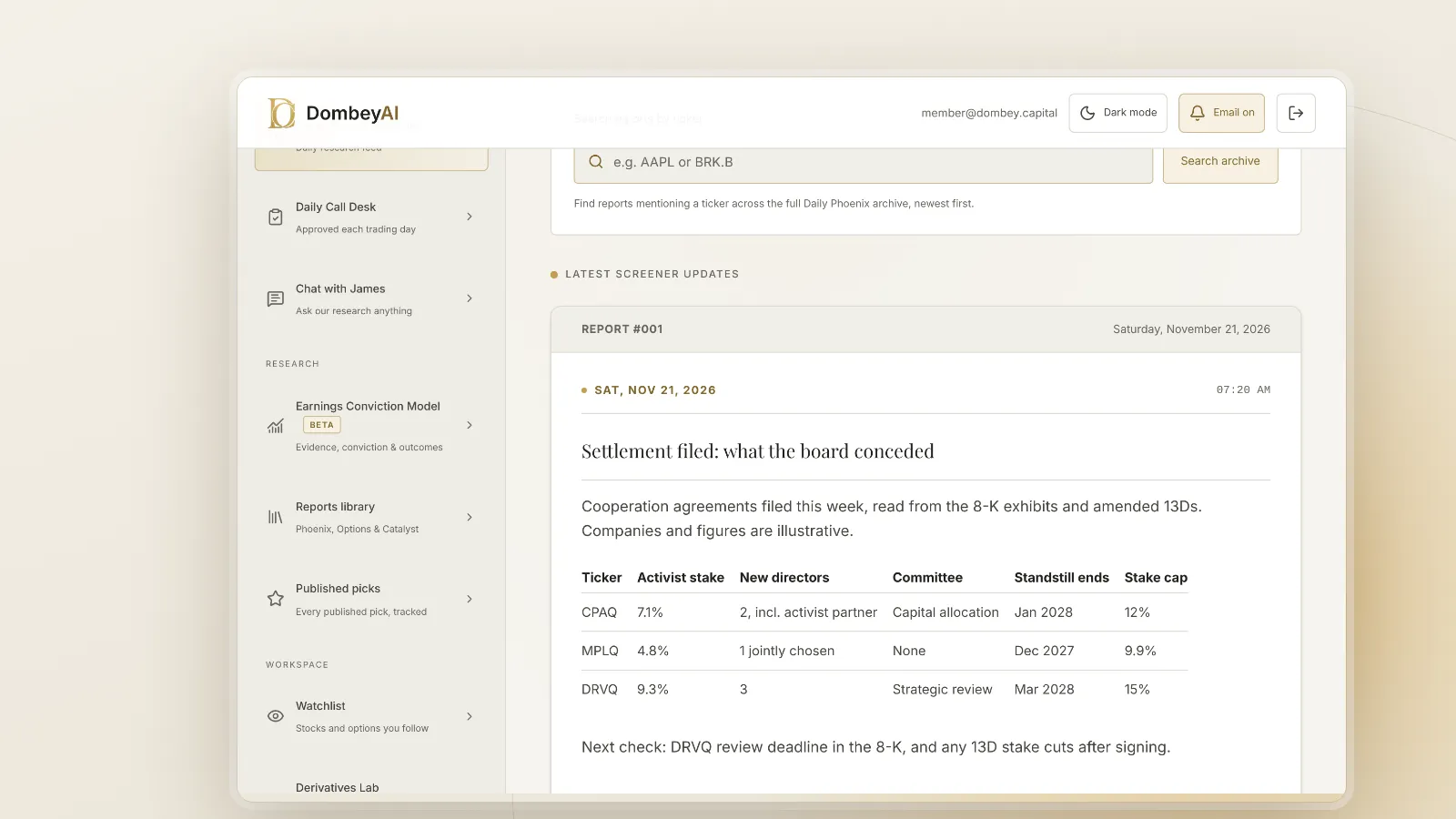
A short definition
Activists build a stake, disclose it on a Schedule 13D, and push for changes: board seats, a sale, a spin-off, cost cuts or a buyback. If the board resists, the activist can nominate directors and run a proxy fight. Most campaigns never reach a vote. They end in a negotiated settlement, and the document that records it is the cooperation agreement, also called a settlement or nomination agreement.
The trade is simple. The company gives the activist influence, usually through directors it nominates or approves. The activist gives the company peace, usually until shortly before the next annual meeting.
Real examples of common terms
Agreements differ, but the same terms recur across settlements filed on EDGAR. The table shows the usual provisions and what each tells you.
| Term | What it usually says | What it signals |
|---|---|---|
| Board appointments | One to three new directors, either the activist's own people or independent names both sides approve | More seats and activist principals on the board mean more influence |
| Committee formation | A new strategy, capital allocation or operations committee that includes a new director | The board accepts a specific question is open |
| Strategic review | The company commits to review options such as a sale or separation | A dated catalyst may follow |
| Standstill | No nominations, solicitations, stake above a cap, or public campaigns for the term | The activist's time horizon is at least that long |
| Voting commitment | The activist votes for the board's nominees and its recommendations on most items | The next annual meeting is largely settled |
| Ownership threshold | The designee steps down if the stake falls below a set level | A way to track the activist's commitment |
| Non-disparagement | Neither side criticizes the other publicly | The public campaign ends |
| Expense reimbursement | The company pays some of the activist's costs, up to a cap | Usually small; the amount is disclosed |
Where the agreement appears
Three filings carry the terms, in this order:
- The company's Form 8-K. A cooperation agreement is typically a material definitive agreement, reported under Item 1.01 and attached as an exhibit. Board changes go under Item 5.02. Our guide on how to read an 8-K for catalysts covers the item numbers.
- The activist's amended Schedule 13D. Item 4 describes the activist's plans and Item 6 describes contracts with the company, so the amendment usually summarizes the agreement and attaches it.
- The next proxy statement. It explains how the new directors were selected and confirms who the board is nominating. See how to read a proxy statement.
Why both sides settle
For the company, a contested election costs money and management attention, and the outcome is uncertain. Under the SEC's universal proxy rules, in effect since 2022, shareholders can mix nominees from both slates on one card, which makes it easier for an activist to win one or two seats without winning the whole board. Proxy advisers such as ISS and Glass Lewis often back some dissident nominees at underperforming companies. A settlement lets the board choose who joins and on what terms.
For the activist, a settlement delivers influence without the cost of a full solicitation and without the risk of losing. It also gives a director a seat inside the boardroom, where information and persuasion work better than open letters.
How to read the terms
The question is how much the board conceded. A useful order:
- If the agreement adds one independent director approved by both sides and nothing else, the board conceded little.
- If the activist's own principal joins the board, the activist has direct influence on strategy and capital allocation.
- If a new committee has a named mandate, such as reviewing the portfolio, the agreement has set an agenda.
- If the company commits to a strategic review or a separation with a date, the agreement has created a catalyst.
- If the standstill is short or ends at the next nomination window, the activist can return quickly if results disappoint.
Cooperation agreements and the company's value
The agreement itself does not change the business. What it changes is who sits in the room when the board decides on capital allocation, asset sales and management. That is why the same settlement can be followed by very different outcomes.
Pros
- An activist director brings an owner's view of capital allocation to the board.
- A dated committee or review gives shareholders a deadline to hold the board to.
- The company avoids the cost and distraction of a contested election.
Cons
- A single new director can be outvoted on every decision that matters.
- The standstill removes public pressure for its full term.
- The activist may be satisfied with a short-term step, such as a buyback, that does little for long-term value.
Settlements often precede larger events. A strategic review can end in a sale, a spin-off or nothing; a new capital allocation committee can lead to a buyback or an asset sale; a board refresh can lead to a CEO change. Read the agreement as the first document in a sequence, and note which later filing would show whether the sequence is happening.
The timeline after a settlement
| When | Event | What to check |
|---|---|---|
| Day 0 | Settlement announced | 8-K Item 1.01 exhibit, press release |
| Within days | Activist amends its 13D | Item 4 plans, Item 6 contracts, stake size |
| Weeks to months | New directors join, committee starts | Committee mandate and any stated deadline |
| Next proxy season | Annual meeting with the agreed slate | Proxy statement, voting results on Form 8-K |
| Standstill end | Activist free to nominate again | Advance notice deadline in the bylaws, 13D changes |
The standstill end date is the one most investors miss. It often lines up with the company's advance notice window, and an activist who is unhappy with progress can start a new campaign from that date.
Where this goes wrong
- Treating the settlement as the catalyst. The proxy fight is over, but the change the activist wanted may not happen. The catalyst moves to the committee, the review or the next set of results.
- Ignoring stake changes. Some activists reduce their stake once the agreement is signed. A falling stake below the ownership threshold can remove their designee.
- Missing the termination clauses. Early termination rights, such as on a change of control or a material breach, can shorten the standstill.
- Assuming every new director favors change. Directors chosen jointly may be closer to the existing board than to the activist.
- Reading the day-one move as information. The price reaction reflects the end of uncertainty about the vote, not the value of what follows.
Dombey's published research tracks settlements like these against the dated events they set up; see the research archive. Recent stock moves tied to activist settlements and other corporate events are covered on Dombey's market pages.
The bottom line
A cooperation agreement settles an activist campaign by trading board influence for a standstill and voting support. The terms are public, in the 8-K exhibit and the amended 13D, and they show how much the board conceded. Read the board changes, any committee or review, the standstill end date and the ownership threshold, then follow the catalyst the agreement created rather than the settlement headline.