

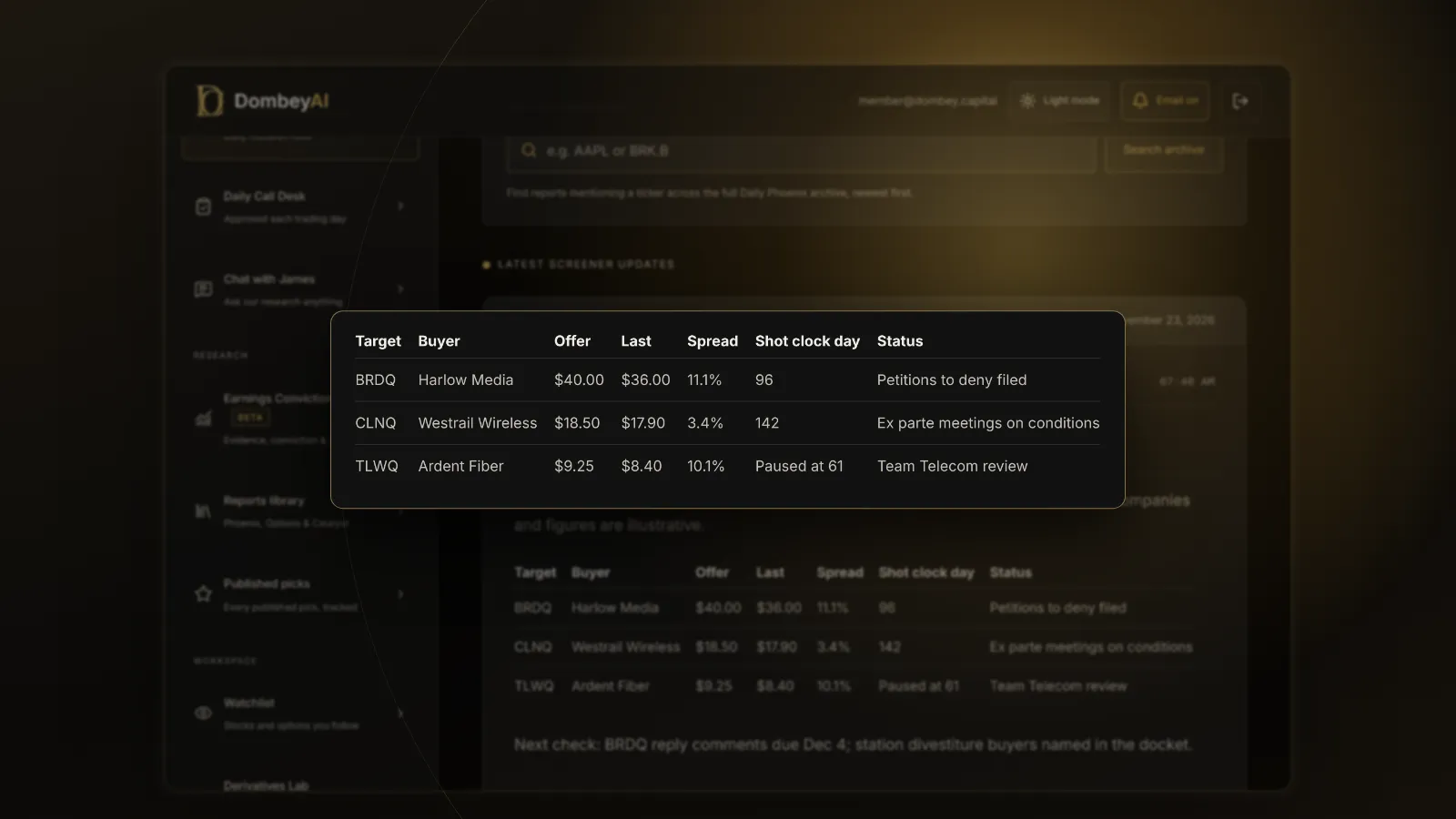
What the FCC reviews
The FCC's authority comes from the Communications Act. Section 310(d) requires its consent before a broadcast or wireless license, or control of the company holding it, is transferred. Section 214 covers authorizations to provide interstate and international common carrier service. A merger between two telecom or media companies usually involves many licenses, so the parties file transfer-of-control applications for each.
The FCC looks at more than competition. Its public interest review can consider:
- Competition in local and national markets, including spectrum concentration.
- Compliance with ownership rules, such as broadcast ownership caps and foreign ownership limits under Section 310(b).
- Effects on service, rural coverage, network investment and diversity of voices.
- The applicants' character and record of compliance.
- Claimed benefits, which must be specific to the deal and verifiable.
This breadth is why FCC review can produce conditions that antitrust agencies would not seek, such as commitments on network build-out or local programming.
The FCC process step by step
| Step | What happens | Timing |
|---|---|---|
| Applications filed | Transfer of control applications for each license | Day 0, often soon after signing |
| Public notice | FCC accepts the applications and sets a pleading cycle | Days to weeks after filing |
| Petitions to deny and comments | Third parties file objections | Deadline set in the public notice, often about 30 days |
| Oppositions and replies | Applicants respond; petitioners reply | Following weeks |
| Information requests | FCC staff ask questions; shot clock may pause | Any time |
| Team Telecom review | National security review if foreign ownership | Runs in parallel, often months |
| Decision | Order approving, often with conditions, or a hearing designation order | Target of 180 days, frequently longer |
The 180-day clock is the FCC's internal target for major transactions. It starts on the date in the public notice and can be stopped, and the FCC does not have to decide by day 180. The regulatory approvals explainer covers how to treat soft deadlines like this one.
How FCC review fits with antitrust and other reviews
Most large telecom and media deals face several reviews at once:
- Antitrust under the HSR Act, usually handled by the Justice Department for telecom. The HSR waiting period explainer covers the 30-day initial period and second requests.
- Team Telecom, if a party has foreign ownership. It can require a mitigation agreement covering data, network equipment or access by U.S. law enforcement.
- State commissions, for deals involving local phone, cable or utility operations in some states.
- Foreign regulators, if the parties operate abroad. See EU merger control and the UK CMA for the main ones.
Remedies agreed with the Justice Department, such as divesting overlapping spectrum or stations, often appear as conditions in the FCC order too. Our explainer on merger remedies shows how divestitures can save a deal.
What it means for the merger spread
FCC review mainly affects a spread through time and conditions. Few deals are rejected outright; the risk is a long review or conditions that change the economics.
| Scenario | What happens | Company B's share price |
|---|---|---|
| Approval on schedule | Order in about six months | $40 at closing |
| Delay | Clock paused for more information; closing in twelve months | Near $36, with a lower annualized return |
| Conditions | Divest two stations; buyer accepts | $40, perhaps with a short delay |
| Hearing designation | Deal sent to an administrative law judge | Toward $28 if the deal is abandoned |
The $4 spread is pricing mostly the hearing risk and the time value. If you believe there is a 10% chance of the deal failing at $28, expected value is about $38.80, so the spread depends heavily on how quickly the review finishes. The guide on how to calculate a merger arbitrage spread shows the full arithmetic.
Signals to watch in the docket
- Who petitions to deny. A competitor or public interest group filing a detailed petition can slow the review. A petition from a state attorney general or a large competitor is a stronger signal.
- Clock pauses. The FCC announces when it stops the clock. A pause is common but resets the timeline.
- Ex parte meetings. Filings record meetings with FCC staff and commissioners. A burst of meetings about specific conditions often precedes an order.
- Voluntary commitments. Applicants often offer commitments late in the process to address concerns. They usually point to approval with conditions.
- Commission composition. The FCC is a five-member commission. Its majority and priorities shape how it treats media and telecom deals.
The track a merger through approval guide shows how to log these signals alongside the merger agreement's outside date. Event-driven coverage on our market pages follows dated regulatory decisions like these.
Broadcast deals and ownership rules
Broadcast mergers face an extra layer of rules that telecom deals do not. The FCC limits how many TV stations one company can own, nationally and within a single market, and how stations are combined in the same local area.
- National audience cap: a single owner's TV stations may not reach more than a set share of U.S. television households. The FCC has reviewed this cap and how it counts UHF stations several times, so check the current rule before relying on it.
- Local TV ownership: rules limit owning two of the top-rated stations in the same market, with case-by-case review for some combinations.
- Divestiture trusts and sidecar arrangements: to comply, buyers often sell stations to third parties or place them in trusts. The FCC examines these arrangements closely, and how it views them has been decisive in past reviews.
For investors, the practical point is that a broadcast deal's timetable often depends on how many stations need to be sold and to whom. A long list of divestitures, or buyers with close ties to the acquirer, invites petitions to deny and closer scrutiny.
Wireless deals raise a different ownership question: spectrum concentration. The FCC reviews how much spectrum a combined company would hold in each local market, which is why wireless mergers often come with spectrum divestitures or build-out commitments.
Where this goes wrong
- Treating the shot clock as a deadline. Day 180 is a target. Many major transactions run well past it.
- Assuming FCC review is just antitrust. The public interest standard can raise issues no antitrust agency would, from ownership caps to local service commitments.
- Missing Team Telecom. Foreign ownership can add a separate review with its own timetable and mitigation terms.
- Ignoring the outside date. The merger agreement's outside date, and any extension rights, decide what happens if review runs long. Read it alongside the docket.
- Reading too much into one filing. Petitions to deny are common and many fail. Weight them by who filed and how specific they are.
- Forgetting politics. FCC decisions are made by appointed commissioners, and priorities change with the commission's majority.
The bottom line
The FCC reviews mergers that transfer control of its licenses under a public interest standard that is broader than antitrust. The process runs from applications and a public notice through petitions to deny, information requests and an order, with an informal 180-day target. Most risk to a spread comes from delays, conditions and the rare hearing designation, not outright denial. Follow the docket, the clock and the outside date together.