

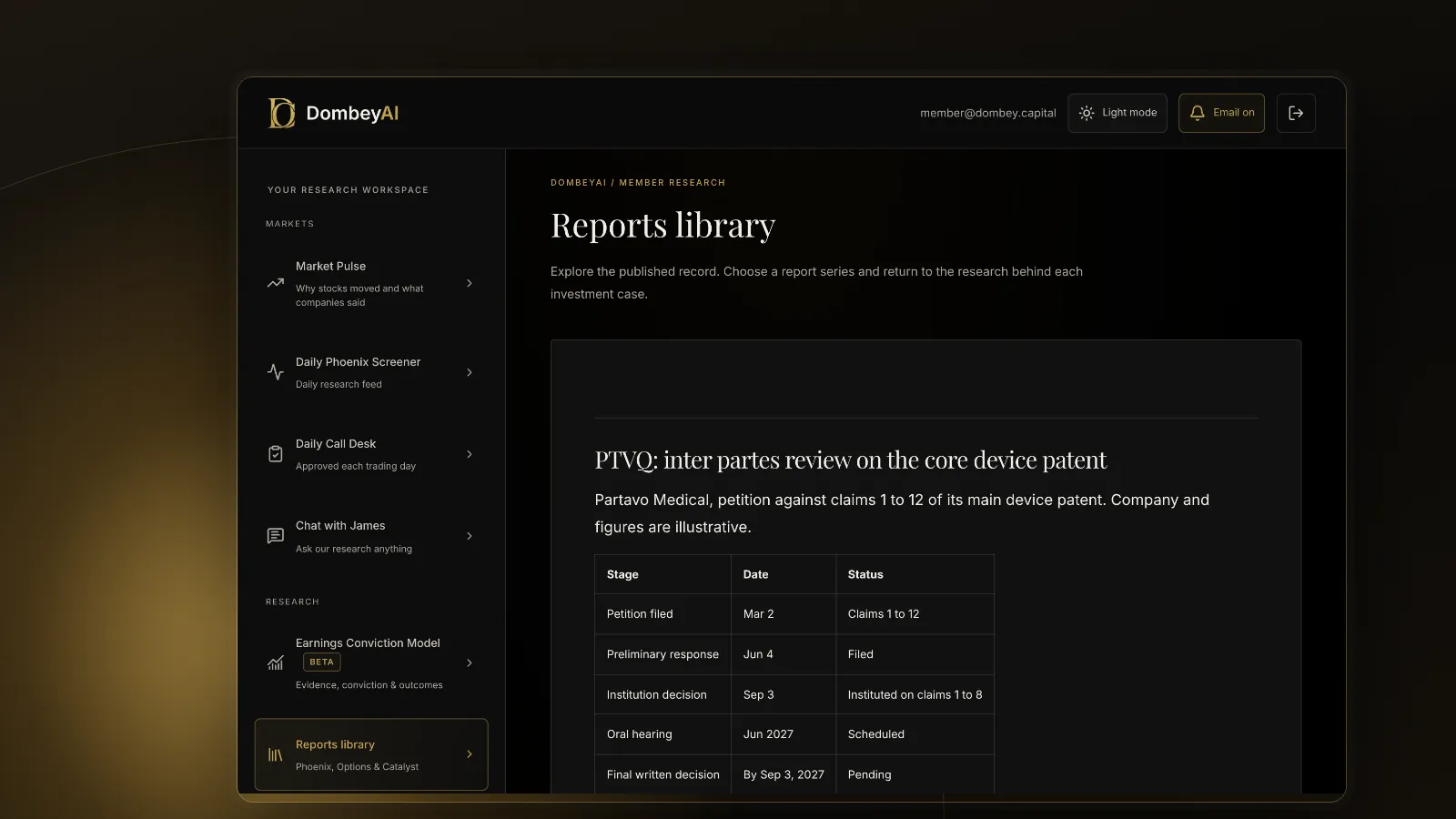
A short definition
The America Invents Act created inter partes review, and it has been available since September 2012. It replaced an older reexamination process with a faster, trial-like proceeding run by administrative patent judges.
Four features define it:
- Who files: anyone other than the patent owner. In practice it is usually a company that has been sued for infringement, or a generic or biosimilar maker that wants to launch.
- What can be argued: only that the claims were anticipated or obvious in light of earlier patents and printed publications. Arguments about written description, enablement or patent-eligible subject matter are not allowed.
- Burden of proof: the challenger must prove unpatentability by a preponderance of the evidence. In district court, an issued patent is presumed valid and must be shown invalid by clear and convincing evidence.
- Outcome: the board cancels the claims it finds unpatentable and confirms the rest. It does not decide infringement or award damages.
Real examples of how IPRs play out
IPR outcomes fall into a handful of patterns. Each leaves a different trace in the filings and changes a stock's case in a different way.
| Pattern | What happened | Where it shows up | What it means for the stock |
|---|---|---|---|
| Petition denied | Board declined to institute | Institution decision; company press release | The patent stands; the challenger moves to court |
| Instituted, all claims survive | Trial held, board confirmed the claims | Final written decision | Patent owner's position in litigation strengthens |
| Instituted, mixed result | Some claims cancelled, others confirmed | Final written decision, claim by claim | Depends on which claims cover the product |
| Instituted, all claims cancelled | Board found every challenged claim unpatentable | Final written decision; 10-Q legal proceedings | Protection may fall away, subject to appeal |
| Settled before decision | Parties settled and asked to terminate | Joint motion; often an 8-K or press release | Terms, not the board, set the outcome |
The middle row is the one investors misread most often. A headline that says a patent "survived" can hide the fact that the claim covering the commercial product was the one cancelled.
The timeline and its dated catalysts
The statute and the PTAB's rules set most of the dates, which is why IPRs suit a catalyst calendar.
| Stage | Timing | What to check |
|---|---|---|
| Petition filed | Day 0 | Which claims are challenged and on what prior art |
| Patent owner preliminary response | Within about 3 months | Whether the owner disputes the art or argues for denial |
| Institution decision | Within 3 months of the preliminary response | Which claims and grounds the board will try |
| Trial: discovery, expert testimony, oral hearing | Months 6 to 17 | Any motion to amend claims; hearing date |
| Final written decision | Within 12 months of institution (up to 6 more for good cause) | Claim-by-claim result |
| Rehearing or Director review request | About 30 days after the decision | Whether either side asks |
| Appeal to the Federal Circuit | Notice within about 63 days | Briefing and argument take many more months |
Two features make these dates more useful than most court dates. The one-year deadline for the final decision is statutory, so it rarely slips. And the board posts its decisions in public, so the market sees them at the same time you do.
Why an IPR can move a stock
A patent challenge matters to the share price only when value depends on the claims. Three situations come up repeatedly.
Drug and biologic patents. A generic or biosimilar maker may file an IPR against patents listed for a branded drug while the parallel court case runs. If key claims fall, an earlier launch becomes more likely. Our explainer on the patent cliff covers what happens to revenue when protection ends.
Licensing and litigation-driven companies. For a company whose income comes from patent licensing or infringement damages, the claims are the asset. Cancelled claims can wipe out a pending damages case, because a patent found unpatentable cannot be infringed.
Defendants. For the challenger, a win can remove a royalty burden or a damages exposure. The effect on its stock is usually smaller, because the liability is one item among many.
The regulatory approvals explainer covers a similar pattern: a dated government decision with a binary first read and a slower real outcome.
A worked example
The headline reads "mixed decision." The questions that matter are narrower:
- Which claims read on the device? The infringement complaint and the claim charts tell you which claims Company A is asserting. If it relies on claims 5 to 8, the decision helps it.
- What is left in the lawsuit? The court case can continue on the surviving claims, and on claims 13 to 20, which were never challenged.
- Is there an appeal? Company B can appeal the confirmation of claims 5 to 8 to the Federal Circuit. That adds time but rarely changes the near-term picture.
- What did the market price? If the stock fell 15% when the review was instituted, a decision confirming the important claims may reverse part of that.
The work is mapping claims to revenue. A hard catalyst with a fixed date is useful only if you know which outcome changes value.
Where to find the documents
- PTAB records: petitions, institution decisions and final written decisions are published through the USPTO's PTAB search tools. Each decision lists the claims and grounds.
- Company filings: the legal proceedings section of the 10-K and 10-Q describes material IPRs. Use EDGAR full-text search for the patent number or "inter partes review" with the company name.
- Press releases and 8-Ks: companies often announce institution and final decisions when they are material.
- Court dockets: district courts frequently stay infringement cases while an IPR runs, which shifts the litigation timeline.
For more on finding and reading patent data, see our roundup of patent research tools for investors.
Where this goes wrong
- Reading institution as a loss. Institution only means the board found a reasonable likelihood of success on at least one claim. Many instituted claims survive the trial.
- Treating all claims as equal. A patent can have dozens of claims, and only some cover the product. The claim-by-claim result matters more than the count.
- Ignoring other patents. Drug and device makers often hold several patents on the same product. Losing one may leave protection in place through another.
- Forgetting the appeal. A final written decision can be appealed, and the Federal Circuit can affirm, reverse or send the case back. The commercial effect of cancelled claims may not arrive for years.
- Assuming fixed rules. The USPTO has changed how it handles discretionary denial and Director review more than once in recent years. Check the current guidance on the PTAB site before relying on how a petition will be treated.
- Overestimating the market's surprise. Institution and final decisions are public on the day they issue. Price moves after the first hour usually reflect analysis of claim scope, not the headline.
How it fits into event-driven work
An IPR is one input to a larger case. On its own it rarely tells you what a company is worth; combined with the product's revenue share, the lawsuit's damages claim and the patent expiry dates, it can tell you a great deal. Event-driven coverage on our market pages tracks dated decisions like these alongside earnings and deal votes.
The bottom line
An inter partes review is a USPTO trial that can cancel patent claims on prior-art grounds, with a lower burden of proof than in court. Its two key dates, the institution decision and the final written decision a year later, are predictable and public. The decision matters only when the challenged claims protect revenue or a damages case, so map claims to products before reacting to a headline. Then check for appeals, surviving claims and other patents before deciding what changed.