

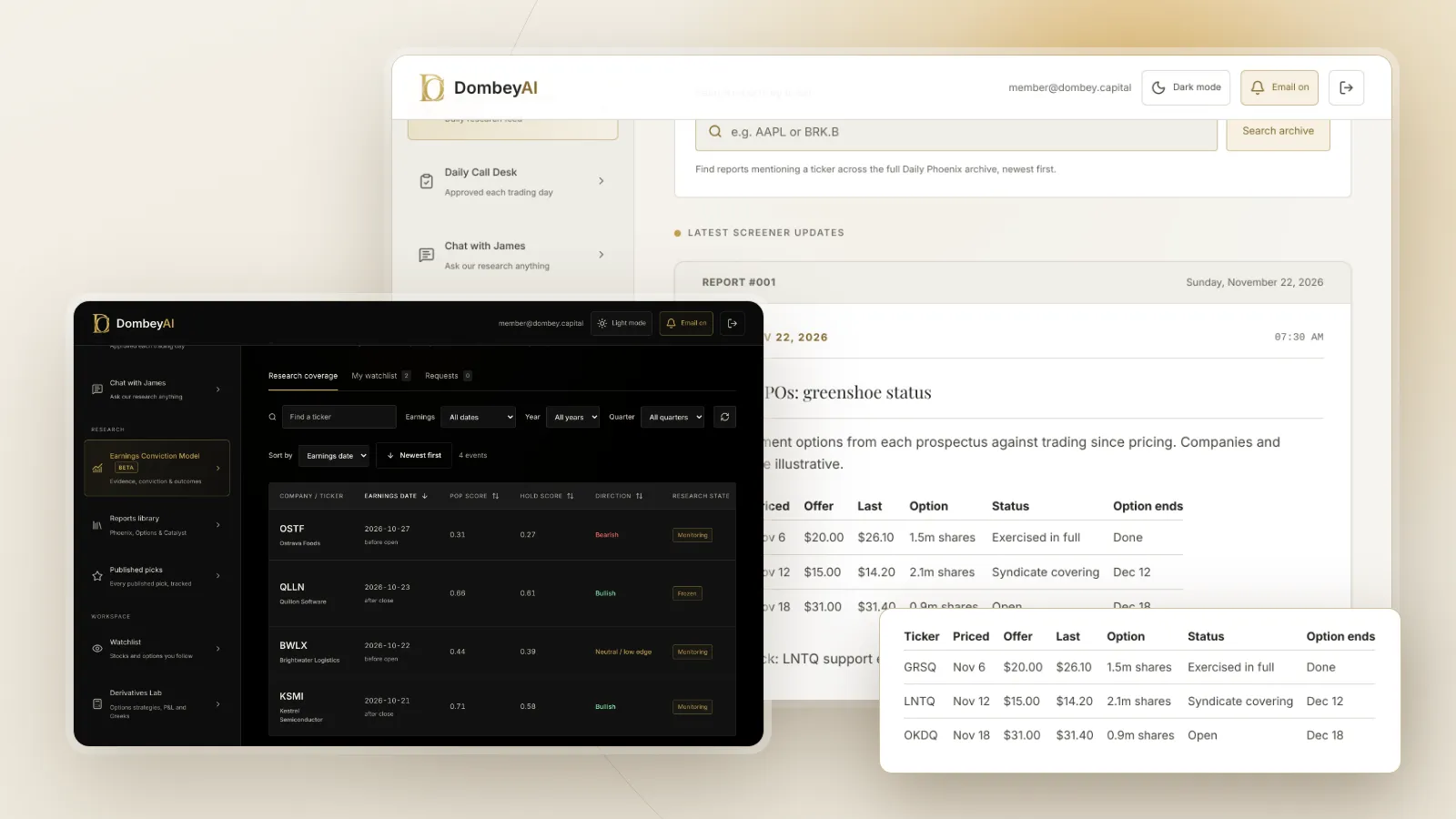
A short definition
In an offering, the issuer agrees to sell a base number of shares through the underwriters. The underwriting agreement also grants them an option to buy additional shares, typically up to 15% of the base, at the same price less the underwriting discount. The prospectus discloses it on the cover and in the underwriting section, usually as an "option to purchase additional shares".
The name comes from the Green Shoe Manufacturing Company, whose 1963 offering is widely cited as the first to use the structure.
The option is used in initial public offerings, follow-on offerings and some convertible bond deals. Our explainers on the S-1 filing and secondary offerings show where the terms appear in each.
Real examples of how greenshoes play out
There are a few standard outcomes. Each leaves a different trace in the filings that follow.
| Outcome | What the stock did | What the underwriters did | What the filings show |
|---|---|---|---|
| Full exercise | Traded at or above the offering price | Exercised the whole option to cover the short | Press release or 8-K on full exercise; more shares issued |
| Partial exercise | Mixed, often near the offering price | Covered part in the market and exercised the rest | Exercise of part of the option; smaller share increase |
| No exercise | Traded below the offering price | Bought shares in the market to cover | No new shares; the option expires |
| Naked short covered | Fell after pricing | Bought beyond the option amount in the market | Not always disclosed directly |
| Secondary-holder greenshoe | Any | Option granted by selling shareholders, not the company | Extra shares come from holders; no dilution |
The fourth row matters because underwriters can sell more than the option covers. That naked short can be closed only by buying in the market, so it adds buying power if the stock falls.
How the mechanics work
Take a simple case.
Two paths follow.
The stock rises to $26. Buying 1.5 million shares in the market would cost far more than $20. Instead the underwriters exercise the greenshoe and buy the 1.5 million shares from Company A at $20, less their discount. The short is closed, Company A raises more money and the share count rises by 1.5 million.
The stock falls to $17. The underwriters buy 1.5 million shares in the market, near or below the offering price, to cover the short. That buying adds demand when the stock needs it. The greenshoe is not exercised, Company A issues no extra shares, and the underwriters keep the gain between the $20 they sold at and the price they paid.
In both cases the underwriters end flat. The greenshoe gives them a way to close the short at no worse than the offering price if the stock goes up, and the short gives them shares to buy if it goes down.
Who benefits from the structure
Each party gets something from the greenshoe, which is why nearly every underwritten IPO includes one.
The issuer can raise up to 15% more money if demand is strong, without committing to a larger deal at the outset. If demand is weak, it issues no extra shares at a depressed price.
The underwriters get a way to support the stock without taking open-ended risk. Their short is covered at the offering price at worst, and they earn the underwriting discount on any shares bought under the option.
IPO buyers get some protection from a sharp drop in the first days, because the syndicate has a reason to buy if the stock trades below the offering price. That protection is limited to the size of the short and to the option period.
Later buyers get information. The exercise announcement, usually within a month, says how the deal traded and fixes the share count they should use.
Stabilization and its rules
Supporting a price after an offering would normally look like manipulation. SEC Regulation M, Rule 104, allows it under conditions: stabilizing bids are limited in price and must be disclosed, and the prospectus must say that stabilization may occur. Covering a short in the market, the main tool, is treated as syndicate covering and is also disclosed.
In practice, the support is strongest in the first days and weeks, when the stock trades near the offering price. It ends when the underwriters have covered their short, either by exercising the option or by buying in the market, or when the option period runs out.
Why the greenshoe matters to investors
The greenshoe is a small clause with readable consequences.
- It tells you how the deal traded. Full exercise usually means the stock held above the offering price for most of the option period. No exercise usually means the underwriters had to buy in the market to support it.
- It changes the share count. A full exercise adds up to 15% to the shares sold. Use the post-exercise count for market value and per-share figures, as our explainer on dilution covers.
- It sets a date when support may end. About 30 days after pricing, the underwriters' buying stops. Together with the end of the IPO quiet period, after which underwriters' analysts can begin publishing, the first month brings two scheduled changes in who is trading and writing about the stock.
- It precedes the lockup. Insider shares usually unlock months later. A stock that needed support in its first month may face that supply with fewer natural buyers. See lockup expirations.
Dated events like these, and the way stocks behave around them, are what our market coverage follows.
A timeline of the first months
| Timing | Event | What to check |
|---|---|---|
| Pricing day | Base deal and greenshoe sold | Final prospectus: base shares, option size, price |
| First trading days | Stabilization, syndicate covering | Price against the offering price |
| At least 10 days after the IPO | Research quiet period ends under FINRA Rule 2241 | Initiation reports from the underwriters |
| Within 30 days | Greenshoe exercised in full, in part or not at all | 8-K or press release, updated share count |
| Usually around 90 to 180 days | Lockup expires | Prospectus lockup terms, early release provisions |
For a stock that broke below its offering price, our explainer on busted IPOs covers why some become special situations.
Where this goes wrong
- Treating support as a floor. Underwriter buying is limited to the size of the short. Once it is covered, the support ends, and a stock held up by it can fall.
- Missing the extra shares. Data services sometimes show the pre-exercise share count for weeks. Recalculate market value after a full exercise.
- Reading exercise as a forecast. Full exercise says the stock traded well in its first month, not that it will keep doing so.
- Ignoring who grants the option. When selling shareholders grant the greenshoe, exercise adds no new shares and the company raises no extra cash.
- Assuming the usual terms. The 15% and 30-day figures are customary, not fixed. Read the prospectus for the actual size and period.
The bottom line
A greenshoe lets underwriters sell up to 15% more shares than the base deal and cover that short by exercising an option at the offering price or by buying in the market. That structure is how new issues get price support in their first weeks, and it ends when the short is closed. Whether the option was exercised tells you how the deal traded and how many shares now exist. Read the prospectus for the terms and watch the 8-K that reports the outcome.