

Where the line sits
Credit ratings sort issuers by the agencies' view of default risk. The scales differ in notation but share one important boundary:
| Agency scale | Lowest investment grade | Highest high yield |
|---|---|---|
| S&P Global Ratings | BBB- | BB+ |
| Moody's | Baa3 | Ba1 |
| Fitch Ratings | BBB- | BB+ |
That one-notch step changes who can own the debt. Many bond indexes, funds and institutional mandates are limited to investment-grade securities. Insurers face higher capital charges on high-yield holdings. Some banks and money market funds cannot buy the company's commercial paper once its short-term rating falls.
Bonds that were high yield from the start are called original-issue high yield. Fallen angels are a separate group: often larger companies with more bonds outstanding, whose debt was sold to investment-grade buyers who may now have to leave.
What a downgrade to high yield triggers
| Effect | Where to find it | Why it matters for the stock |
|---|---|---|
| Forced or rule-based bond selling | Index rules, fund mandates | Bond prices fall; new debt costs more |
| Higher cost of new debt | New issue pricing, credit spreads | Refinancing raises interest expense |
| Coupon step-ups | Bond indentures and 10-K debt notes | Interest on existing debt can rise automatically |
| Collateral calls | Derivative, supply and trading agreements | Cash can be tied up suddenly |
| Loss of commercial paper access | Liquidity disclosures in the 10-Q | Short-term funding moves to bank lines |
| Covenant changes | Credit agreements | Some investment-grade style terms fall away; others tighten |
| Customer and supplier terms | Contracts, earnings calls | Counterparties may ask for letters of credit or shorter terms |
The 10-K and 10-Q usually describe rating triggers in the liquidity section and the debt notes. Searching a company's filings for "rating" and "downgrade" on EDGAR is a quick way to find them.
Why the timing creates an event
The downgrade is a dated event with rule-driven flows on one side. That makes it similar in structure to an index deletion: some holders sell because of a rule, not because they have changed their view of value.
Three dates matter:
- The watch or negative outlook. The agency signals a possible cut. The stock and bonds often move most here.
- The downgrade itself. If it is the decisive rating under index rules, the bond leaves investment-grade indexes, usually at the next monthly rebalancing.
- Index exit and high-yield entry. Bonds move from investment-grade to high-yield indexes. High-yield buyers may step in, but often at a discount.
For equity holders, the stock tends to react less to the rating action itself than to what comes before and after it.
What management usually does next
A company that loses investment grade has a few standard ways to respond. Each is a potential catalyst:
- Cut or suspend the dividend to keep cash for debt reduction. Dividend cuts explains how the market tends to read these.
- Sell assets and use the proceeds to repay debt. Asset sales can reset how the market values the remaining business.
- Issue equity or equity-linked securities, which dilutes shareholders but repairs the balance sheet.
- Cut capital spending and costs to raise free cash flow.
- Extend maturities through exchange offers or new bonds; in weaker cases, a liability management exercise.
- Commit publicly to regaining investment grade, with a leverage target and a date.
The combination and the speed of these steps usually decide the stock's path more than the downgrade does.
Worked example: two fallen angels
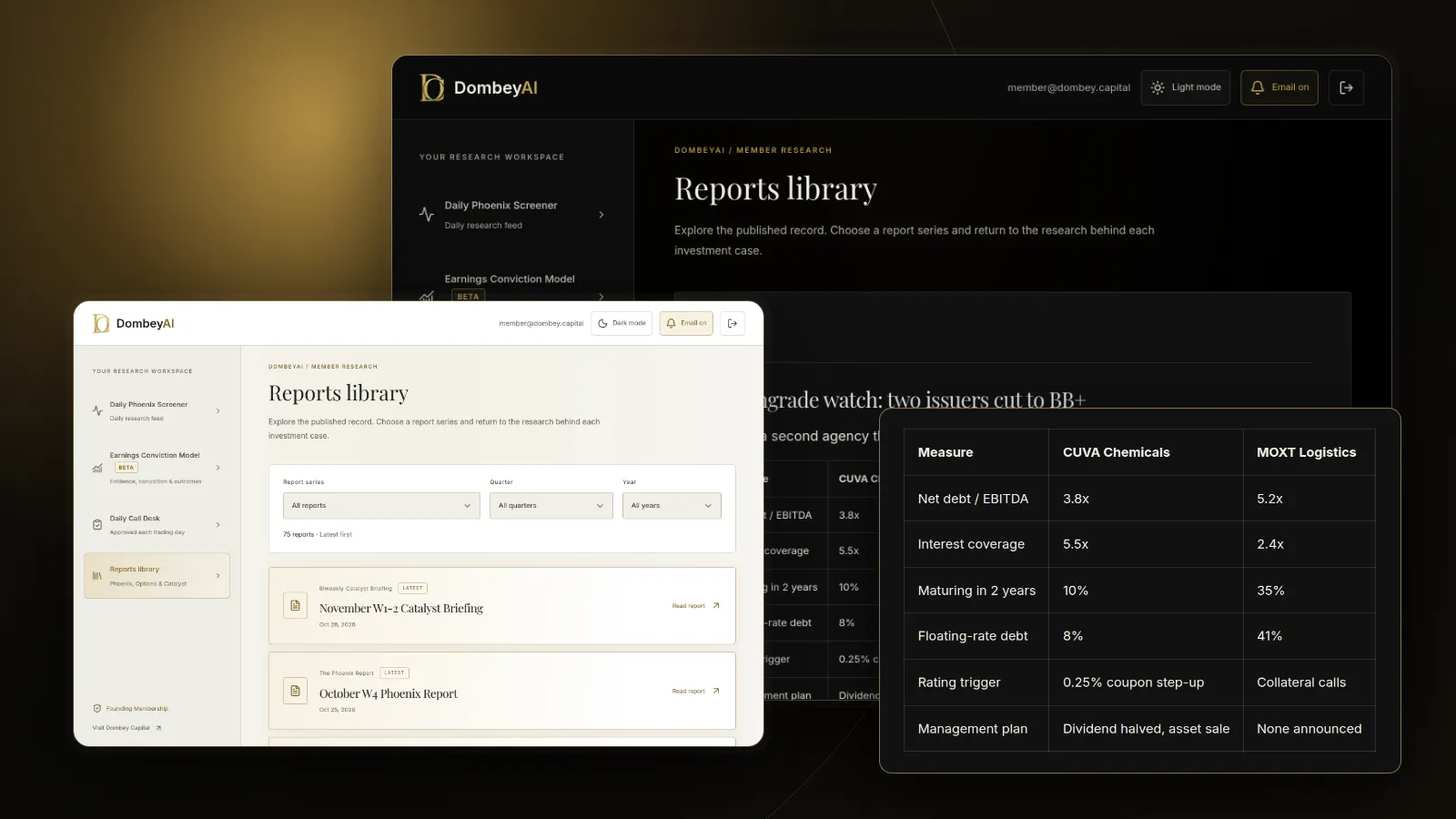
| Company A | Company B | |
|---|---|---|
| Net debt to EBITDA | 3.8x | 5.2x |
| Interest coverage | 5.5x | 2.4x |
| Debt maturing in next 2 years | 10% of total | 35% of total |
| Debt type | Mostly fixed-rate, long-dated | Mix of floating-rate loans and bonds |
| Rating triggers | Coupon step-up of 0.25% on two bonds | Collateral calls on supply contracts |
| Management response | Dividend cut by half, asset sale announced | No plan announced |
Company A has time. Its debt is long-dated, its coverage is comfortable and it has acted quickly. If the asset sale closes and leverage falls toward 3.0x, an upgrade back to investment grade is possible, and the stock may re-rate as the overhang clears.
Company B is at risk of a maturity wall: a third of its debt comes due in two years, refinancing will cost more, floating-rate interest is rising and collateral calls could tie up cash. Its interest coverage leaves little room. The same rating cut is a much bigger event for Company B's shareholders.
How to research a fallen angel
- Read the rating agency releases. They state the reason for the cut and what would lead to an upgrade or a further downgrade.
- Map the maturity schedule. List each debt instrument, its rate, its maturity and whether it is secured.
- Find the rating triggers. Search the 10-K and credit agreements for step-ups, collateral requirements and change-of-terms clauses.
- Check liquidity. Cash, undrawn revolver capacity and expected free cash flow against the next two years of maturities.
- Track management's plan. Note the leverage target, the dividend policy and any asset sales with dates.
- Watch the bonds. Bond prices and yields often give a clearer read on default risk than the stock.
- Check the equity cushion. A large equity market value relative to debt gives management room to issue shares if needed. Debt to equity is a starting point.
Rising stars: the path back
The reverse move, from high yield back to investment grade, is often called a rising star. It is also a dated event with rule-driven flows, this time in the other direction: investment-grade funds and indexes can buy the bonds again, and borrowing costs usually fall.
Agencies tend to want evidence before they upgrade. That usually means leverage at or below the target the company set, a track record of keeping it there for several quarters and a financial policy, such as a dividend or buyback limit, that makes a relapse less likely. For equity holders, the path back is often where the value is. A company that cut its dividend, sold assets and repaid debt can see its stock re-rate as the market stops pricing a balance sheet problem. Tracking the leverage target against reported results each quarter shows whether the company is on the path or drifting from it.
Where this goes wrong
Assuming the downgrade is news. Ratings often lag the market. By the time a company loses investment grade, the stock may already reflect it.
Assuming forced selling means value. Bond selling pressure can create a discount, but some fallen angels keep falling toward distress.
Ignoring split ratings. Index rules often use the middle or lowest of several ratings. The downgrade that moves a bond out of an index may be the second or third, not the first.
Overlooking the equity dilution path. A balance sheet repair through new shares can save the company and still cost existing shareholders.
Missing cyclical context. In a recession, many companies fall at once, and high-yield buyers are scarce. In a calm market, the same downgrade may be absorbed easily.
The bottom line
A fallen angel is a company whose debt has been cut from investment grade to high yield, the line between BBB- and BB+ or Baa3 and Ba1. The cut can force some bondholders to sell, raise borrowing costs and trigger clauses in debt and commercial contracts. For the stock, the rating action is often old news; what matters is the maturity schedule, the liquidity position and how quickly management cuts the dividend, sells assets or raises equity. Dombey's published research reads the debt documents behind each balance sheet catalyst; see the research archive. For current situations, see the market coverage.