

What a liability management exercise does
Every LME tries to solve the same problem. A company has more debt than it can refinance on normal terms, often with a debt maturity wall approaching, and a Chapter 11 filing would be slow, expensive and likely to wipe out the shareholders. An LME uses the flexibility in the existing debt documents to change the capital structure without a court.
The goals usually fall into four groups:
- More runway. Push maturities out by two to five years so the business has time to recover.
- New money. Raise fresh liquidity from lenders who are willing to fund in exchange for better priority.
- Discount capture. Retire debt trading below par for less than its face value, which shrinks the total claim.
- Lower cash interest. Swap cash-pay debt for debt that pays partly in kind, meaning interest is added to the principal instead of paid in cash.
The company rarely does this alone. A group of lenders, usually organized with their own advisers, negotiates the terms and supplies the new money. That group gets better treatment. The cost falls on lenders outside the group, which is why these deals are often called non-pro rata transactions and why they lead to lawsuits.
How an uptier works
An uptier relies on a gap in many older credit agreements. Changes to the most important terms, such as the interest rate, the maturity date and the principal amount, typically need the consent of each affected lender. These are called sacred rights. But many agreements did not treat subordination as a sacred right, so a simple majority of lenders could amend the agreement to allow new debt that ranks ahead of everyone.
The sequence usually runs like this:
- A group holding more than half of the term loan agrees terms with the company.
- The majority votes to amend the credit agreement to permit new super-priority debt and to strip protective covenants from the existing loans.
- The company issues new super-priority debt. Some of it is new money; some is exchanged for the majority's old loans, often at a discount to par.
- The minority keeps its original loans, which now rank behind the new debt on the same collateral and carry fewer covenants.
The majority lenders give up some face value in the exchange but move to the front of the line. The minority keeps full face value on paper but expects a much lower recovery in any later default.
Drop-downs and other variations
An uptier changes who ranks first against the same collateral. Other LMEs change what collateral the old lenders can reach.
| Type | What happens | Who gains | Who loses |
|---|---|---|---|
| Uptier | Majority amends the credit agreement, new debt primes the existing loans | Participating lenders, company liquidity | Non-participating lenders |
| Drop-down | Assets move to an unrestricted or non-guarantor subsidiary that raises new secured debt | New-money lenders at the subsidiary | Existing secured lenders, who lose collateral |
| Double-dip | New lenders get a claim against the parent and a separate guarantee claim against subsidiaries | New-money lenders | Other creditors, who share recoveries with a larger claim |
| Pari-plus | New debt ranks equal to the old debt but gets extra guarantees or collateral | New-money lenders | Existing lenders of the same rank |
| Distressed exchange | Bonds exchanged for new notes with lower face value or later maturity | Company, through discount capture and runway | Holders who exchange at a loss, or holdouts left structurally junior |
| Amend and extend | Lenders agree to push maturities out, usually for a higher rate or fee | Company runway | Equity, through higher interest cost |
The drop-down became widely known after a 2016 and 2017 transaction in which a retailer moved brand intellectual property into an unrestricted subsidiary and borrowed against it. Credit agreements written since then often include a "J.Crew blocker" that limits that move. Lenders now add similar clauses aimed at uptiers and other tactics, and borrowers look for the gaps those clauses leave.
Bond exchanges can avoid SEC registration under Section 3(a)(9) of the Securities Act, which covers exchanges by an issuer with its existing security holders when no commission is paid for soliciting them, or under private placement exemptions limited to large institutional holders. That is why many exchange offers are open only to qualified institutional buyers.
What an LME means for shareholders
Shareholders do not vote on most LMEs, and the shares usually stay outstanding with no direct dilution. That makes the first reaction in the stock easy to misread. The real question is what the deal does to the claims ahead of the equity.
Four things change:
- Time. The company may get two or more extra years before a maturity forces a decision. That is real option value for the equity.
- Total debt. Discount capture can cut face value. New money and paid-in-kind interest add to it.
- Interest cost. Super-priority debt is expensive. Higher cash interest can eat the liquidity the deal was meant to create.
- Priority. More senior debt means a lower recovery for every junior claim, and equity is the most junior claim of all.
If the business recovers, the shares benefit from having avoided a restructuring. If it does not, the company may file later with more secured debt ahead of the equity than before. The guide to what happens to stock in Chapter 11 explains why that usually leaves little or nothing for the old shares. Some LMEs also include warrants or equity issued to lenders, which works like a debt-for-equity swap and dilutes existing holders directly.
A worked example
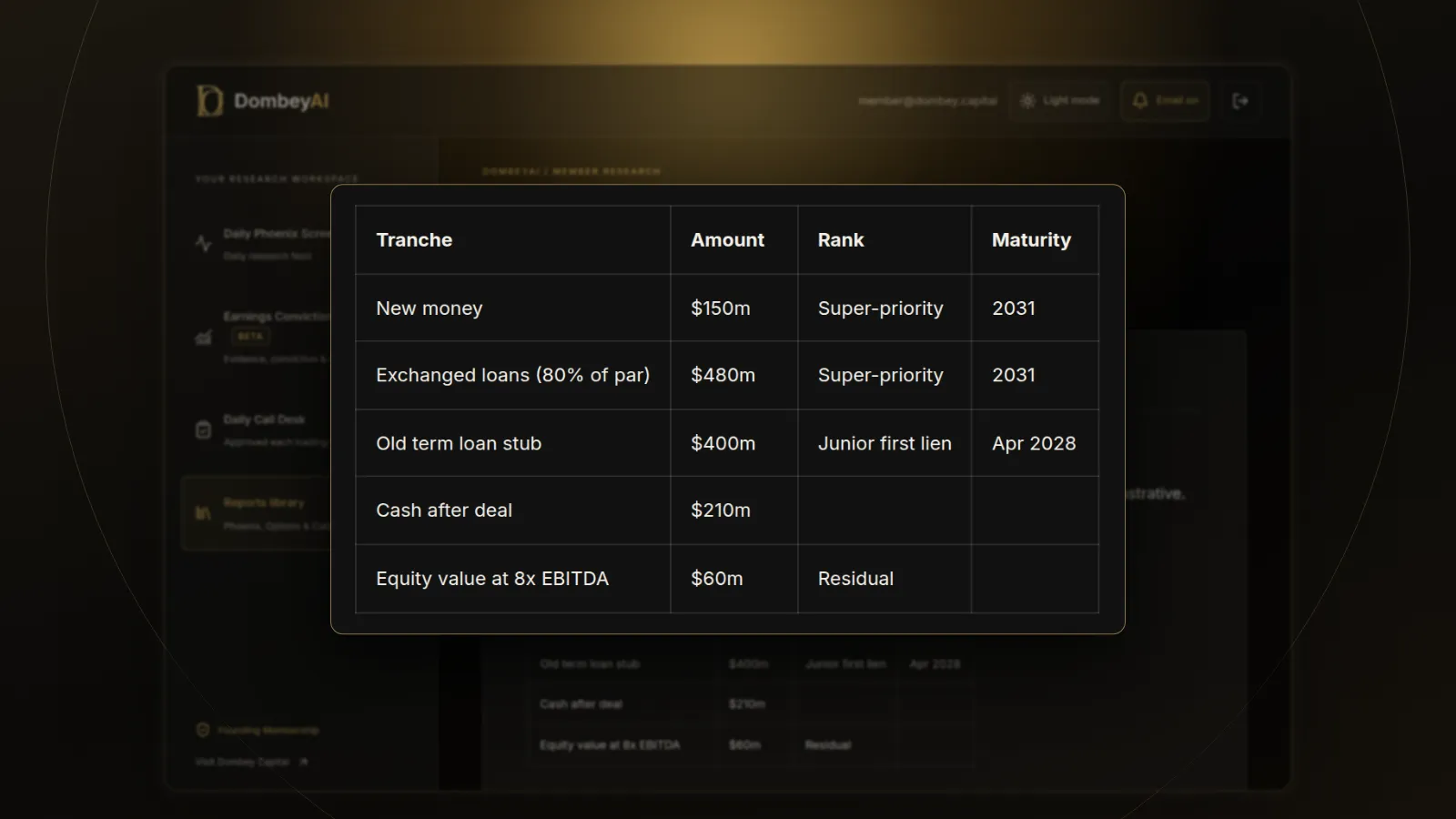
Lenders holding 60% of the loan, or $600 million, agree to an uptier. They exchange their loans into $480 million of new super-priority debt, a 20% discount to par, and fund $150 million of new money at the same super-priority rank. Everything new matures in five years. The other $400 million of old loans stays outstanding, now ranked behind $630 million of super-priority debt, with the same 18-month maturity.
After the deal, Company A has $1,030 million of debt instead of $1,000 million, but $210 million of cash and five years of runway on most of it. The shareholders own 100% of a company that is still alive.
Now test the equity. Say the business is worth 8x EBITDA, or $880 million. Add the $210 million of cash and the total available to claims is $1,090 million. After $1,030 million of debt, the equity is worth about $60 million, or $1.50 per share, half the pre-deal price. At 7x EBITDA the equity is worth nothing on this math. The shares rest on the business recovering before the old $400 million comes due, which is now a smaller wall the company must still clear.
How to read an LME in the filings
The announcement usually comes in an 8-K, with the transaction support agreement or the amended credit agreement attached as exhibits. The guide on how to read an 8-K for catalysts covers where those exhibits sit. Search the company's filings with SEC EDGAR full-text search for phrases like "super-priority", "exchange offer" and "transaction support agreement".
Then check five things:
- New priority. How much debt now ranks ahead of the old loans and the equity.
- Discount captured. Face value retired against face value issued, including any paid-in-kind interest that will build up.
- Maturity schedule. When each tranche comes due, and whether any springing maturity ties the new debt to the old stub.
- Cash interest. The new annual cash interest bill against free cash flow.
- Equity issued. Any warrants or shares given to lenders, and the fully diluted share count after them.
The next 10-Q debt note will show the new tranches in one place. The guide to reading a 10-Q for special situations explains where to look.
Where this goes wrong
LMEs buy time. They do not fix a business that earns too little to carry its debt.
- Re-defaults. Many companies that complete an LME come back for a second deal or a Chapter 11 filing within a few years, now with more senior debt than before.
- Litigation. Excluded lenders sue. A court can unwind or reprice a deal, and the legal costs and uncertainty can freeze refinancing.
- Liquidity drain. Super-priority debt costs more. If the new money mostly pays higher interest, the runway is shorter than the maturity dates suggest.
- Misread signals. A stock rally on an LME announcement prices in survival, not value. The going concern warning that preceded the deal may still apply.
- Hidden terms. Paid-in-kind interest, fees and warrants can make the claim ahead of the equity grow each quarter, which a headline number does not show.
Treat an LME as a dated event that resets the capital structure and the timeline, then rebuild the equity value from the new claims. Dombey's published research works through deals like these when they create a dated catalyst; see the research archive. For outside sources that cover stressed credit and restructurings, the list of the best investing newsletters for special situations is a starting point.
The bottom line
A liability management exercise is an out-of-court debt restructuring that uses the flexibility in a company's own credit documents. Uptiers reorder priority among lenders, and drop-downs move assets away from them. For shareholders the deal usually buys time without direct dilution, but it often adds expensive senior debt ahead of the equity. Value the shares from the new capital structure, the new maturities and the new interest bill, not from the relief rally.