

How a CVR works
A CVR is created by a separate contract, the CVR agreement, signed between the buyer and a rights agent, usually a bank or transfer agent acting for the holders. At closing, each target share converts into the upfront consideration plus one CVR (or a fraction of one). From that point the CVR is a claim on the buyer, not on the target, which no longer exists as a public company.
The life of a typical CVR runs in four stages.
- Announcement. The merger agreement describes the CVR, and the form of CVR agreement is attached as an exhibit. Public companies report entry into a material definitive agreement on Form 8-K, generally within four business days of signing, so the terms reach EDGAR early. The guide on reading an 8-K for catalysts covers where the exhibits sit.
- Closing. Shareholders receive the upfront payment and the CVRs. In a tender offer structure the offer must stay open at least 20 business days, and for at least 10 business days after any change in the consideration offered, under SEC Rule 14e-1. A tender offer paired with a CVR is a common biotech structure.
- Milestone period. The buyer runs the business and decides how to pursue the milestone, within whatever effort obligation the agreement sets. Holders wait and read the buyer's filings for updates.
- Payment or expiry. If the milestone is met by the deadline, the buyer pays through the rights agent, usually within a set number of days. If not, the CVR terminates.
Common types of CVR
Milestone CVRs
The most common type pays a fixed dollar amount if a named event happens by a date: approval of a specific drug for a specific use in a specific market, first commercial sale, or completion of a trial. Some have several milestones, each with its own payment and deadline.
Sales or revenue CVRs
These pay if net sales of a product cross a threshold within a period, sometimes as a fixed payment and sometimes as a percentage of sales above the line. The definition of net sales, and which products and territories count, decides most of the value.
Price-protection CVRs
Less common today, these appear in stock deals. They pay the difference if the buyer's stock trades below a floor on a set date, protecting target holders who received shares. They behave like a put option the buyer has written.
Proceeds and litigation CVRs
These pass through part of the cash from a future event: the sale of a legacy asset, the collection of a receivable, or a judgment or settlement in a lawsuit the target was pursuing. Valuing them overlaps with valuing a litigation outcome and with how liquidations get valued, since the payment is a share of uncertain future proceeds after costs.
Quick reference: CVR terms to read
| Term | What it says | Why it matters |
|---|---|---|
| Milestone definition | The exact event that triggers payment | Narrow wording can exclude outcomes that look like success |
| Deadline | The date by which the event must happen | A delay of a few months can mean zero |
| Payment amount | Fixed dollars or a formula per CVR | Sets the maximum payoff |
| Effort clause | How hard the buyer must try | Weak wording lets the buyer deprioritize the milestone |
| Transferability | Whether the CVR can be sold | Decides whether you can exit before the outcome |
| Enforcement | Who can sue, often holders of a set share of CVRs | Individual holders may have no direct remedy |
| Asset sale and change-of-control terms | What happens if the buyer sells the product | Can shift or end the obligation |
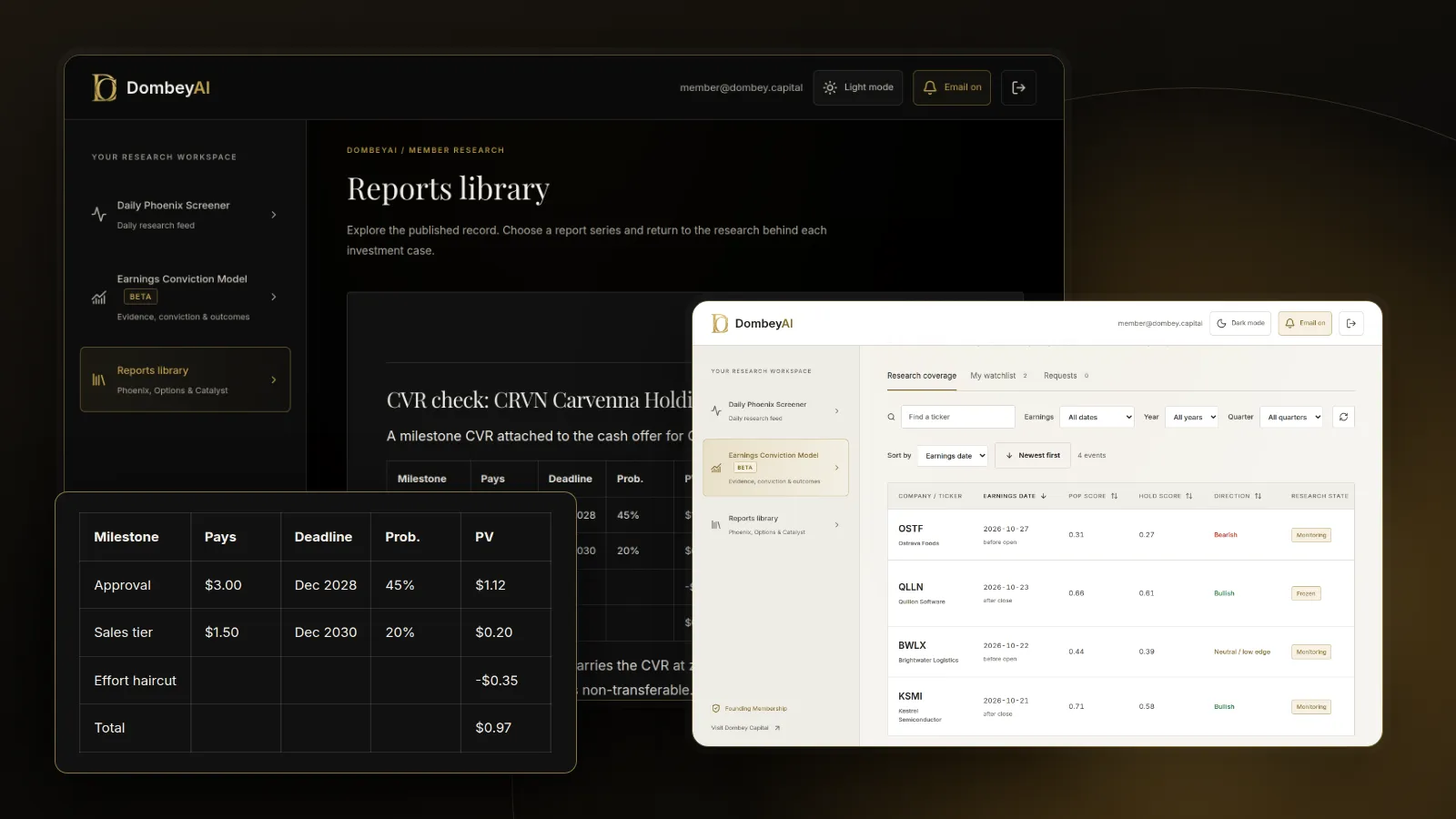
Valuing a CVR: a worked example
The figures below are illustrative. Company A and Company B are hypothetical.
That $1.12 is a starting point, not an answer. Three adjustments usually follow.
- Effort risk. If the agreement only requires the buyer to use efforts it would apply to its own similar products, and the buyer has a competing drug, cut the probability.
- Payment risk. The CVR is an unsecured claim on the buyer. A strong buyer makes this small; a weak or highly indebted one does not.
- Liquidity. A non-transferable CVR cannot be sold, so its value to a holder who needs the cash is lower than the math suggests.
After those haircuts, many investors would put this CVR somewhere well below $1.12, and a conservative base case carries it at zero. The market price of Company A before closing tells you what investors are paying for it. If Company A trades at $20.40, the market is paying about $0.40 for the CVR plus the time and break risk on the cash. The merger arbitrage spread guide shows how to separate those pieces.
Multiple milestones
When a CVR has several milestones, value each one separately and add them up. Later milestones often depend on earlier ones, such as a second approval that only matters after the first, so the probability of the later payment is the product of both steps, not a standalone guess. For approval milestones, the regulator's calendar sets the timing; see how PDUFA dates work.
Transferable and non-transferable CVRs
Whether a CVR can trade changes how you hold it.
A transferable CVR can be bought and sold after closing, on an exchange or over the counter. It is typically registered with the SEC, often on the buyer's registration statement for the deal. A market price gives holders an exit and gives new investors a way to buy the contingent payment directly. Trading is often thin, with wide spreads, and prices can drop sharply on trial data or regulatory news.
A non-transferable CVR cannot be sold except in narrow cases such as inheritance. Holders wait for the outcome. These are common because they are simpler for the buyer, and the only way to get exposure is to own the target shares before closing.
- If the CVR is transferable and listed, check its trading volume and bid-ask spread before treating its price as a fair value.
- If the CVR is non-transferable, value it with a liquidity discount and assume you will hold it to the end.
- If the milestone is a single binary event, size any position as you would an all-or-nothing bet.
- If the buyer has a product that competes with the milestone product, read the effort clause twice.
Where this goes wrong
- Effort clauses with little bite. Many agreements require "commercially reasonable efforts" defined by reference to the buyer's own practices. A buyer that reprioritizes its pipeline can let a milestone slip without breaching the contract.
- Deadlines that pass by weeks. Approvals and sales thresholds that arrive after the deadline usually pay nothing. Regulatory delays are common, and a CVR has no partial credit for being close.
- Milestone wording. An approval for a narrower patient group, a different market or a different dosing schedule may not count. The definition in the CVR agreement controls, not the press release.
- Enforcement limits. Many CVR agreements let only the rights agent, or holders of a stated majority of CVRs, bring a claim. Individual holders may have no direct way to sue, and litigation takes years.
- Buyer changes. The buyer can sell the product line, merge with another company or restructure. Read what the agreement says the new owner must assume.
- Anchoring on the headline. A deal announced as "up to $25 per share" may be $20 in cash and $5 of CVRs that are unlikely to pay. The upfront cash is the only certain part.
How CVRs fit into special situations
A CVR turns part of a takeover price into a dated, binary claim that most former shareholders did not ask for. Index funds and holders who wanted cash often sell transferable CVRs soon after they start trading, and that can push prices below a reasonable estimate of value. The same feature makes CVRs a recurring item in special situations work, alongside other structures where holders receive a piece of paper they did not choose, such as spin-off shares and leftover stub equity.
The work is mostly reading. The CVR agreement, the merger agreement, the proxy or tender documents and the buyer's later filings hold every term that matters, and all of them are on EDGAR. Deal registration filings, where a CVR is offered to target holders, are covered in what an S-4 is. For data sources that list active and expired CVRs, see the best merger arbitrage data sources.
Dombey's published research reads the CVR agreement and effort terms alongside the deal spread for the takeovers it covers; see the research archive.
The bottom line
A CVR is a buyer's promise to pay target shareholders more if a defined event happens after closing, by a deadline. Its value is the payment times the probability of the event, discounted for time, then cut for effort-clause risk, buyer credit and illiquidity. The CVR agreement decides almost everything, from what counts as success to who can enforce payment. Treat the upfront consideration as the deal and the CVR as a separate, uncertain claim that often pays nothing.