

What stub equity means
A company's equity is the residual claim: what is left of enterprise value after debt and other senior claims. Most of the time that residual is large. A stub appears when a transaction moves most of the equity value out to shareholders as cash and replaces it with debt. What remains is the same business, now owned through a much smaller and riskier equity slice.
There are three common ways the term is used:
| Type of stub | How it arises | What the holder owns | Main risk |
|---|---|---|---|
| Leveraged recap stub | Company borrows and pays a special dividend or buys back most shares | Listed common stock with heavy debt ahead of it | Debt service and refinancing |
| Buyout stub (rollover) | Buyer pays cash but lets holders keep a small stake in the new company | Equity in the acquired company, sometimes unlisted | Illiquidity, sponsor control, leverage |
| Parent stub (implied) | Parent owns a listed stake or is spinning off a unit | Not a separate security; an implied value | Mispricing of the stake or spinco |
The first two are real securities with real leverage. The third is an analytical tool. This article focuses on the first two.
How a leveraged recapitalization creates a stub
In a leveraged recapitalization, a public company takes on new debt and uses the proceeds to return capital to shareholders. The cash goes out in one of two ways:
- A special dividend. Every shareholder receives the same cash per share and keeps all their shares. The share price drops by roughly the dividend on the ex-date, and what trades afterward is the stub. For how ex-dates and tax treatment work, see what a special dividend is.
- A large share repurchase. The company buys back a big share of its stock, often through a tender offer. Holders who tender get cash; holders who do not, or whose shares are prorated, keep stub shares. Under SEC Rule 14e-1, a tender offer must stay open at least 20 business days, and at least 10 business days after any change in the price or the percentage of shares sought. See how tender offers work and Dutch auction tenders.
Companies use recaps for a few reasons: to defend against a hostile bid by giving holders value directly, to return cash when a business throws off more than it can reinvest, or to let a controlling owner take money out without selling. The business does not change on the transaction date. Its capital structure does.
The arithmetic of a leveraged stub
The value per stub share is:
Stub value per share = (enterprise value minus net debt after the recap) / shares remaining
The leverage effect follows from that formula. Net debt is fixed in dollars. Enterprise value is not. When net debt is a large share of enterprise value, every dollar change in enterprise value falls entirely on a small equity base.
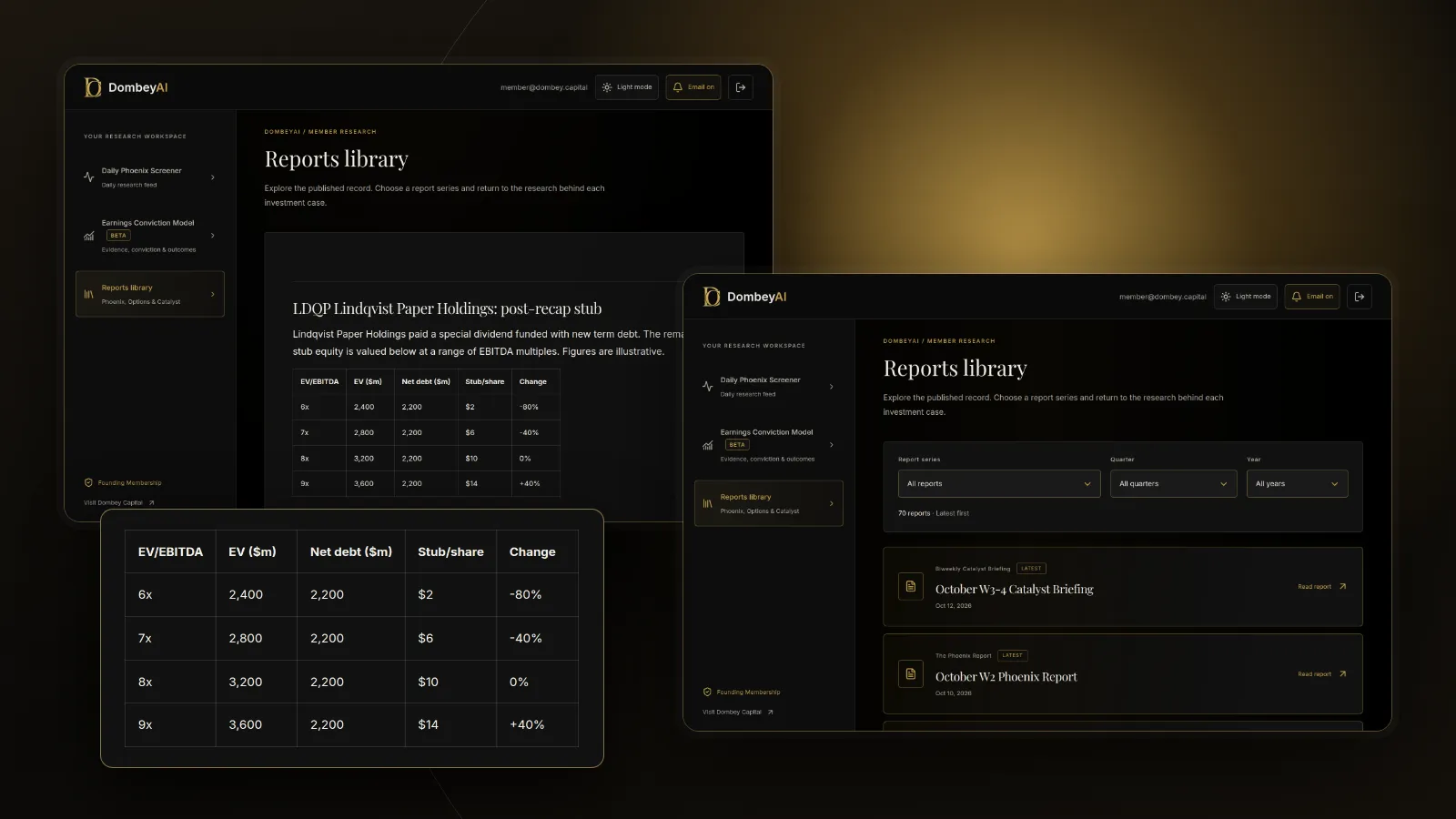
Now change the multiple the market pays for the business and compare the old stock with the stub:
| EV / EBITDA | Enterprise value ($m) | Old equity per share | Stub per share | Stub change from $10 |
|---|---|---|---|---|
| 6x | 2,400 | $22 | $2 | down 80% |
| 7x | 2,800 | $26 | $6 | down 40% |
| 8x | 3,200 | $30 | $10 | unchanged |
| 9x | 3,600 | $34 | $14 | up 40% |
| 10x | 4,000 | $38 | $18 | up 80% |
A one-turn move in the multiple changes the old stock by about 13% and the stub by 40%. At 5.5x EBITDA of the new debt, a fall to 6x leaves the stub almost worthless, and below 5.5x the equity is underwater on paper. That is the trade a stub holder accepts.
Cash flow matters as much as the multiple. If Company A pays 9% on $2.2 billion, interest is about $198 million a year, roughly half of EBITDA. What is left must cover taxes, capital spending and any required amortization before a dollar goes to paying down debt. If the business can do that and reduce debt each year, enterprise value that only holds steady still transfers value to the stub as debt falls. If it cannot, the stub depends on refinancing.
Buyout stubs and rollover equity
Some buyouts offer public holders a choice: take cash, or keep a small equity stake in the company after the buyer takes it over. The stake is usually capped, and elections above the cap are prorated, much like a merger arbitrage cash-and-stock election.
These stubs differ from recap stubs in three ways:
- Listing. The post-deal company may not be listed, so the stub may be hard to sell and may report less information than a public company.
- Control. A sponsor or strategic buyer controls the board, the dividend policy and the timing of any later sale. Minority holders ride along.
- Rules. SEC Rule 13e-3 covers certain purchases, tender offers and proxy solicitations by an issuer or its affiliates in connection with a merger, recapitalization or similar transaction, when the transaction is reasonably likely to cause, or has the purpose of causing, the stock to be delisted or deregistered. When a buyer is an affiliate, such as management or a controlling holder, the parties file a Schedule 13E-3 with added disclosure about fairness. Read it on EDGAR alongside the proxy or offer documents.
A buyout stub is best analyzed as a private equity position you did not negotiate. Read the governing documents for drag-along and tag-along rights, information rights, transfer restrictions and any preferred equity that ranks ahead of the common.
The parent stub: a different use of the word
In spin-offs and holding companies, "stub" often means the market-implied value of what stays behind. If Parent B trades at $50 and each share will receive spinco shares worth $20 on when-issued prices, the parent stub is $30. The same calculation applies to a company that owns a listed stake: price minus the stake's value per share, net of tax and holding company debt.
This stub is not a security and carries no new leverage. It is a way to ask whether the market is paying a sensible price for the remaining business. Spin-off investing and how to analyze a Form 10 show the spin-off version, and holding company discounts covers the stake version. The rest of this article stays with leveraged stubs.
How to value a leveraged stub
Work from the business down to the equity, not from the share price up.
- Rebuild the capital structure after the transaction. List every tranche of new and existing debt, leases, pension deficits, preferred stock and minority interests. Use the pro forma balance sheet in the proxy, offer document or 8-K. The enterprise value build is the right template.
- Forecast cash flow after interest. Use the new interest rate, including any floating-rate exposure. Subtract taxes, capital spending and working capital needs. This is the cash available to reduce debt.
- Map the maturities and covenants. Note when each tranche comes due and what leverage or coverage tests apply. A stub with no maturity for five years has time; one facing a refinancing in 18 months does not. See debt maturity walls.
- Value at a range of multiples. Run the table above for your own case. Stubs are best seen as a distribution, not a point estimate.
- Write the downside first. Assume a lower multiple, lower EBITDA and higher rates at once, and see whether equity survives. The base and worst case guide walks through the method.
- Count the shares that remain. After a tender, the share count is lower. Include new management equity grants, which are common after recaps and dilute the stub.
Where this goes wrong
The business is more cyclical than the debt assumes. Recaps are often done at peak earnings, when lenders are willing. A normal downturn can cut EBITDA by a fifth, and at 5.5x leverage that can wipe out most of the stub.
Rates move against floating-rate debt. Term loans used in recaps often float. Higher base rates raise interest cost without any change in the business.
Refinancing is not available. A stub can be solvent on cash flow and still fail if a maturity arrives when credit markets are closed. Equity holders then face a distressed exchange or a restructuring. See post-bankruptcy equities for what happens to the capital structure afterward.
Liquidity disappears. After a large tender, the float may be small. Index funds may sell, analysts may drop coverage, and spreads widen. A fair value on paper may not be reachable in the market.
Control works against the minority. In a buyout stub, the controlling owner can pay itself fees, add debt for further dividends or time an exit to suit itself. The documents decide what protection minority holders have, and it is often little.
Leverage cuts both ways. The table that shows a 40% gain also shows an 80% loss. Treat the volatility as a feature of the security, not as a signal.
The bottom line
Stub equity is what is left for common shareholders after a company pays out most of its value and replaces it with debt. Its value is enterprise value minus a large, fixed debt load, so it moves several times as much as the old stock in either direction. Value a stub from the business down: rebuild the capital structure, forecast cash after interest, test the maturities and run the downside before the upside. Dombey's published research applies this kind of capital structure check before each dated catalyst; see the research archive. This article is education, not investment advice.