

Why failed listings get mispriced
An IPO is priced for the buyers who want it most. Once the stock falls below the offer, those buyers often become sellers, for reasons that have little to do with the company's value:
- Disappointment. Funds that bought the growth story sell when the first quarter misses, whatever the price.
- Mandates. Growth funds may not hold a company whose growth has slowed. Small-cap funds may sell a stock that has shrunk below their size floor.
- Tax-loss selling. Holders with losses near year end sell to realize them. Our explainer on tax-loss selling covers the timing.
- Supply. Pre-IPO holders become free to sell when lockups end, adding shares just as demand is weakest.
- Neglect. A company that fell 60% may lose analyst coverage, so fewer investors look at it at all.
These are the same forces that make small caps misprice events more often: forced or indifferent sellers and few careful buyers.
Busted IPO, broken business or both
The first task is to separate a bad price from a bad business.
| Signal | Bad price, sound business | Broken business |
|---|---|---|
| Revenue after IPO | Growing, slower than the story | Falling or below prospectus disclosures |
| Cash | IPO proceeds largely intact | Burning quickly, raise likely |
| Margins | Stable or improving | Falling as growth slows |
| Insider behavior | Purchases or holding through lockup | Heavy sales at lockup expiry |
| Guidance | Cut once, then met | Cut repeatedly |
| Balance sheet | Net cash or modest debt | Debt from a pre-IPO buyout |
A stock can fit both columns: a fair business priced well above its value at listing and still above it now. The test is a value estimate built from the filings, not the distance from the offer price.
What to read in the prospectus
The final prospectus is the most detailed document a new public company produces. Our explainer on the S-1 filing covers its structure. For a busted IPO, focus on:
- Use of proceeds. Did the company keep the cash, or did it repay debt or pay selling holders?
- Capitalization and dilution. The share count after the offering, plus options, warrants and restricted stock. See how dilution changes the share count.
- Risk factors and MD&A. The metrics management chose to highlight. Compare them with the first two quarterly reports.
- Principal and selling stockholders. Who owns what, and whether a private equity sponsor still controls the company.
- Underwriting. The lockup length, any early-release triggers and who can waive them.
- Share classes. Dual-class structures limit what outside holders can force. See dual-class share collapses.
The first-year calendar
A busted IPO's first year runs on a predictable sequence of events:
| Timing | Event | What to check |
|---|---|---|
| About 10 days after the offering | Quiet period ends for underwriters' research | Initiations and their targets |
| First quarter after listing | First earnings report and 10-Q | Results against prospectus trends |
| Often 180 days after pricing | Lockup expiration | Size of the unlock, insider Form 144 filings |
| End of first fiscal year | First 10-K | Full-year results, auditor, controls |
| First annual meeting | Proxy statement | Compensation, governance, sponsor plans |
| Year end | Tax-loss selling window | Pressure on holders with losses |
Timings vary, so take the dates from the filings themselves. The lockup expiration is often the most important single date because it can double the shares available to trade.
How busted IPOs resolve
A busted IPO tends to end in one of a few ways:
- Recovery on results. The company meets lowered guidance for several quarters and new holders arrive.
- Take-private. A sponsor or strategic buyer offers a premium to the depressed price. Our guide to going-private transactions covers how those deals work.
- Capital return. A cash-rich company buys back shares below the value of its cash.
- Dilution. A company that needs money raises it at a low price, which locks in losses for current holders.
- Slow decline. The business never meets the prospectus story and the stock drifts.
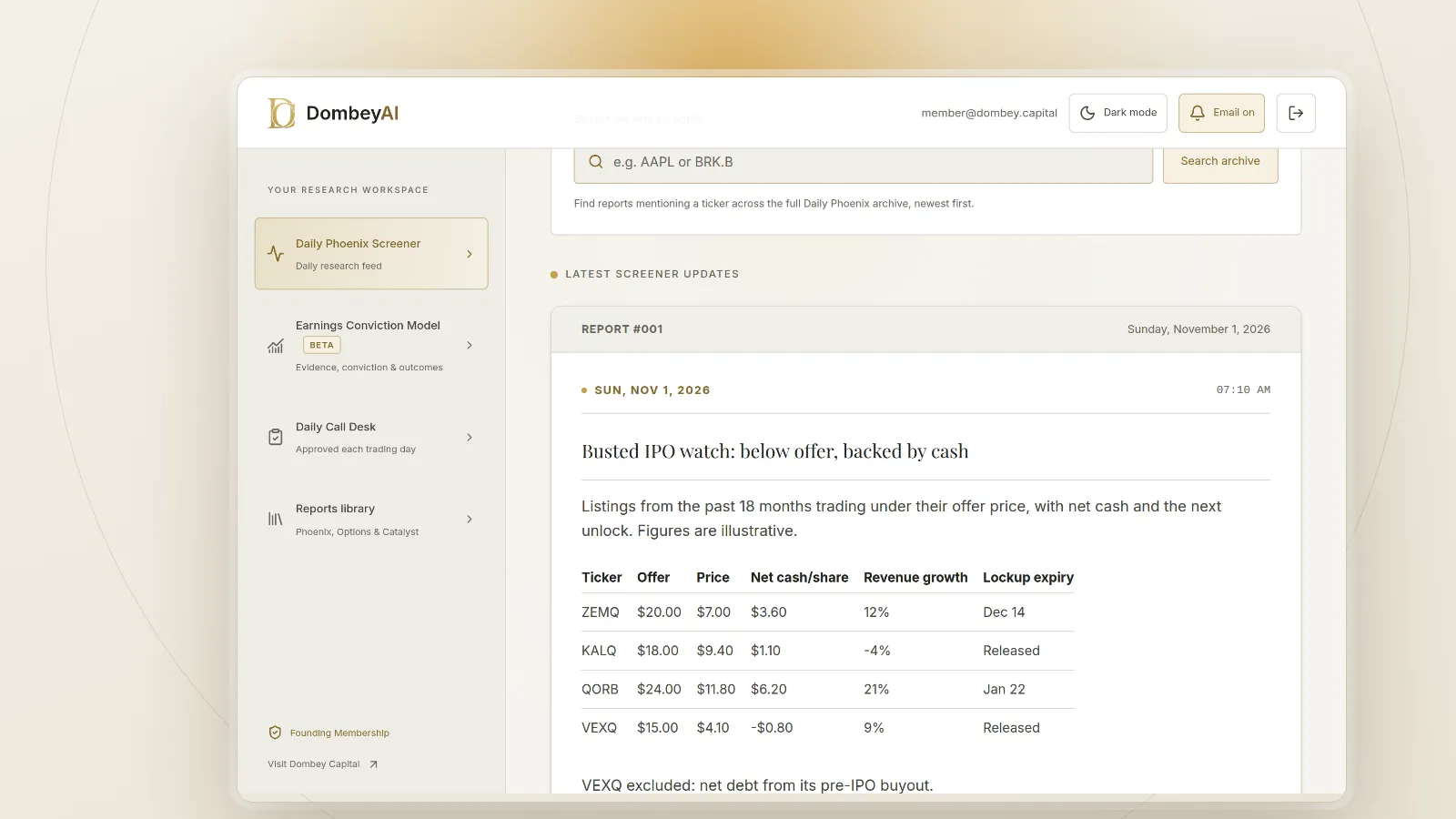
Screening for stocks trading below net cash is one way to find busted IPOs where the downside is backed by the balance sheet. Our list of the best special situations newsletters includes services that follow new listings after they break. Dombey's published research applies this kind of balance sheet test before each catalyst; see the research archive.
Timing an entry around the calendar
The calendar matters as much as the valuation. Buying a few weeks before a large lockup expiry means owning the stock through the period when supply is highest, which can push the price lower even when the business is unchanged. Some investors wait until after the unlock and the first full-year report, accepting a higher price in exchange for a cleaner shareholder base and audited annual numbers.
Liquidity is the other constraint. Many busted IPOs are small and thinly traded once the original funds leave, so wide bid-ask spreads can take a meaningful share of the expected gain. Position size should reflect how long it would take to exit if the thesis breaks. Our guide on how to build a base and worst case shows how to set the downside before deciding on size.
Where this goes wrong
- Anchoring on the offer price. The offer price was set in a different market. It is not a fair value.
- Ignoring the burn. IPO cash that funds losses shrinks every quarter. Value the cash at the date it will run out, not today.
- Underestimating supply. Lockups, sponsor sell-downs and secondary offerings can keep adding shares for a year or more.
- Trusting adjusted metrics. New public companies often lean on adjusted EBITDA and exclude large stock compensation costs.
- Missing control. A sponsor with majority voting power can choose the timing and price of any take-private.
The bottom line
A busted IPO is a stock trading below its offer price, and most stay there for good reasons. The opportunity appears when sellers act on disappointment, mandates, taxes or lockups while the business still supports a higher value. Read the prospectus against the first quarterly reports, value the company from its cash and cash flow, and date the lockup, earnings and tax-loss events that will change who owns the shares.