

How an Up-C and a TRA fit together
In an Up-C IPO, the listed company is a holding company. Its main asset is an interest in an operating partnership or LLC that owns the business.
- Pre-IPO owners keep units in the operating partnership, plus voting shares in the public company.
- Public investors buy Class A shares of the holding company.
- Over time, pre-IPO owners exchange their partnership units for Class A shares, usually one for one.
- When the holding company acquires units in an exchange, an election under Section 754 of the tax code lets it step up the tax basis of its share of the partnership's assets to reflect the exchange value.
- The higher basis produces larger depreciation and amortization deductions, which lower the holding company's taxes for years.
- Under the TRA, the holding company pays the exchanging owners the agreed share of the taxes it saves, commonly 85%.
TRAs also appear outside the Up-C, for example where a company has net operating losses or other tax attributes from before its IPO, often in sponsor-backed listings or companies emerging from restructuring. The question is the same: who gets the value of the tax asset?
What the numbers look like
| Item | Annual amount | Over 15 years, undiscounted |
|---|---|---|
| Extra tax deductions | $26.7m | $400m |
| Cash tax saved at 25% | $6.7m | $100m |
| Paid to pre-IPO owners (85%) | $5.7m | $85m |
| Kept by the public company (15%) | $1.0m | $15m |
An investor who credits Company A with the full $100m of savings overstates the value by $85m before discounting.
Where it shows up in the filings
- S-1 or prospectus. The structure, the percentage and the acceleration terms are described in the risk factors and a section on the organizational structure. The agreement itself is filed as an exhibit. Our explainer on the S-1 shows where to look.
- Balance sheet. A liability, often called "liabilities under tax receivable agreement," split into current and non-current portions.
- Footnotes. The income tax and related party notes report payments made, the liability recorded and, in many filings, an estimate of the payment if the TRA were terminated today. Our guide on reading the footnotes in a 10-K covers both notes.
- Cash flow statement. TRA payments usually appear in financing or operating activities, depending on the company.
Terms to check in the agreement
TRAs share a common shape, but the details decide how much they cost public holders. These are the terms worth finding in the exhibit:
| Term | What it says | Why it matters |
|---|---|---|
| Payment percentage | Share of realized savings paid out, often 85% | Sets how much of each tax dollar leaves the company |
| Covered tax assets | Basis step-ups, pre-IPO losses, imputed interest | Wider coverage means larger payments |
| "Realized" savings test | How savings are measured, usually with and without the covered assets | Determines when a payment is owed |
| Payment timing | Annual, after the tax return is filed | Payments lag the savings by a year or more |
| Interest | Rate charged on deferred or late payments | Adds to the cost if payments are delayed |
| Early termination | Company's right to end the TRA and the formula for the lump sum | Sets the price of removing the overhang |
| Change of control | Whether a sale triggers acceleration | Can reduce what a buyer pays shareholders |
| Discount rate for acceleration | The rate used to compute present value | A lower rate means a larger lump sum |
Acceleration: the part that matters most in a sale
Many TRAs accelerate on a change of control, a material breach or an early termination by the company. The company then owes the present value of all expected future payments in one lump sum, usually calculated under assumptions that favor the TRA holders:
- that the company will have enough taxable income to use every deduction,
- that all remaining units are exchanged at the current share price,
- and a discount rate set in the agreement, sometimes based on a benchmark rate plus a spread.
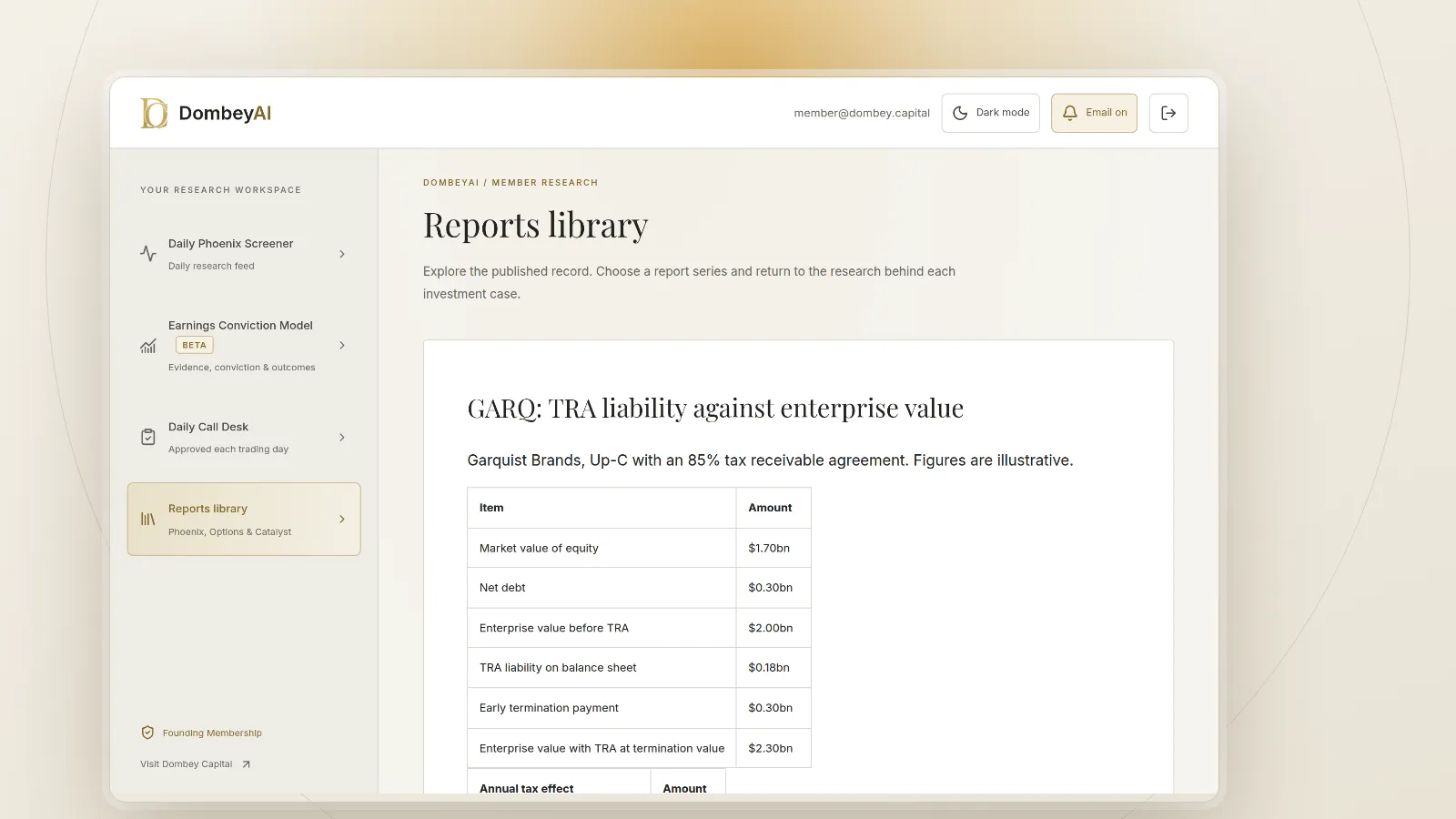
For a buyer, that lump sum is effectively debt. If an acquirer values the business at $2.0bn and the TRA accelerates for $300m, there is $300m less for the shareholders. Treat the acceleration amount as part of enterprise value when you value the stock for a sale.
Why it matters for special situations
TRAs show up in several event-driven setups:
- Take-privates and mergers. Acceleration terms can make a sale more expensive, or give TRA holders a reason to negotiate. Our explainer on going-private transactions covers how insiders sit on both sides.
- Structure simplifications. Companies sometimes collapse the Up-C or buy out the TRA, which can remove an overhang. The logic is similar to a dual-class share collapse.
- Distress. A struggling company with little taxable income may owe little under a TRA in practice, but acceleration on a restructuring can still matter.
- Hidden liabilities. Analysts who skip the footnotes miss it, much like other off-balance-sheet liabilities, even though this one sits on the balance sheet.
Dombey's published research adjusts for TRA liabilities when valuing Up-C companies; see the research archive. For other sources that cover these structures, see the best investing newsletters for special situations.
How to value a company with a TRA
- If you value the company on earnings, use the reported tax rate but subtract the expected TRA payments, since the savings mostly leave the company.
- If you value it on enterprise value, add the present value of expected TRA payments to debt.
- If a sale is likely, use the acceleration amount from the footnotes rather than the recorded liability.
- If the company has little taxable income, the payments may be small for years, but check whether a sale or termination would still trigger the full amount.
Where this goes wrong
- Counting tax savings twice. Reported cash flow benefits from the step-up, but most of it is paid out under the TRA.
- Ignoring acceleration. The headline liability can be much smaller than the payment due on a sale.
- Missing future exchanges. Each new exchange of units creates new TRA obligations; the liability grows as insiders convert.
- Overlooking the conflict. Insiders who hold TRA rights may favor deals, timing or structures that maximize their payments.
- Assuming it never matters. A TRA can be small relative to market value in good times and decisive in a sale or a downturn.
The bottom line
A tax receivable agreement gives a company's pre-IPO owners most of certain tax savings, commonly 85%, leaving public holders the rest. It usually comes with an Up-C structure, where exchanges create the tax assets. Treat expected payments like debt, read the footnotes for the acceleration amount, and check how a sale would trigger it. A company that looks cheap on reported cash flow can look very different once the TRA is counted.