

How a mutual insurer works
In a mutual insurer, policyholders are the members. They elect the board and have a claim on the company's surplus, the capital that remains after reserves for future claims. A mutual cannot raise equity by selling shares, so it grows through retained earnings and, at times, surplus notes.
Many mutual life insurers sell participating policies, which pay dividends to policyholders out of the company's results. Those dividends are not promised, but policyholders expect them to continue on a consistent basis.
Why mutuals convert
- Access to capital. A stock company can issue shares to fund growth, acquisitions or a stronger balance sheet.
- Acquisition currency. Shares can be used to pay for other businesses.
- Management incentives. Stock compensation can align management with shareholders.
- Policyholder value. Converting turns a hard-to-value membership interest into tradable shares or cash.
The conversion process
The rules come from the insurance law of the state where the company is domiciled, so details vary. The common steps are:
| Step | What happens | What to read |
|---|---|---|
| Plan of conversion | The board adopts a plan setting out eligibility, compensation and the closed block | Plan filed with the regulator |
| Actuarial and fairness opinions | Independent actuaries and advisers assess allocation and the closed block | Exhibits to the plan |
| Regulatory review and hearing | The state insurance regulator reviews the plan, usually after a public hearing | Regulator's order |
| Policyholder vote | Eligible policyholders vote on the plan | Policyholder information statement |
| IPO and registration | The company registers shares with the SEC, often on Form S-1 | S-1 and prospectus on EDGAR |
| Distribution | Policyholders receive shares, cash or credits; the stock begins trading | Prospectus, 8-K |
How compensation is allocated
Plans usually give each eligible policyholder a fixed number of shares for being a member, plus a variable number based on how much the policy contributed to the surplus. Policyholders who prefer cash, or who live where share distribution is impractical, may receive cash or policy credits instead. Many plans also allow small holders to sell their shares cheaply through a commission-free program soon after the IPO.
The closed block
Participating policyholders have an expectation of continuing dividends. To protect it, conversion plans usually set up a closed block: a segregated pool of assets and policy liabilities expected to be enough to keep paying dividends at the existing scale, if experience is as assumed.
The closed block matters to shareholders for two reasons. Its assets are not available to them while the block runs off, and its results are reported separately. Read the closed block footnote in the 10-K to see how large it is and how its earnings emerge over time.
The mutual holding company alternative
Some insurers convert partway. The mutual becomes a mutual holding company owned by policyholders, and the insurance operations move into a stock subsidiary. The holding company must retain a majority of the voting stock, so public investors can only buy a minority. Policyholders keep their membership rights in the holding company rather than receiving compensation.
The same structure is common in savings banks, covered in our explainer on mutual bank conversions. For investors, a minority stake in a company controlled by a mutual holding company offers less influence and usually trades at a lower valuation, but a later second-step conversion can release that discount.
Why converted insurers can be mispriced
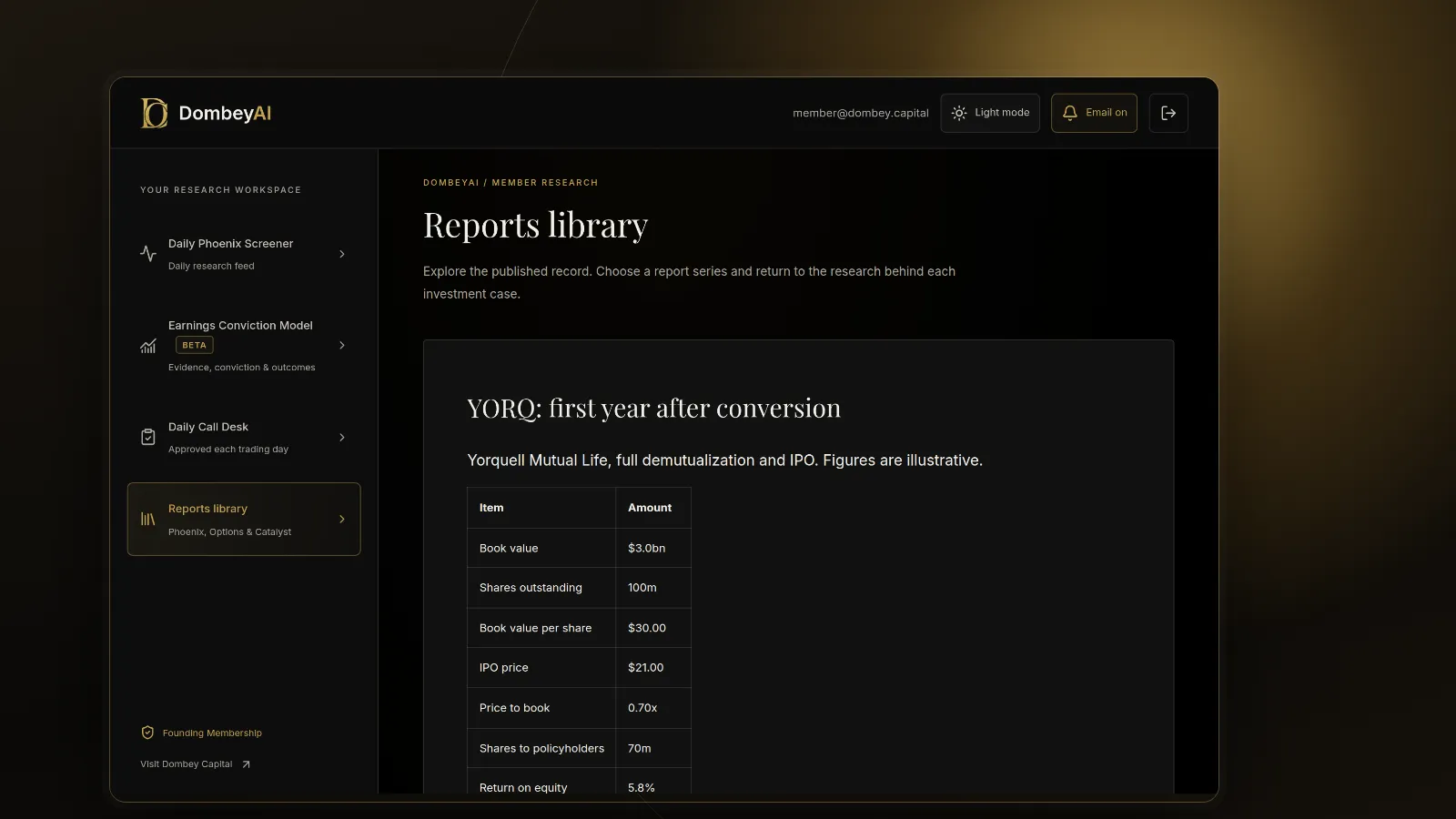
| Item | Amount |
|---|---|
| Book value after the IPO | $3.0bn |
| Shares outstanding | 100m |
| Book value per share | $30.00 |
| IPO price | $21.00 |
| Price to book | 0.70x |
| Shares distributed to policyholders | 70m |
| Policyholders holding under 100 shares | Most eligible members |
Several forces can hold the price below book. Policyholders with small allocations sell. There is no trading history and little research coverage at first. The company may earn a low return on equity because a mutual focused on safety, not profitability. And the IPO is often priced to clear a large offering.
The opportunity, when there is one, comes from what happens next: expense cuts, capital returned through buybacks or dividends, or a sale of the company once any post-conversion restrictions lapse. Buybacks below book value raise book value per share, a mechanism covered in our explainer on price to book. Our list of the best investing newsletters for special situations includes sources that follow conversions as they come to market.
What investors check
- Return on equity against peers. A gap is the room for improvement.
- Excess capital. Compare capital with the regulatory requirement and the company's own target. Capital above the target can fund buybacks.
- Closed block size and run-off. A large block ties up assets and limits flexibility.
- Post-IPO selling. Large policyholder distributions mean steady supply until the register settles.
- Ownership limits. Some states restrict acquisitions of a converted insurer for a period, which delays a sale.
Our guide to finding investment ideas covers how to track IPO filings and conversion plans as they appear.
A timeline for following a conversion
A conversion produces a series of public documents and dates, each a chance to update the estimate of value.
| Stage | Event | What to check |
|---|---|---|
| Announcement | Board adopts the plan of conversion | Form of compensation, closed block, any mutual holding company step |
| Public hearing | State regulator hears comments | Objections from policyholders or consumer groups |
| Registration | S-1 filed with the SEC | Book value, capital, expense ratio, use of proceeds |
| Vote and approval | Policyholders vote; regulator issues its order | Turnout and margin |
| Pricing and first trade | IPO priced; shares distributed | Price to book, size of the policyholder distribution |
| First annual report | 10-K under public ownership | Return on equity, buyback authorization, capital targets |
The first year as a public company is often the most useful period to watch. Selling by policyholders tends to come early, while management's first capital decisions, such as an initial buyback or dividend, show how it intends to run the company for shareholders.
Where this goes wrong
- Cheap for a reason. A low price to book can reflect a weak book of business, such as products with guarantees that are costly when interest rates move.
- Slow change. Mutual cultures do not change overnight. Expense cuts and capital returns can take years.
- Interest rate exposure. Life insurers carry long-dated liabilities. Rate moves can change book value and earnings more than any conversion effect.
- Minority structures. In a mutual holding company, public shareholders cannot force change, and the holding company may never complete a second step.
- Accounting complexity. Insurance accounting, reserves and the closed block make book value harder to judge than in most industries.
The bottom line
A demutualization converts a policyholder-owned insurer into a stock company, with policyholders compensated in shares, cash or credits and participating policies protected by a closed block. Converted insurers can start public life cheap, with forced selling, no history and thin coverage, which makes them a recurring special situation. The opportunity depends on what management does with excess capital and returns afterward. Dombey's published special situations theses are in the research archive.