

How a squeeze-out works
A controlling holder that already owns a majority, or effective control, wants to own 100%. It offers to buy the shares it does not own. If the deal is approved, every remaining share is converted into the right to receive the merger price.
There are three main routes in Delaware, where many US companies are incorporated:
| Route | Ownership needed | Vote needed | Main protection for the minority |
|---|---|---|---|
| Short-form merger (Section 253) | At least 90% of each class | None from the subsidiary's board or holders | Appraisal rights |
| Long-form merger (Section 251) | Control, below 90% | Board approval and a shareholder vote | Special committee, majority-of-the-minority vote, appraisal |
| Tender offer, then merger | Enough tendered to reach control or 90% | Depends on structure | Tender offer rules, appraisal, committee review |
Other states and countries have their own thresholds. The UK Companies Act 2006, for example, lets a bidder that acquires 90% of the shares to which its offer relates compulsorily buy the rest.
Why the controller's position matters
In an ordinary merger, the buyer and the seller's board are on opposite sides. In a squeeze-out, the controller is the buyer and also has influence over the board that is supposed to protect the seller. That conflict is the reason for the extra rules.
Delaware courts review a controller buyout under entire fairness, the strictest standard, unless the deal follows the framework from Kahn v. M&F Worldwide (2014), known as MFW. Under MFW, the controller conditions the deal from the start on two protections:
- An independent special committee with the power to hire its own advisers, negotiate the price and say no.
- A majority-of-the-minority vote, informed and uncoerced, so the holders being bought out approve it themselves.
When both are in place from the start and work as intended, courts apply the more deferential business judgment review. In 2025 Delaware also amended its statute to add safe harbors for controller transactions, and a going-private deal still needs both a committee and a disinterested holder vote to use them. Read the proxy to see which protections a deal actually includes.
The SEC side: Rule 13e-3
When an issuer or its affiliate takes a public company private, SEC Rule 13e-3 requires a Schedule 13E-3. The filing must describe the purpose of the deal, the alternatives considered, the filer's belief about whether the deal is fair to unaffiliated holders, and any reports, opinions or appraisals it relied on. Banker presentations to the committee are often attached as exhibits.
For a minority holder, the 13E-3 and the proxy statement are the most useful documents in the deal. Our guide on how to read a proxy statement covers where the background section, fairness opinions and projections sit. The broader process is covered in our explainer on going-private transactions.
A typical timeline
Each deal differs, but a long-form controller buyout often follows this path. The dates come from the filings, not a fixed rule.
| Stage | Event | What to check |
|---|---|---|
| Day 0 | Controller sends an offer letter, often filed as a 13D amendment | Price, conditions, whether a minority vote is promised |
| Weeks 1 to 2 | Board forms a special committee | Who sits on it, its powers, its advisers |
| Months 1 to 3 | Committee negotiates | Counteroffers, any price increase, a signed merger agreement |
| After signing | Preliminary proxy and Schedule 13E-3 filed | Background of the deal, projections, fairness opinions |
| About a month after the definitive proxy | Shareholder meeting and vote | Majority-of-the-minority result, appraisal demands |
| Days after the vote | Closing | Payment date, appraisal filing deadline |
Watch the controller's 13D amendments throughout. They often disclose the first offer, changes to it and any agreements with other holders, sometimes before the company says anything.
What minority holders can do
A minority holder has four options, and none of them is "keep the shares."
- Accept the price. Sell in the market before closing or receive the merger consideration at closing.
- Vote no. In a long-form merger with a majority-of-the-minority condition, the minority vote can block the deal.
- Seek appraisal. Holders who do not vote for the deal and follow the procedure can ask the court to set fair value. Our explainer on appraisal rights covers the steps and the risks.
- Join litigation. Shareholders sometimes sue over price or process. Outcomes vary and take time.
A worked example
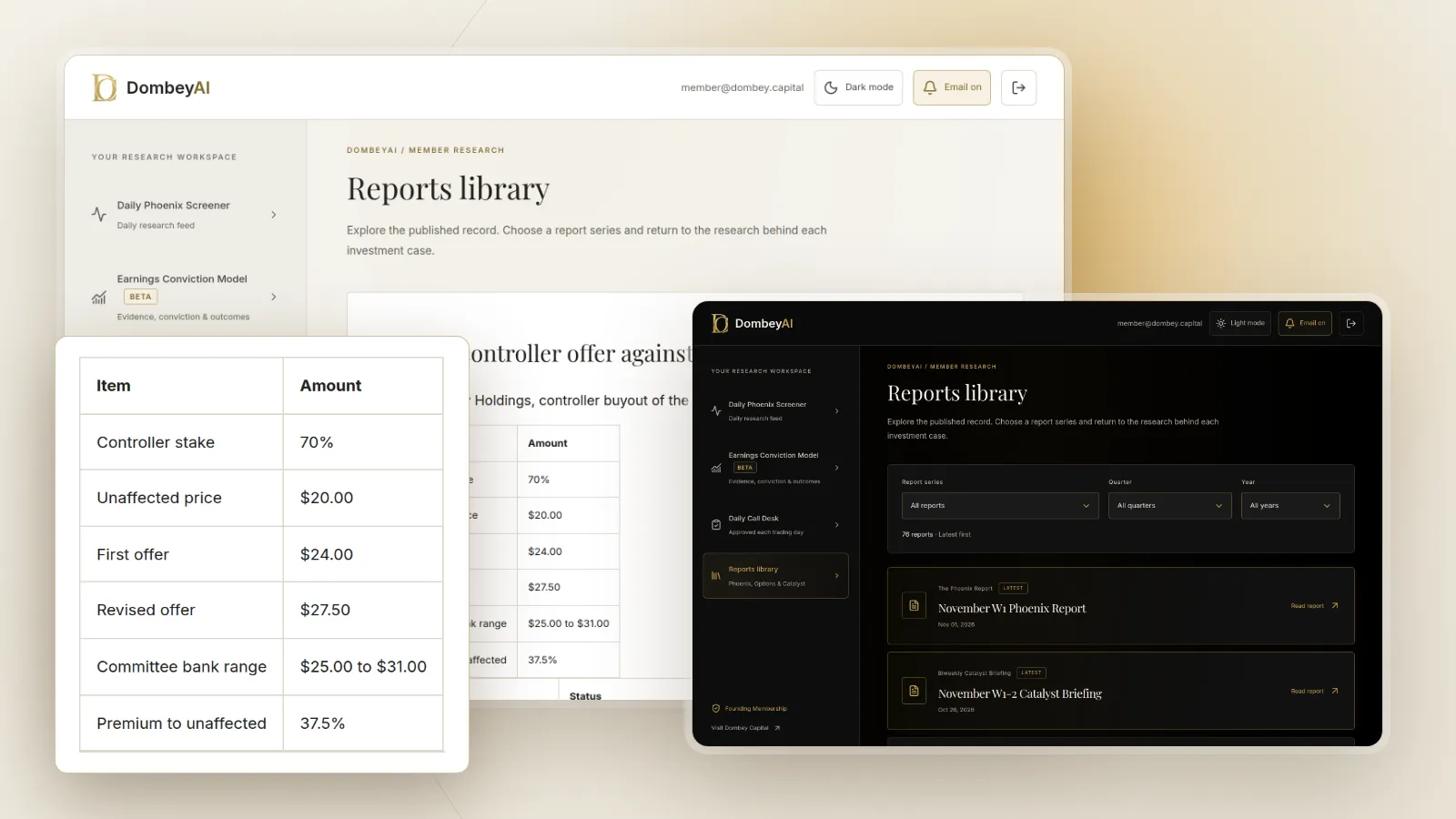
What a holder would check in that case:
| Question | Where to look | What it told the holder |
|---|---|---|
| Is the price inside the valuation range? | Fairness opinion summary in the proxy | $27.50 sits in the lower half of $25 to $31 |
| Did the committee negotiate? | Background of the merger section | Two counteroffers, one price increase |
| Is the minority vote a real condition? | Merger agreement conditions | Yes, from the first offer |
| Is appraisal available? | Proxy, notice of appraisal rights | Yes, with a filing deadline |
| What do projections assume? | Projections section | Revenue growth above recent history |
The takeover premium alone does not answer whether the price is fair. A 20% premium over a depressed price can still be below fair value, which is the core idea behind a take-under.
Why squeeze-outs can be special situations
Several features make squeeze-outs interesting for event-driven investors:
- Controllers often raise offers. The first offer opens a negotiation with the committee, and an improved price is common, though never certain.
- The deal rarely fails for financing or regulation. The buyer already controls the company, so antitrust review is usually simple and financing is often committed.
- Timing is public. The committee process, proxy, vote and closing follow a visible path in the filings.
- The controller has information. It knows the business better than any outside holder, which cuts both ways: it suggests value, and it means the controller will not overpay.
Dombey's published research covers controller buyouts as part of its special situations work; see the research archive. For other services that cover these deals, see our list of the best investing newsletters for special situations.
Where this goes wrong
- Timing your entry on a bump that never comes. Some controllers hold firm, and some withdraw the offer, which can send the stock back below the pre-offer price.
- Treating appraisal as free money. Appraisal takes time, ties up capital and can return less than the deal price.
- Ignoring the "majority of the minority" math. If the controller's allies or index funds dominate the unaffiliated shares, the vote may be easier to win than it looks.
- Relying on management projections. Projections in a squeeze-out may be conservative, because a lower forecast supports a lower price.
- Assuming the process is independent. Read who sits on the committee, how they were chosen and whether they had the power to say no.
- Missing a tender offer structure. In a two-step deal, the tender offer timeline runs faster than a proxy vote.
The bottom line
A squeeze-out merger lets a controlling holder buy out the minority, who must take the price or seek appraisal. Because the buyer sits on both sides, the protections that matter are an empowered independent committee, a real majority-of-the-minority vote and full disclosure in the proxy and Schedule 13E-3. Judge the price against a fair value range rather than the premium alone. The best opportunities come where the process can push the price up and the downside, if the offer is withdrawn, is limited.