

How a 363 sale works
Section 363(b) allows a debtor to use, sell or lease property of the estate outside the ordinary course of business after notice and a hearing. Courts approve such a sale when the debtor shows a sound business reason, the price is fair, and the process was run in good faith.
Three other parts of section 363 make the sale attractive to buyers:
- 363(f), free and clear. The court can approve a sale free and clear of liens and other interests. The lenders' liens attach to the cash proceeds instead of the assets.
- 363(k), credit bidding. A secured lender can bid the amount of its claim instead of cash.
- 363(m), good-faith protection. If the buyer acted in good faith, a later reversal of the sale order on appeal does not undo the sale unless the order was stayed.
Our explainer on what happens to stock in Chapter 11 covers the wider process that a 363 sale sits inside.
The stages of a sale
| Stage | What happens | Where to find it |
|---|---|---|
| Stalking horse agreement | A first bidder signs an asset purchase agreement that sets a floor price | First day filings, an 8-K, the sale motion |
| Bidding procedures motion | The debtor asks the court to approve the auction rules, deadlines and bid protections | Court docket |
| Bidding procedures order | The court sets the bid deadline, auction date and sale hearing | Court docket, claims agent website |
| Bid deadline and auction | Qualified bidders submit offers; an auction is held if there is more than one | Notice of auction results on the docket |
| Sale hearing | Objections are heard; the court decides whether to approve the sale | Sale order on the docket |
| Closing | Assets transfer; proceeds are held for distribution under a plan | 8-K, notice of closing |
The stalking horse
A stalking horse bidder does the diligence first and signs a binding agreement. In return, the bidding procedures usually give it protections: a break-up fee and expense reimbursement if another bidder wins. These protections must be approved by the court, and objectors often argue about their size. A high break-up fee can discourage competing bids because a rival must beat the stalking horse price plus the fee plus any minimum overbid.
The auction
If qualified bids arrive by the deadline, the debtor runs an auction, usually at its lawyers' offices or online. The winner is the "highest or otherwise best" bid, which may not be the highest headline price if another bid carries less closing risk or assumes more liabilities. A backup bidder is often named in case the winner fails to close.
Credit bidding and why lenders often win
A secured lender owed $400 million can bid up to $400 million of its claim without paying cash. An outside bidder must beat that number in real money. When the business is worth less than the secured debt, the lender often ends up owning it.
Courts can limit credit bidding "for cause", and objections sometimes argue that credit bidding chills an auction. But in most cases where the lender's lien is valid, the credit bid is the price the market has to beat.
A worked example
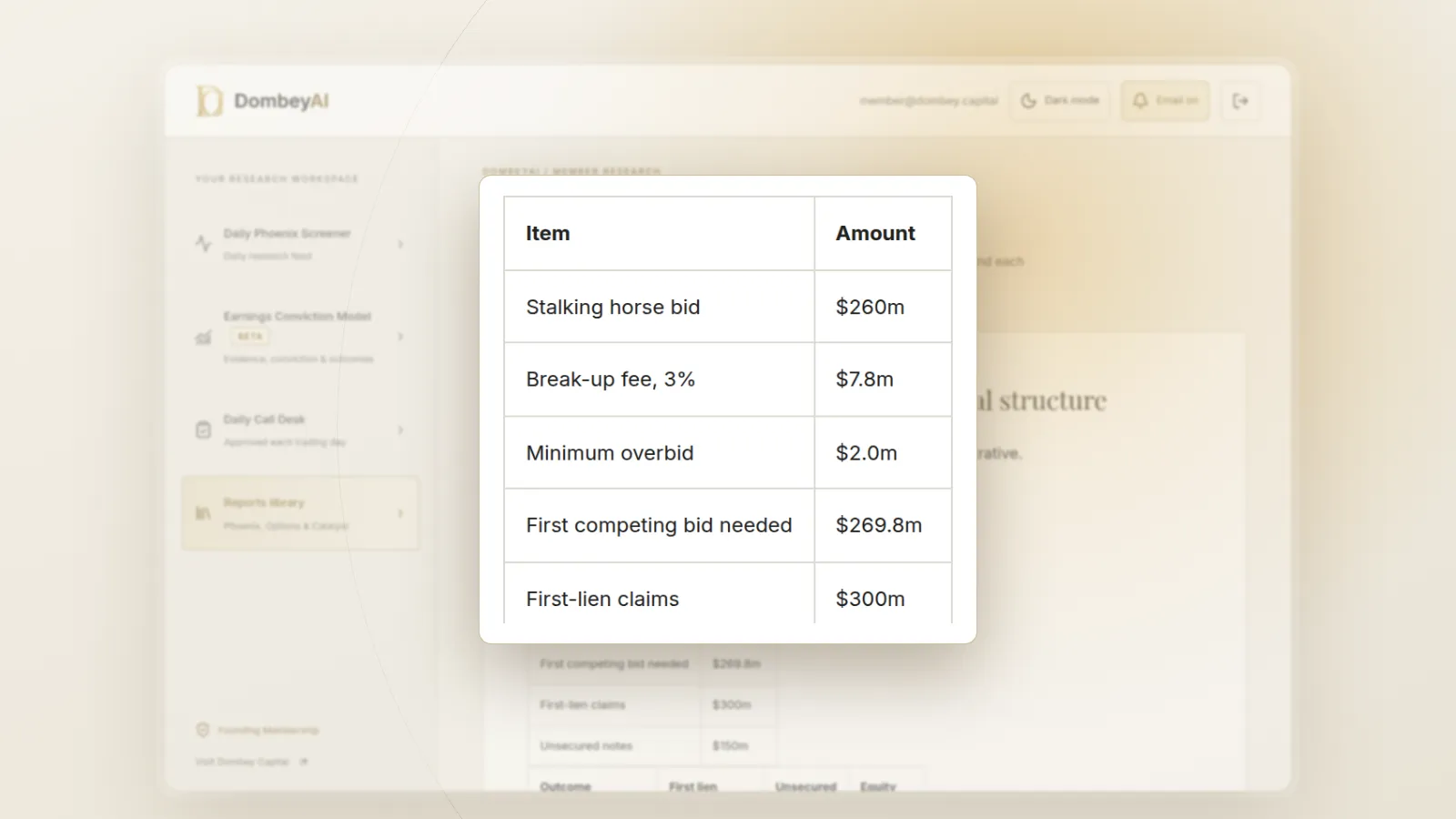
Before filing, Company A signs a stalking horse agreement with Buyer X for $260m in cash, with a 3% break-up fee and a $2m minimum overbid. The first-lien lenders support the sale but reserve the right to credit bid.
| Outcome | Sale price | First lien ($300m) | Unsecured ($150m) | Equity |
|---|---|---|---|---|
| Stalking horse wins | $260m | Recovers about 87% (before fees and costs) | Little or nothing | Nothing |
| Competing bid wins at auction | $320m | Paid in full | About $20m, or 13%, before fees | Nothing |
| Lenders credit bid $300m | $300m in debt | Own the business | Nothing from the sale | Nothing |
To top the stalking horse, a rival must offer at least $260m plus the $7.8m break-up fee plus the $2m overbid, about $270m. Even the best case here leaves nothing for shareholders, because unsecured creditors are not paid in full. That is the usual pattern, and it is why equity in a company that files with a stalking horse below its debt tends to trade like an option on a much higher bid.
What investors watch
- The price against the capital structure. Line up the stalking horse price against secured debt, administrative claims and unsecured claims. Our guide to debt-for-equity swaps shows how the same waterfall works in a reorganization.
- Bid protections and overbid size. They set the minimum competing bid.
- Who is objecting. The unsecured creditors' committee often objects to a quick sale, a low price or a credit bid. A strong objection can delay the sale or lead to a settlement that pays unsecured creditors something.
- What is excluded. Cash, litigation claims, tax attributes and some contracts may stay with the estate and fund recoveries later.
- Assumed liabilities. A buyer that assumes contracts, leases or payables may be offering more value than its headline price suggests.
Sale vs plan of reorganization
| 363 sale | Plan of reorganization | |
|---|---|---|
| Speed | Faster; can close before a plan | Slower; requires a disclosure statement, a vote and confirmation |
| Creditor vote | No vote; court approval after notice and objections | Impaired classes vote |
| Value test | Market test through the auction | Valuation evidence, often contested |
| Typical buyer | Strategic buyer, private equity, or the secured lenders | Existing creditors take the new equity |
| What follows | A liquidating plan distributes the proceeds | The reorganized company emerges |
Many cases combine the two: assets are sold under section 363 and a liquidating plan then distributes the cash. Our list of bankruptcy and restructuring research sources covers where to follow dockets and claims trading.
Where this goes wrong
- Sub rosa plans. Courts reject sales that dictate how proceeds are distributed or that strip creditors of plan rights without a vote. A sale that looks like a plan in disguise can be blocked.
- Insider buyers. When the buyer is the old management or a sponsor, courts look harder at whether the process was fair and the marketing was real.
- Thin markets. A quick sale with one bidder may be a market test in name only. The price can be low because the timetable left no room for others.
- Closing risk. Financing, regulatory approvals or a CFIUS review can delay or sink a closing after the auction.
- Reading the stock as a bet on the auction. Shares often trade on the hope of a bidding war. In most cases the bids do not reach the level where equity is paid.
The bottom line
A Section 363 sale lets a bankrupt company sell assets free of liens, under court supervision, often well before a plan is confirmed. A stalking horse sets the floor, an auction tests it, and credit bidding often hands the business to the secured lenders. For investors, the sale price against the capital structure is the number that matters, and it usually decides that the old equity receives nothing. For more special situations research sources, see our list of the best investing newsletters for special situations; Dombey's own published theses are in the research archive.