

Why contract awards can move a stock
Government contracts can last years, often with option periods that extend them further. A win can add a steady stream of revenue and backlog; a loss can remove a company's largest program. For a small contractor, a single award can be worth more than a year of current revenue.
The market reaction depends on surprise. Incumbents that win recompetes usually see little movement because the win was expected. A first-time win, a takeaway from an incumbent or an unexpected loss is where the price tends to adjust. Our explainer on hard and soft catalysts explains why a dated, binary decision like an award is easier to research than a vague expectation.
Read the headline carefully
| Term | What it means | Why it matters |
|---|---|---|
| Ceiling value | The maximum the government could spend over the contract's life | Often far above what will be spent |
| Funded or obligated amount | Money actually committed so far | The near-term revenue |
| Base period | The committed initial term | Revenue the company can count on |
| Option periods | Extensions the government may exercise | At the government's discretion |
| IDIQ | Terms and ceiling with orders placed later | Revenue arrives through task orders |
| Multiple award | Several companies named on one vehicle | Each must still win orders |
| Single award | One company receives the contract | Higher certainty of revenue |
Our piece on the book-to-bill ratio shows how awards flow into backlog and how to judge whether backlog is growing faster than revenue.
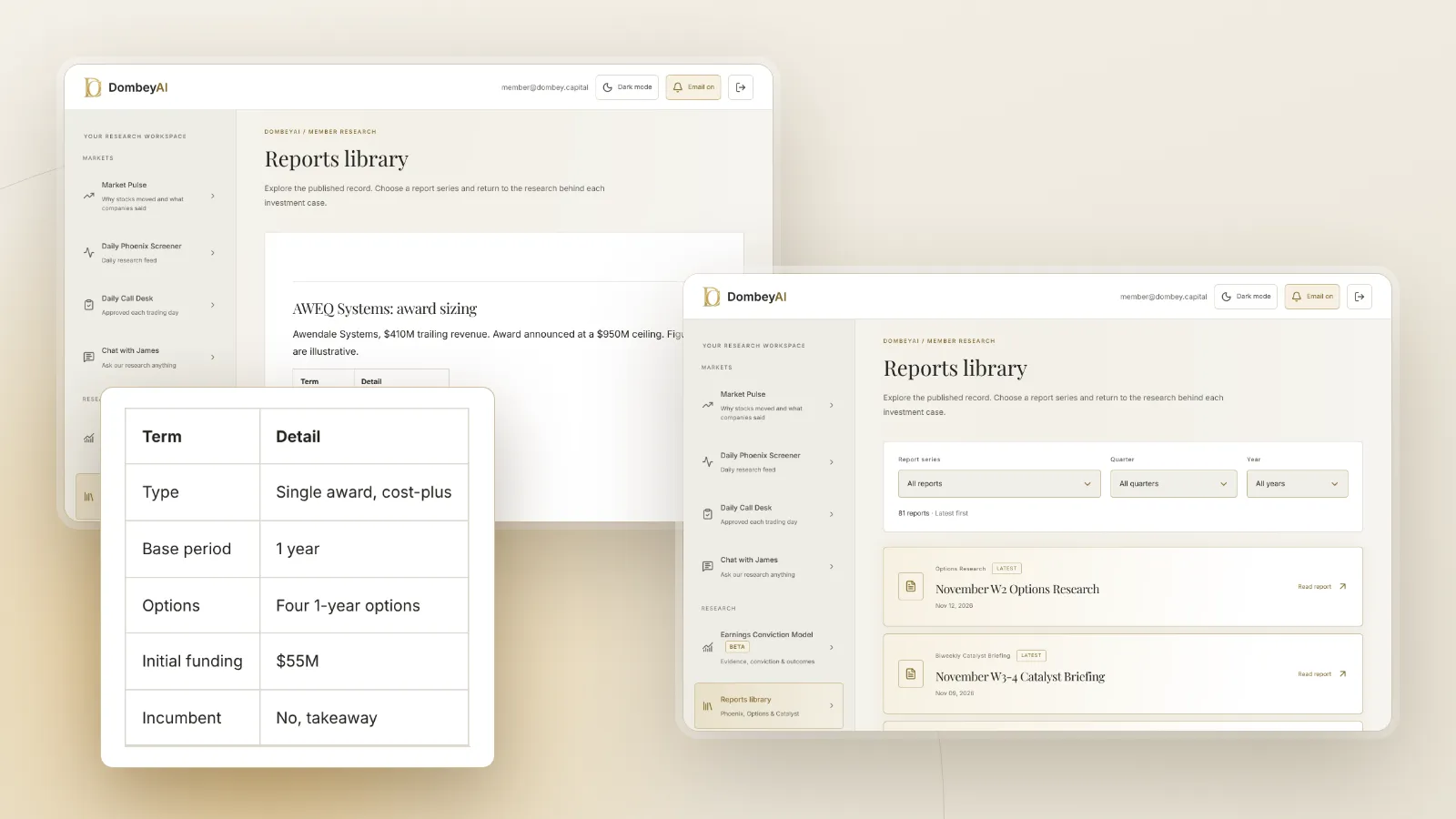
A worked example
The same headline would be close to irrelevant for a contractor with $20 billion of revenue, and transformational for one with $60 million.
Protests, budgets and timing
Bid protests. Losing bidders can protest to the Government Accountability Office or the Court of Federal Claims. The GAO must decide a protest within 100 days. A protest filed promptly after award or debriefing usually suspends performance while it is decided. If the GAO sustains the protest, the agency may re-evaluate proposals, and the award can move to another bidder. Large awards with several bidders are protested often.
Budget timing. Federal fiscal years start on October 1. When Congress has not passed full-year appropriations, agencies operate under continuing resolutions at prior-year levels, which generally block new program starts. A contract tied to a new start may wait months for funding.
Option exercises. Options are exercised at the government's discretion. Watch for exercise notices and for any sign that an agency is planning a recompete instead.
| Stage | Event | What to check |
|---|---|---|
| Before award | Solicitation and proposal deadline | Incumbent, number of bidders, contract type |
| Award day | Announcement and company release | Funded value, ceiling, base and option periods |
| First 10 days | Debriefings and protest window | Whether a losing bidder files |
| Up to 100 days | GAO decision on any protest | Sustained or denied; corrective action |
| Fiscal year start | Appropriations or continuing resolution | Whether funding allows the work to start |
| Each option date | Option exercise | Continued funding and any recompete plans |
Our guide on how to build a catalyst calendar shows how to keep dates like these in one place.
A quick sizing checklist
Before reacting to an award, five numbers answer most of the question:
- Annual run rate. Divide the realistic value, not the ceiling, by the years of performance including options.
- Share of revenue. Compare the run rate with trailing revenue. Below about 5% it rarely changes the story; above 20% it usually does.
- Margin. Estimate operating margin from the contract type and the company's segment margins. Fixed-price development work carries more risk than cost-plus services.
- Incremental or replacement. A recompete win keeps existing revenue; only new work adds to it. The company's release or the award notice usually says whether it was the incumbent.
- Start date. Note when funding begins and when the protest window closes.
Multiply the run rate by the margin and an appropriate multiple, discount for the probability of protest and option exercise, and compare the result with the change in market value since the announcement. If the stock has already moved by more than the probability-weighted value, the headline has done the work.
Where to find awards
- Department of Defense announcements. The department publishes contracts valued at $7.5 million or more each business day.
- SAM.gov. Solicitations, award notices and entity registrations for many agencies.
- USAspending.gov. Obligations by contract and recipient, useful for seeing how much has actually been funded over time.
- Company filings. A company that considers an award material may file an 8-K under Item 1.01; our guide on how to read an 8-K for catalysts shows what to look for. The 10-K and 10-Q describe backlog, major programs and customer concentration.
Our comparison of the best government contract databases for investors covers these and paid tools in more detail.
Where this goes wrong
- Treating the ceiling as revenue. IDIQ ceilings and option values are maximums, not commitments.
- Ignoring multiple-award structure. Being one of many names on a vehicle guarantees little until orders are won.
- Forgetting protests. A large, contested award may not start for months and can be reversed.
- Missing margin. Cost-plus and fixed-price contracts carry different margins and risks; a large fixed-price award can lose money.
- Overlooking concentration. A company dependent on one program faces the mirror-image risk at recompete.
- Assuming budgets arrive on time. Continuing resolutions can delay new work well into the fiscal year.
How it fits a research process
Treat an award as a dated event with a range of outcomes: full exercise of options, partial use of the ceiling, a successful protest or a funding delay. Estimate the revenue and margin under each, then compare the probability-weighted value with the move in the stock. For other dated events of this kind, see what a stock catalyst is, and for current events across sectors, see Dombey's market coverage.
The bottom line
A government contract award is a catalyst only when its realistic annual value is large relative to the company and the market did not expect it. Read past the headline to the funded amount, the base period and the award structure, then allow for protests, budget timing and option risk. Sized properly, most awards are smaller and slower than their announcements suggest, and the gap between headline and reality is where the research earns its keep.