

The EVA formula
The standard formula has three inputs:
EVA = NOPAT minus (Invested capital x WACC)
- NOPAT, net operating profit after tax, is operating profit times one minus the tax rate. It excludes interest so that the result does not depend on how the company is financed.
- Invested capital is the capital tied up in operations: working capital plus fixed assets and other operating assets, or, from the financing side, debt plus equity minus excess cash.
- WACC, the weighted average cost of capital, blends the after-tax cost of debt with the cost of equity in proportion to each.
Divide NOPAT by invested capital and you get return on invested capital. That gives an equivalent form:
EVA = (ROIC minus WACC) x Invested capital
The first part, ROIC minus WACC, is the spread. The second scales it by how much capital is at work. A small spread on a large base can produce more EVA than a large spread on a small one.
Why EVA differs from accounting profit
Net income charges for the cost of debt through interest expense but makes no charge for equity. Shareholders' capital looks free in the income statement. EVA corrects that by charging for all capital at a rate that reflects what investors could earn elsewhere at similar risk.
The practical consequence: a company with net income of $50 million can still have negative EVA if it uses $1 billion of capital and investors require 8%. It earns 5% on capital that costs 8%.
This is why return on equity alone can mislead. A company can raise ROE with leverage while its operating returns stay below the cost of capital.
A worked example
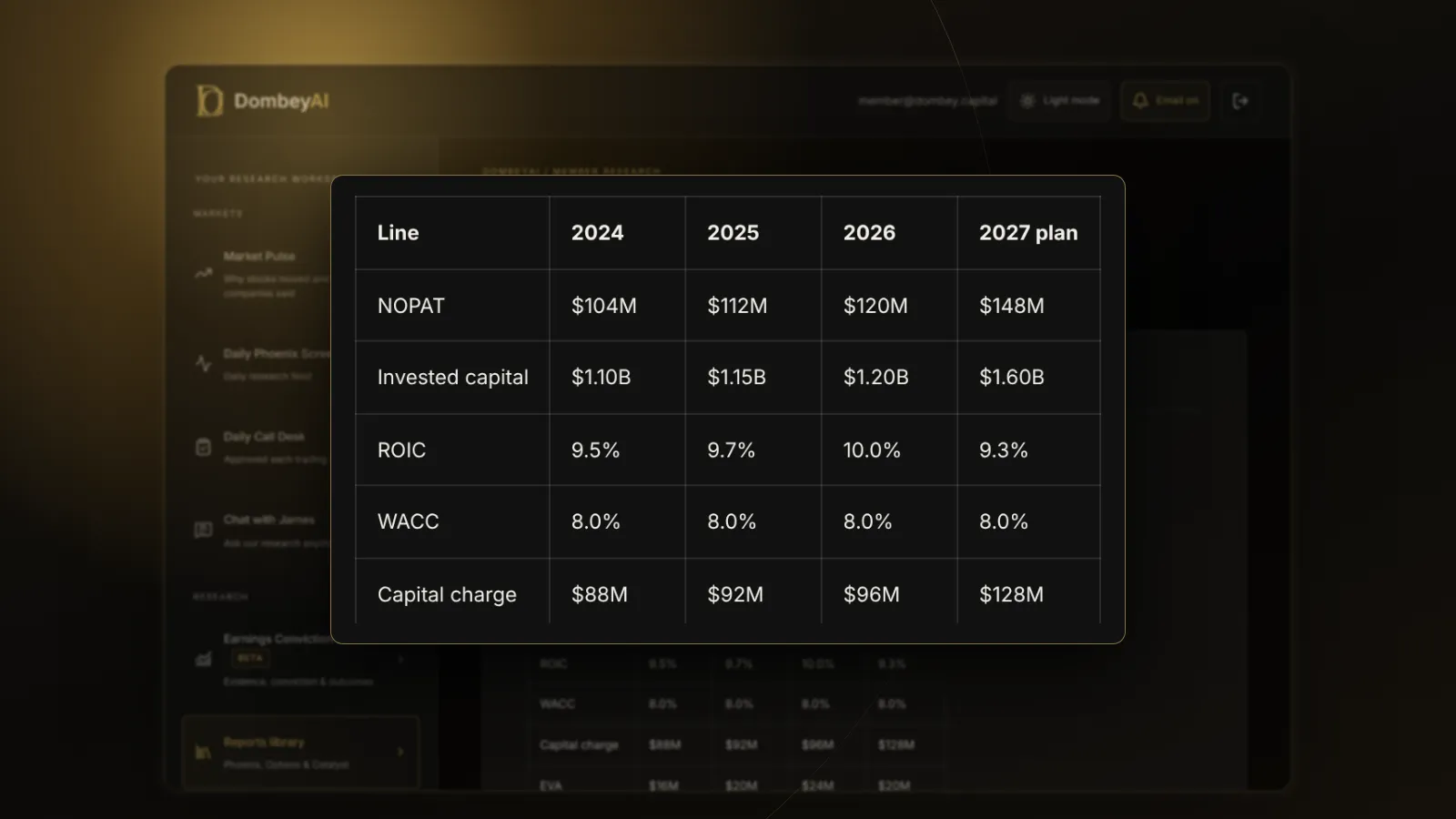
Now suppose Company A plans a $400 million expansion expected to add $28 million of NOPAT. The project returns 7%, below the 8% WACC. Total NOPAT rises to $148 million and capital to $1.6 billion. The capital charge becomes $128 million and EVA falls to $20 million. Profit grows by 23%, but value creation shrinks. That is the core insight EVA gives: growth below the cost of capital makes the company bigger and worth less per dollar invested.
Quick reference: EVA and related measures
| Measure | Formula | What it shows | Blind spot |
|---|---|---|---|
| EVA | NOPAT minus capital x WACC | Dollar value created in a period | Sensitive to WACC and capital definition |
| ROIC | NOPAT / invested capital | Return on operating capital | Ignores the cost of capital |
| ROIC minus WACC spread | ROIC minus WACC | Value creation per dollar | Ignores scale |
| Net income | Revenue minus all expenses | Accounting profit to equity | No charge for equity |
| Market value added | Market value minus invested capital | Value the market expects to be created | Moves with the share price |
How EVA links to valuation
EVA is not only a performance measure. It connects directly to the value of the business:
Value of operations = Invested capital + Present value of expected future EVA
Discounted at WACC, this gives the same answer as a discounted cash flow valuation when the inputs are consistent. The EVA form is often easier to sense check because it isolates the part of value that depends on beating the cost of capital.
- If a company is expected to earn exactly its cost of capital forever, future EVA is zero and the business is worth its invested capital.
- If it is expected to earn more, the market should value it above invested capital.
- If it is expected to earn less, it should be worth less than the capital put in.
That last point links EVA to Tobin's Q and replacement cost: companies with persistently negative EVA tend to trade below the value of their assets, and companies with high EVA above it. Market value added (MVA), market value minus invested capital, is the market's estimate of all future EVA in present value terms.
How investors use EVA
- Screening for quality. A long record of positive EVA points to a business with a lasting advantage. Our list of the best stock research tools for individual investors covers platforms that show ROIC and WACC history, the two inputs you need.
- Judging growth. Expansion plans, acquisitions and capital programs can be tested against WACC. Growth with a negative spread is a warning.
- Turnarounds and special situations. A company moving from negative to positive EVA, through cutting unproductive capital or improving margins, can be revalued sharply. Asset sales that remove low-return capital can raise EVA even if they cut profit.
- Management incentives. Some companies link pay to EVA or economic profit. The proxy statement will say how it is defined.
Adjustments analysts make
Raw accounting figures rarely give a clean EVA, so analysts adjust both NOPAT and invested capital to reflect the economics:
- Research and development. Capitalizing R&D and amortizing it over its useful life treats it as the investment it is. NOPAT rises by the year's spending less amortization, and capital rises by the unamortized balance.
- Operating leases. Most leases now sit on the balance sheet, but check that lease liabilities are treated consistently in capital and that the interest part of lease cost is excluded from NOPAT.
- Goodwill. Including it measures returns on what was paid for acquisitions; excluding it measures returns on the operating assets alone. Both are useful, and the answers can differ widely.
- One-time items. Restructuring charges and asset sale gains are usually removed from NOPAT, but recurring "one-time" charges should stay in.
- Excess cash. Cash beyond operating needs is excluded from invested capital, since it earns a market return rather than an operating one.
Whatever choices you make, apply them the same way across years and peers.
Where this goes wrong
EVA looks precise but rests on judgment calls.
- The cost of capital is an estimate. A WACC of 7% versus 9% on $1.2 billion of capital changes the charge by $24 million, enough to wipe out the EVA in the example.
- Capital definitions vary. Whether to include goodwill, capitalize R&D or count operating leases changes invested capital materially. Our explainer on goodwill and impairments shows how acquisitions inflate the base.
- Accounting distortions. Old, depreciated assets make ROIC look high; new investment makes it look low. EVA can penalize a company in the years it invests most.
- Expenses in NOPAT. Whether to treat stock-based compensation as a real expense affects NOPAT. It should be deducted.
- One-year snapshots. A single year's EVA can reflect a cycle peak or trough. Look at several years.
- Hard to compare across industries. Asset-light businesses show high returns on small capital; asset-heavy ones the reverse. Compare within a sector.
The bottom line
Economic value added is operating profit after tax minus a charge for all the capital used, at the weighted average cost of capital. It shows whether a business earns more than its investors require, and it ties directly to valuation, since a company's worth equals its invested capital plus the present value of future EVA. Use it to test whether growth and capital spending create value, but treat it as an estimate, sensitive to WACC and to how capital and profit are measured. Several years of EVA across a consistent method say more than any single figure.