

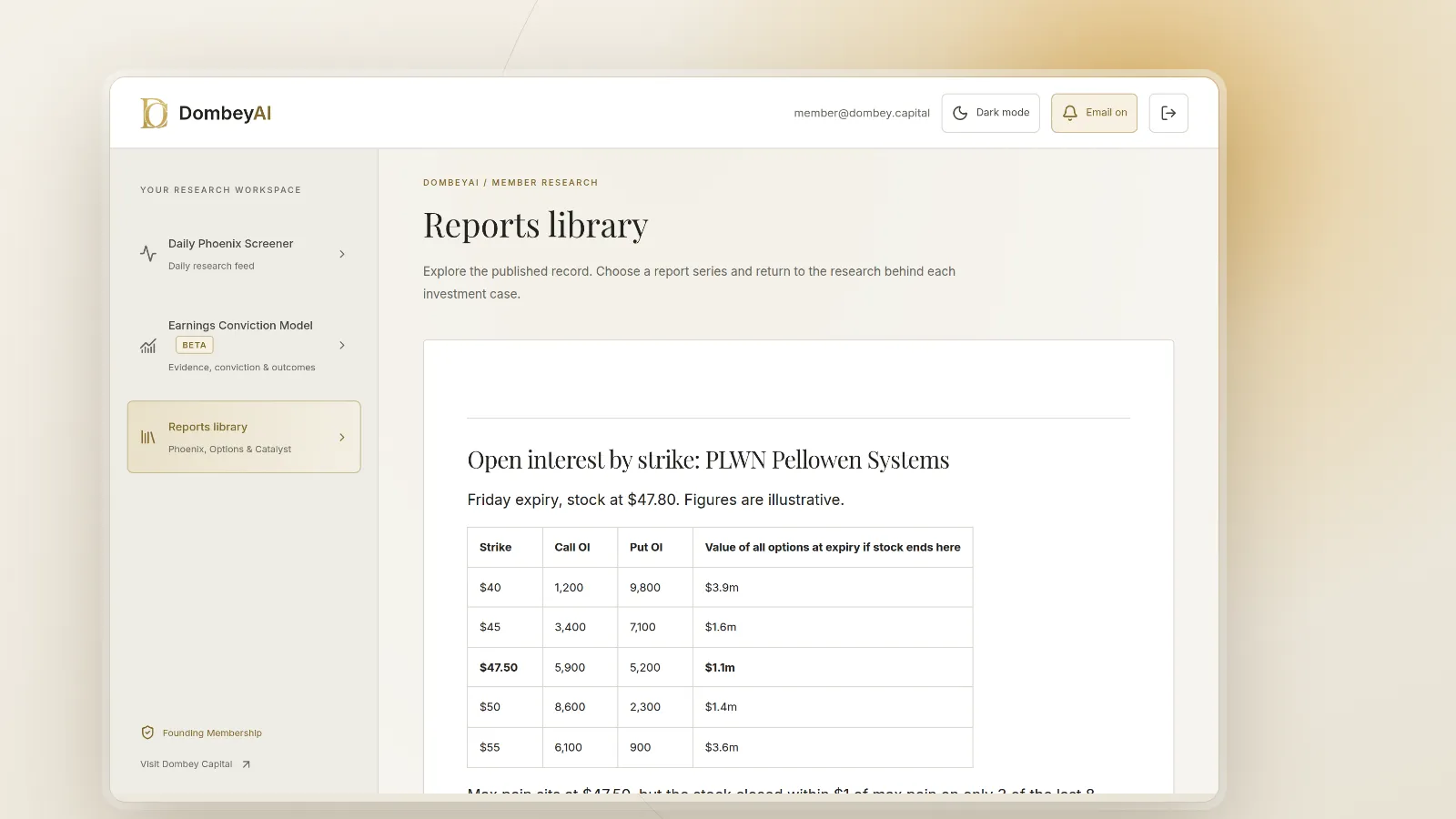
How max pain is calculated
The calculation uses one input: open interest, the number of contracts still outstanding at each strike. If you need a refresher on the number itself, see what open interest is and how to read it before a catalyst.
The steps are mechanical:
- Pick one expiration date.
- Choose a list of possible settlement prices. Most sites use each listed strike.
- For each settlement price, work out the intrinsic value of every open call (settlement minus strike, if positive) and every open put (strike minus settlement, if positive).
- Multiply each value by the open interest at that strike and by the contract multiplier, usually 100 shares.
- Add up calls and puts. The settlement price with the smallest total is max pain.
At that price, the options that finish in the money are worth the least in aggregate. In plain terms, it is the price at which the most options expire worthless by value.
Why the theory says prices drift there
The idea rests on a story about who sits on the other side. Option buyers are said to be mostly retail traders, and option writers are said to be mostly market makers and large institutions. If writers lose least at max pain, the story goes, they have a reason and the means to nudge the stock toward it in the last days before expiry.
A second version uses hedging rather than intent. Market makers who sell options buy or sell stock to hedge, and that hedging changes as the stock moves near a strike. In some conditions, hedge adjustments lean against moves away from a heavily traded strike, which could hold a stock near it into the close.
Both stories sound plausible. The question is whether the number captures either effect, and it mostly does not.
A worked example
| Strike | Call open interest | Put open interest |
|---|---|---|
| $45 | 1,000 | 5,000 |
| $50 | 3,000 | 4,000 |
| $55 | 6,000 | 1,500 |
| $60 | 4,000 | 500 |
Now test each strike as the settlement price. At $50, only the $45 calls are in the money, by $5, for 1,000 contracts: $5 x 1,000 x 100 = $500,000. On the put side, the $55 puts are worth $5 on 1,500 contracts ($750,000) and the $60 puts are worth $10 on 500 contracts ($500,000). The total is $1.75 million.
| Settlement price | Call value | Put value | Total payout |
|---|---|---|---|
| $45 | $0 | $4.25 million | $4.25 million |
| $50 | $0.50 million | $1.25 million | $1.75 million |
| $55 | $2.50 million | $0.25 million | $2.75 million |
| $60 | $7.50 million | $0 | $7.50 million |
The smallest total sits at $50, so $50 is the max pain price for this expiration. The theory would say QRMX, now at $52, should lean toward $50 by expiry.
Three things the table does not tell you. It does not say who bought and who sold these contracts. It does not include the premium the buyers paid, which the writers already hold. And it does not show whether the writers hedged with stock, which would offset most of the payout. A writer who sold the $55 calls for $3 and bought shares against them may be indifferent between $50 and $55.
Quick reference: max pain at a glance
| Question | Short answer |
|---|---|
| What it measures | Total intrinsic value of open options at each possible settlement price |
| Input | Open interest by strike for one expiration |
| What it assumes | Writers are one side, unhedged, and want the smallest payout |
| What it leaves out | Premium paid, position direction, hedges, news and scheduled events |
| How often it changes | Daily, as open interest changes |
| Best use | A rough map of where open interest is concentrated |
| Weakest use | A price target or forecast |
What the research shows
The strongest evidence on this subject is about strikes in general, not max pain. In a 2005 study in the Journal of Financial Economics, Ni, Pearson and Poteshman found that closing prices of stocks with listed options tend to cluster at strike prices on expiration dates. They attributed the effect to hedge rebalancing by option market makers and, in part, to trading by firm proprietary traders that moved prices.
That finding is often cited in support of max pain, but it says something narrower. Pinning near a strike is not the same as moving to the one strike where the total option payout is lowest. A stock can pin at a heavily traded strike that is not max pain. Discussion of the study ties pinning to market makers being net long options as a group. In that case their hedging leans against price moves and can hold a stock near a strike. When dealers are net short options, the same hedging logic works the other way and tends to add to moves rather than damp them.
None of this is visible in a max pain chart. Open interest shows how many contracts exist, not which side dealers are on.
Where this goes wrong
Assuming one side holds all the short options. Open interest counts each contract once, but it does not say who is long and who is short. Many writers are retail investors selling covered calls or cash-secured puts. Many buyers are institutions hedging stock. The idea that writers are a single group with a single goal does not match the market.
Ignoring hedges. Market makers typically hedge the stock exposure of the options they hold, as our explainer on the option greeks describes. A hedged dealer earns mainly from the bid-ask spread and from managing the hedge, not from the stock settling at one price. The payout in the max pain table is not their loss.
Leaving out the premium. Option buyers paid for their contracts at the start. A put that expires worthless was still a transfer of premium from buyer to seller. Max pain minimizes payout at expiry, not anyone's profit or loss over the life of the trade.
Treating a moving number as fixed. Open interest changes every day, so max pain does too. A figure read on Monday can shift by Friday as positions open and close.
Applying it through a catalyst. If earnings, a court ruling, a shareholder vote or a deal deadline falls inside the expiration, the news will matter far more than dealer hedging. The at-the-money straddle is a better guide to how large a move the market expects than any open interest calculation.
Reading thin markets. On smaller stocks, open interest at a strike may reflect one trader. Wide quotes also make option values less reliable, as our piece on options liquidity and wide spreads explains. Max pain built on a handful of positions is not a crowd signal.
Using it on cash-settled index options. Many index options settle in cash against a special opening quotation, not the closing price, and trade at enormous volume across many expirations. The mechanics that could pin a single stock at the close do not carry over directly.
How to use it, if at all
Max pain is most useful as a summary of where open interest is concentrated, not as a target.
- If a stock has no scheduled news before expiration and very large open interest at one or two strikes, max pain may point to a level where hedging activity could matter on expiration day.
- If a dated catalyst falls inside the expiration, set max pain aside and look at the implied move. Our guide on estimating an earnings move from options covers that step.
- If max pain and the largest open interest strike disagree, look at the chain directly. Our guide on how to read an option chain shows where to find open interest and volume by strike.
- If you are tempted to combine max pain with other crowd measures, read what each one leaves out first. The put-call ratio has many of the same blind spots.
Dombey's published research reads open interest alongside the dated event, the implied move and the filings; see the research archive.
Expiration mechanics that matter
Standard monthly equity options expire on the third Friday of the month, and many stocks also list weekly expirations. At expiration, the Options Clearing Corporation's exercise-by-exception procedure generally exercises equity options that finish in the money by $0.01 or more, unless the holder instructs otherwise. Holders of options that are near the money at the close can face exercise or assignment they did not expect, which is a real risk independent of any max pain forecast.
Assignment risk near a strike is one reason short option holders often close or roll positions before the last day. That behavior changes open interest late in the week, which is another reason a max pain number read early can drift. To see how individual stocks actually moved on recent news, browse today's biggest stock moves.
The bottom line
Max pain is the settlement price at which the open options in one expiration would pay out the least in total, calculated from open interest at each strike. The theory that stocks drift toward it rests on assumptions about who is short, whether they hedge and what they want, none of which the number can show. Research supports a narrower effect: optionable stocks tend to close near strike prices on expiration days, with direction depending on how dealers are positioned. Treat max pain as a rough map of open interest, and set it aside when a dated catalyst falls inside the expiration. Options carry substantial risk, and this article is education, not a recommendation.