

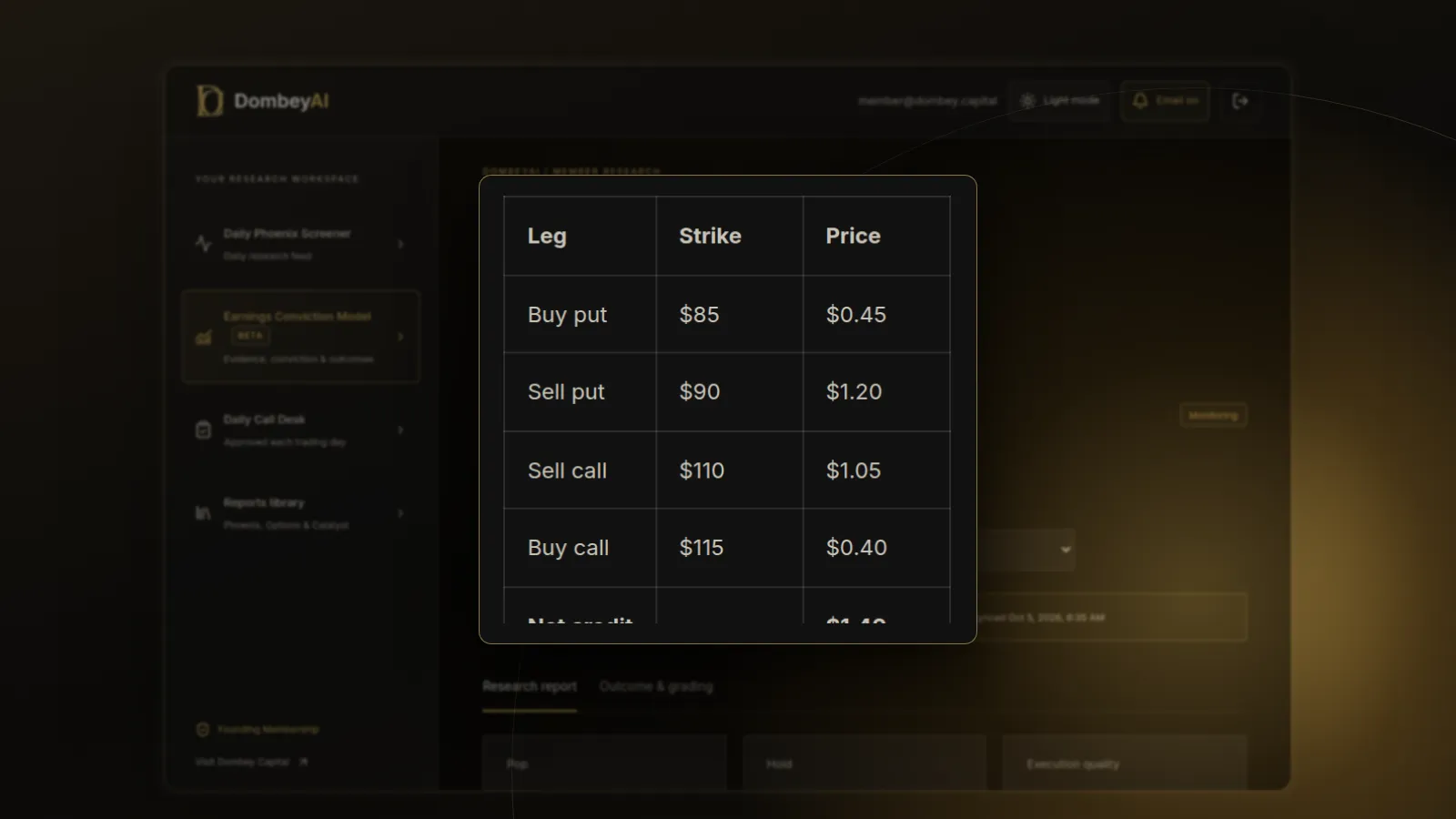
How an iron condor is built
An iron condor has four legs, all on the same underlying and the same expiry:
- Sell an out-of-the-money put (the short put).
- Buy a further out-of-the-money put (the long put), which caps the loss on the downside.
- Sell an out-of-the-money call (the short call).
- Buy a further out-of-the-money call (the long call), which caps the loss on the upside.
The two short options bring in more premium than the two long options cost, so the position opens for a net credit. The put side is a bull put spread and the call side is a bear call spread. Together they bet that the stock finishes between the short strikes.
Each standard US stock option covers 100 shares, so a condor quoted at a $1.40 credit brings in $140 before fees. If you are new to strikes, expiries and quotes, start with how to read an option chain.
Payoff at expiry
At expiry, the outcome depends on where the stock finishes.
| Stock at expiry | Result |
|---|---|
| Between the short strikes | All four options expire worthless; you keep the full credit |
| Between a short strike and its long strike | Partial loss or partial gain, depending on how far into the spread the stock finished |
| Beyond either long strike | Maximum loss: spread width minus the credit |
| At a breakeven | Zero gain or loss before fees |
The breakevens are:
- Lower breakeven = short put strike minus the net credit.
- Upper breakeven = short call strike plus the net credit.
Only one side can lose at expiry, because the stock cannot be below the puts and above the calls at the same time. That is why the maximum loss is one spread's width less the credit, not two.
A worked example around earnings
Three things make this trade work or fail:
- The report. If the stock moves 5%, the condor keeps most or all of its credit, and the collapse in implied volatility after the report makes the options cheaper to buy back.
- The gap. If the stock opens 15% lower, it is below the long put. The condor has its maximum loss of $360 at the open, and there is nothing to adjust.
- The ratio. The trade risks $3.60 to make $1.40. It needs to win more often than it loses by a wide margin just to break even over many trades, and a single large gap can erase several small wins.
Our guide to estimating an earnings move from options shows how to read the straddle price as an implied move, and IV crush explains why the options fall in value after the event.
Choosing strikes and wings
Strike selection decides the shape of the trade.
| Choice | Effect on credit | Effect on risk |
|---|---|---|
| Short strikes closer to the stock | Larger credit | Narrower profit zone, higher chance of loss |
| Short strikes beyond the implied move | Smaller credit | Wider profit zone, but a gap still produces full loss |
| Wider wings | Larger credit | Larger maximum loss |
| Narrower wings | Smaller credit | Smaller maximum loss, more legs per dollar risked |
| Uneven sides | Leans the trade bullish or bearish | Larger loss on the side with the closer strike |
Two inputs help here. The first is the implied move, which tells you where the market prices the likely range. The second is options skew: puts often carry higher implied volatility than calls, so the put side may pay more for the same distance from the stock.
How the Greeks behave
The option Greeks describe how a condor reacts before expiry:
- Theta is positive: the position gains as time passes and the options decay, all else equal.
- Vega is negative: the position gains when implied volatility falls and loses when it rises.
- Gamma is negative: as the stock nears a short strike, the position's losses accelerate.
- Delta is near zero when the stock sits in the middle, and turns against you as the stock moves toward either short strike.
Before earnings, implied volatility usually rises, which hurts a condor that is already open. That is why many condors around events are opened shortly before the report and closed soon after.
Iron condors as a catalyst trade
A condor is a view that the stock's move will be smaller than the options imply. That is a view on the catalyst, not only on volatility. Before you open one, ask what the event could reveal:
- If the report is routine and guidance rarely changes, a range-bound outcome is more plausible.
- If the company faces a binary question, such as a trial result, a regulatory decision or a guidance reset, a condor is a bet against an outcome built to be large.
- If the stock has a history of gaps beyond its implied move, the credit may not pay for the risk.
- If the implied move is unusually low compared with past reactions, the market may be underpricing the event, which works against the condor.
Event coverage of large moves after earnings and other news is in our market articles, which show how far single reports can move a stock.
Where this goes wrong
Iron condors fail in predictable ways.
- The gap. Earnings, deal news and court rulings can move a stock past both the short and long strikes in one print. The defined loss is still the full loss.
- Early assignment. A short leg that goes deep in the money can be assigned before expiry, especially ahead of an ex-dividend date. You are left with a stock position to manage.
- Pin risk. A stock that closes near a short strike at expiry leaves you unsure whether you will be assigned, and the stock can move after the close.
- Costs. Four legs mean four spreads to cross and four commissions, twice if you close early.
- Sizing on the credit. Traders sometimes size by the credit they want, not the loss they can bear. Size by the maximum loss.
Dombey's weekly Options Research examines event-driven options setups with their risks; see the research archive.
The bottom line
An iron condor sells a put spread and a call spread on the same expiry to collect a credit if the stock stays in a range. Its gain and loss are capped and known at the start, with breakevens at the short strikes plus or minus the credit. Around earnings, falling implied volatility works in its favor, but a gap past either wing produces the maximum loss at once. Compare the short strikes with the implied move, check liquidity and size the trade by what it can lose, not by what it can earn.