

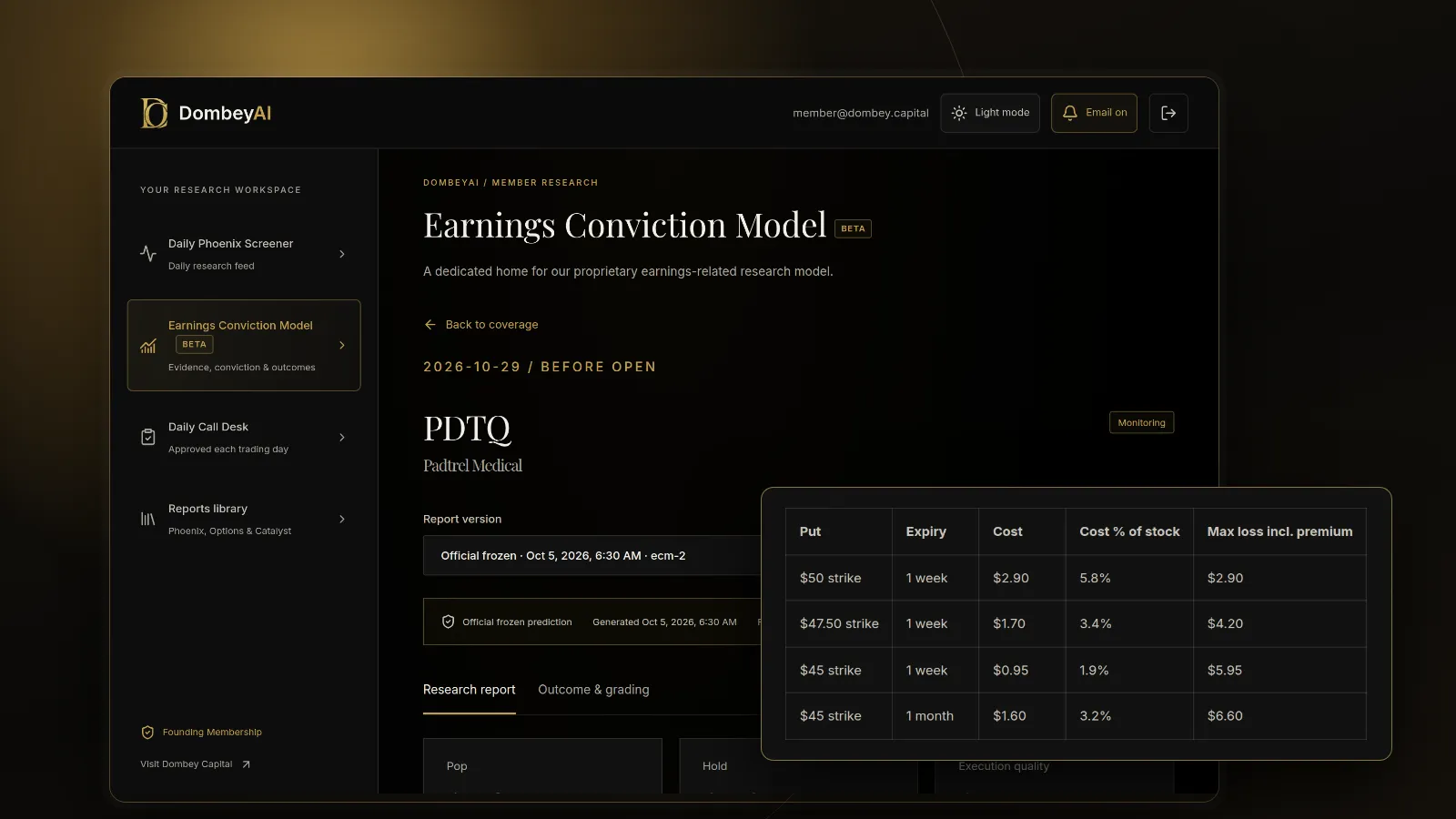
How a protective put works
A standard US stock option covers 100 shares. If you own 100 shares and buy one put, the put covers the whole position. If you own 300 shares, you need three puts for full coverage.
The put gives you the right, not the obligation, to sell at the strike. If the stock is above the strike at expiry, the put expires worthless and you still own the shares. If the stock is below the strike, the put is worth at least the difference, and you can either sell the put for its value or exercise it and deliver the shares at the strike. Most stock options in the US are American style, so the holder can exercise at any time before expiry, though selling the put is usually better than exercising early because selling captures any remaining time value.
If you are new to reading prices on a chain, start with how to read an option chain, which explains bids, asks, strikes and expiries in order.
Cost, breakeven and maximum loss
Three numbers describe a protective put at expiry:
- Cost: the premium per share times 100 for each contract.
- Breakeven: your stock price plus the premium. The stock has to rise by the premium before the combined position makes money.
- Maximum loss: your stock price minus the strike, plus the premium. Below the strike, every dollar the stock loses is offset by a dollar the put gains.
The maximum gain is unlimited in theory, less the premium, because you still own the stock.
The strike is the main dial. A put closer to the stock price costs more but kicks in sooner. A put further below costs less but leaves you to absorb a larger drop first. The table below uses the same hypothetical Company A at $50.
| Strike | Illustrative premium | Breakeven | Max loss per share | Loss absorbed before put pays |
|---|---|---|---|---|
| $50 (at the money) | $2.60 | $52.60 | $2.60 | $0 |
| $47.50 | $1.80 | $51.80 | $4.30 | $2.50 |
| $45 | $1.20 | $51.20 | $6.20 | $5.00 |
| $40 | $0.45 | $50.45 | $10.45 | $10.00 |
The cheaper put is not automatically the better deal. The $40 put costs little because the market sees a drop of more than 20% as unlikely. If that drop is exactly the risk you are worried about, it may be all the hedge you need. If a 10% drop would already hurt, it does nothing for you.
Choosing the strike and expiry around a dated catalyst
A hedge around an event has one hard rule: the put must expire after the event. A put that expires the Friday before an earnings date protects nothing on the night that matters. Leave room for the date to move, since companies sometimes reschedule reports and regulators sometimes take longer than the calendar suggests.
Within that rule, the choices are trade-offs:
- If you want protection only for the event itself, the first standard expiry after the date is usually the cheapest way to get it, because it carries the least extra time.
- If the catalyst date is uncertain, such as a court decision with no fixed date or a merger review that may run long, a later expiry costs more but avoids paying twice to roll a put that expired too soon.
- If you can accept a moderate drop but not a severe one, a strike further out of the money cuts the cost, and you still own the floor for the tail case.
- If the stock has a history of large moves on this kind of event, compare the cost of a near-the-money put with the moves it has made before, not just with the premium on a quiet week.
A useful check before choosing a strike is the move the options already imply. The at-the-money straddle for the first expiry after the event gives a rough estimate; how to estimate an earnings move from options walks through the arithmetic, and what a straddle is explains why traders use it as the market's price for the event. A strike set well inside the implied move is paying for a scenario the market treats as ordinary. A strike far outside it is cheaper insurance against a scenario the market treats as rare.
Why puts get expensive into events
Implied volatility is the volatility the option price assumes. It usually rises in the days and weeks before a scheduled event, because the market expects a bigger move on that date than on an ordinary day. Higher implied volatility means higher premiums for both calls and puts. What implied volatility is covers the mechanics in detail.
Two consequences follow for a protective put:
- You pay a higher price for the same strike. A $45 put that costs $0.70 three months before earnings might cost $1.20 the week before, with the stock at the same price. To see whether current levels are high for this stock, compare them with its own history using IV rank and IV percentile.
- The put loses value quickly after the event. Once the news is out, implied volatility usually falls back. If the stock barely moves, the put can lose a large part of its value overnight. This is IV crush, and it hits the put buyer the same way it hits any option buyer.
Some hedgers buy protection earlier, before implied volatility builds, accepting more time decay in exchange for a lower volatility price. Others hedge only the event week and accept the higher price. Neither is right in general; the choice depends on how early you know the date and how long you want the floor. The rate at which the put loses value each day is its theta, one of the option Greeks.
Protective put vs stop-loss vs collar
A protective put is one of three common ways to limit losses on a stock you own. Each one fails in a different way.
| Protective put | Stop-loss order | Collar | |
|---|---|---|---|
| Up-front cost | Premium paid | None | Low or zero (call premium offsets put) |
| Floor on loss | Firm at the strike until expiry | None; triggers a market order | Firm at the put strike until expiry |
| Overnight gap down | Protected | Can fill far below the stop | Protected |
| Upside | Kept in full, less premium | Kept in full while not triggered | Capped at the call strike |
| Shaken out by a dip that recovers | No | Yes | No |
| Expires or needs renewing | Yes | No, unless set as a day order | Yes |
| Assignment risk | None | None | Short call can be assigned |
The gap row is the reason puts matter around events. Earnings and rulings often land outside market hours. If Company A closes at $50 and opens at $38, a stop at $46 becomes a market order at the open and fills somewhere near $38. The put with a $45 strike still pays from $45 down.
The same Company A, at expiry, under each approach, with illustrative numbers ($45 put at $1.20; collar using the $45 put and a $57 call sold at $1.10, net cost $0.10):
- Stock opens at $38: unhedged loses $12 per share; stop at $46 loses about $12; protective put loses $6.20; collar loses $5.10.
- Stock ends at $50: unhedged is flat; stop is flat; protective put loses $1.20; collar loses $0.10.
- Stock ends at $60: unhedged gains $10; stop gains $10; protective put gains $8.80; collar gains $6.90.
The collar looks cheapest, and it is, until the stock runs. On a takeover bid or a strong report, the short call hands the shares away at the strike. The covered call article explains what that leg does around catalysts, since a collar is a covered call plus a protective put.
Where this goes wrong
A protective put limits one risk and adds others.
- Paying for insurance on every event adds up. Hedging four earnings reports a year at 2% to 3% of the position each time is a meaningful drag. If the hedge rarely pays, it has cost more than the drops it protected against.
- The put expires before the damage. A delayed ruling, a rescheduled report or a slow sell-off that starts after expiry leaves you unhedged when it counts.
- The strike is too far out. A deep out-of-the-money put feels cheap and covers only the tail. A 15% drop that stops short of the strike is a full loss on the shares and a loss on the put.
- The coverage is mismatched. Owning 250 shares and buying two puts leaves 50 shares unprotected. Contract adjustments after a special dividend, split or merger can also change what one contract covers; check the adjustment notice before assuming the hedge still fits.
- Liquidity is thin. On small caps with few listed strikes, the put you want may not exist, or the spread may be so wide that the hedge costs much more than its quoted mid price.
- Taxes. Buying a put on stock you have held for a short time can affect your holding period under the tax rules on hedged positions. Check IRS guidance or a tax adviser before relying on long-term treatment.
How to decide whether to hedge an event
A short sequence covers most cases:
- Write down the loss you could accept on the position if the event goes badly, in dollars.
- Look up the implied move for the first expiry after the event.
- If the implied move would take you past your acceptable loss, price puts at strikes that cap the loss at that level.
- Compare the premium with the cost of reducing the position instead. Selling some shares before the event costs nothing in premium and removes the same risk on that portion.
- Choose the expiry that clears the event date with room to spare, and check the spread before placing the order.
Dated events are the reason to think about this at all. The market coverage on Dombey tracks real stocks around their moves and catalysts, which is a practical way to see how often gaps blow through levels that looked safe the day before.
The bottom line
A protective put sets a floor under shares you own, at the strike, for as long as the put is alive. You pay for that floor with the premium, which raises your breakeven and costs more right before a scheduled event because implied volatility is high. Around a catalyst, the put must expire after the date, and the strike should match the loss you can actually accept. A stop-loss is free but fails on gaps, and a collar is cheaper but gives up the upside; the protective put costs the most and keeps the most.