

What you need
- A place to keep notes: a spreadsheet, a notes app or the watchlist feature of a research platform that allows custom fields.
- Access to company filings through SEC EDGAR, which is free.
- A calendar you check daily.
- An alert tool for prices and filings. Many brokers and the tools in our list of SEC filing tools and EDGAR alerts can send both.
- A starting list of ideas. If you do not have one, our guide on how to find investment ideas covers the main sources.
Step 1: Decide what the list is for
A watchlist that tries to do everything ends up doing nothing. Choose one purpose, or keep separate lists for separate purposes:
- Waiting for a price. Good businesses you would own at a lower valuation.
- Waiting for an event. Special situations with a dated catalyst, such as a spin-off, merger vote or debt refinancing.
- Following a thesis. Companies where a specific change, such as a margin recovery, would make the case.
The purpose decides which fields you need. A price list needs valuation ranges; an event list needs dates and documents.
Step 2: Keep an idea list separate
Names you have not researched go on an idea list, not the watchlist. Moving a company from one to the other should require at least a first read of its latest annual report, recent quarterly results and the main risk. That gate is what keeps the watchlist small and useful.
Step 3: Write a one-line thesis for each name
For every company, write one sentence that says why it is on the list and what would have to be true. For example: "Company A trades below net cash; the thesis works if the cash is returned or the loss-making unit is closed by mid-2027."
A one-line thesis does three jobs. It forces clarity, it tells you what news matters, and it makes it obvious when the reason has gone. Our guide to writing a dated investment thesis covers a fuller version for names you move toward a decision.
Step 4: Record the dates that matter
Add every dated event that could change the thesis, and put each one in your calendar as well as on the list:
| Event | Where to find the date | Why it matters |
|---|---|---|
| Earnings report | Company investor relations page or press release | Results against the thesis |
| Annual meeting and votes | Proxy statement | Board changes, deal approvals |
| Debt maturities | 10-K debt footnote | Refinancing risk or a catalyst |
| Lockup expirations | IPO prospectus | Supply of shares |
| Deal milestones | Merger agreement, S-4, 8-Ks | Votes, regulatory decisions, outside dates |
| Regulatory decisions | Company disclosures | Approval or rejection |
Our guide on building a catalyst calendar shows how to keep these dates in one place and what to check before each one.
Step 5: Set a valuation range and price alerts
For each name, write down a rough range of value, the low and high ends of what you think the business is worth per share, and the method you used. Then set price alerts at levels that mean something: the low end of the range, a price that implies a specific multiple, or a level where the margin of safety you want is available.
An alert is a prompt to re-check the facts, not an instruction. When it fires, the first question is whether the price moved because the value changed.
Step 6: Set filing alerts
Most changes to a thesis appear in a filing before they appear in commentary. Set alerts for each company's:
- 8-Ks, which report material events, including results, deals, executive departures and financing.
- 10-Qs and 10-Ks, for the full quarterly and annual picture.
- Proxy statements, for votes and pay.
- Form 4s, for insider buying and selling.
- Schedule 13D and 13G, for large holders and activists.
EDGAR offers RSS feeds by company and full-text search; many research tools add email alerts on top. Our guide to searching SEC EDGAR filings covers both.
Step 7: Build a weekly review routine
Once a week, work through the list in the same order:
- Read any alerts and new filings.
- Check the next two weeks of dated events.
- Update the thesis line if the facts changed.
- Note the date of the review against each name.
| Step | What to check | Where to find it |
|---|---|---|
| Filings | New 8-Ks, 10-Qs, Form 4s | Filing alerts, EDGAR |
| Dates | Events in the next 14 days | Calendar |
| Price | Moves through alert levels | Watchlist or broker |
| Thesis | Whether any fact contradicts it | Your notes |
Keep a short investment checklist for names that move toward a decision, so the review and the decision use the same questions.
Step 8: Prune every month
Once a month, remove names that no longer earn a place:
- The thesis is broken by new facts.
- The catalyst has passed and nothing replaced it.
- The stock has reached the top of your value range.
- You have not reviewed it in a month, which means you are not really watching it.
Removing a name is a decision, not a failure. Write one line on why it left, which becomes useful later when you look back at what you got right. Our list of portfolio trackers for event-driven investors includes tools that keep this history alongside the list.
A sample watchlist layout
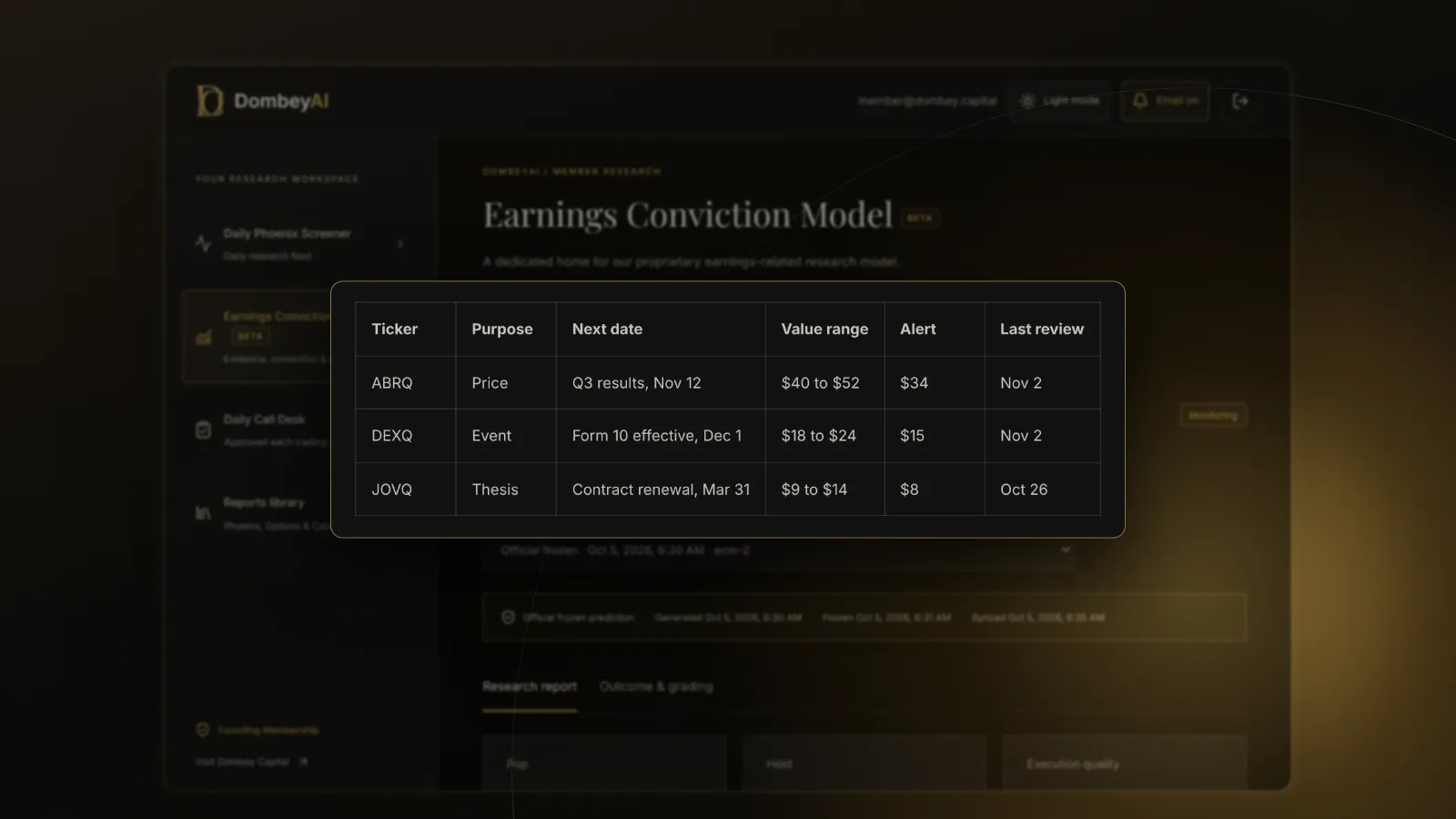
The columns below work for a spreadsheet or for any platform that allows custom fields. All companies and figures are invented and illustrative.
| Ticker | Purpose | Thesis in one line | Next date | Value range | Alert | Last review |
|---|---|---|---|---|---|---|
| ABCQ | Price | Steady niche manufacturer; interesting below 10x normalized earnings | Q4 results, Feb 12 | $40 to $52 | $34 | Nov 2 |
| DEFQ | Event | Spin-off of the services unit; parent left with net cash | Form 10 effective, Dec 1 | $18 to $24 | $15 | Nov 2 |
| GHIQ | Thesis | Margin recovery as a contract reprices in 2027 | Contract renewal, Mar 31 | $9 to $14 | $8 | Oct 26 |
| JKLQ | Event | Pending cash deal at $30; vote due | Shareholder vote, Dec 9 | $30 if closed | $27 | Nov 2 |
Three columns do most of the work. "Next date" makes the list a calendar. "Value range" makes alerts meaningful. "Last review" shows which names you have stopped watching, which is the first sign they should go. If you track special situations, add a column for the key document, such as the Form 10 or merger agreement, so the source is one click away.
Common mistakes
- Adding stocks because they moved. A big daily move is a reason to look, which belongs on the idea list, not a reason to watch.
- No written reason. Without a thesis line, every price change looks meaningful and none of them is.
- Too many names. A list of 200 tickers is a market screen, not a watchlist. Keep only what you can review weekly.
- Dates kept only in your head. An event you forget about is an event you react to late. Put every date in a calendar.
- Alerts with no meaning. A round-number price alert says nothing about value. Tie each alert to your range.
- Never removing anything. Old names crowd out new ones and the review gets skipped.
The bottom line
A stock watchlist works when each name has a reason, a set of dates and a value range, and when alerts and a calendar do the monitoring. Start with one clear purpose, keep unresearched ideas on a separate list, and prune monthly. The list then tells you exactly what to check when news arrives. For tools that help with each step, see our guide to the best stock research tools for individual investors.