

What you need
- The target's merger proxy (PREM14A or DEFM14A), S-4 or F-4 for a stock deal, or Schedule 14D-9 for a tender offer
- The merger agreement, usually an annex to the same document
- The fairness opinion summary and the projections section, also in the proxy
- A spreadsheet or notes page for the timeline
- The target's share price history around the key dates
If proxy statements are new to you, how to read a proxy statement covers the layout first.
Step 1: Find the section and note its length
Open the filing on EDGAR and go to the table of contents. The section is usually titled "Background of the Merger," "Background of the Offer" or "Background of the Transaction." For stock deals, the same narrative appears in the S-4 merger registration.
Note the page count. Two or three pages usually means a quick, negotiated deal with one buyer. Fifteen or more often means a long process, several bidders, a conflict that had to be explained, or all three.
Step 2: Build a dated timeline
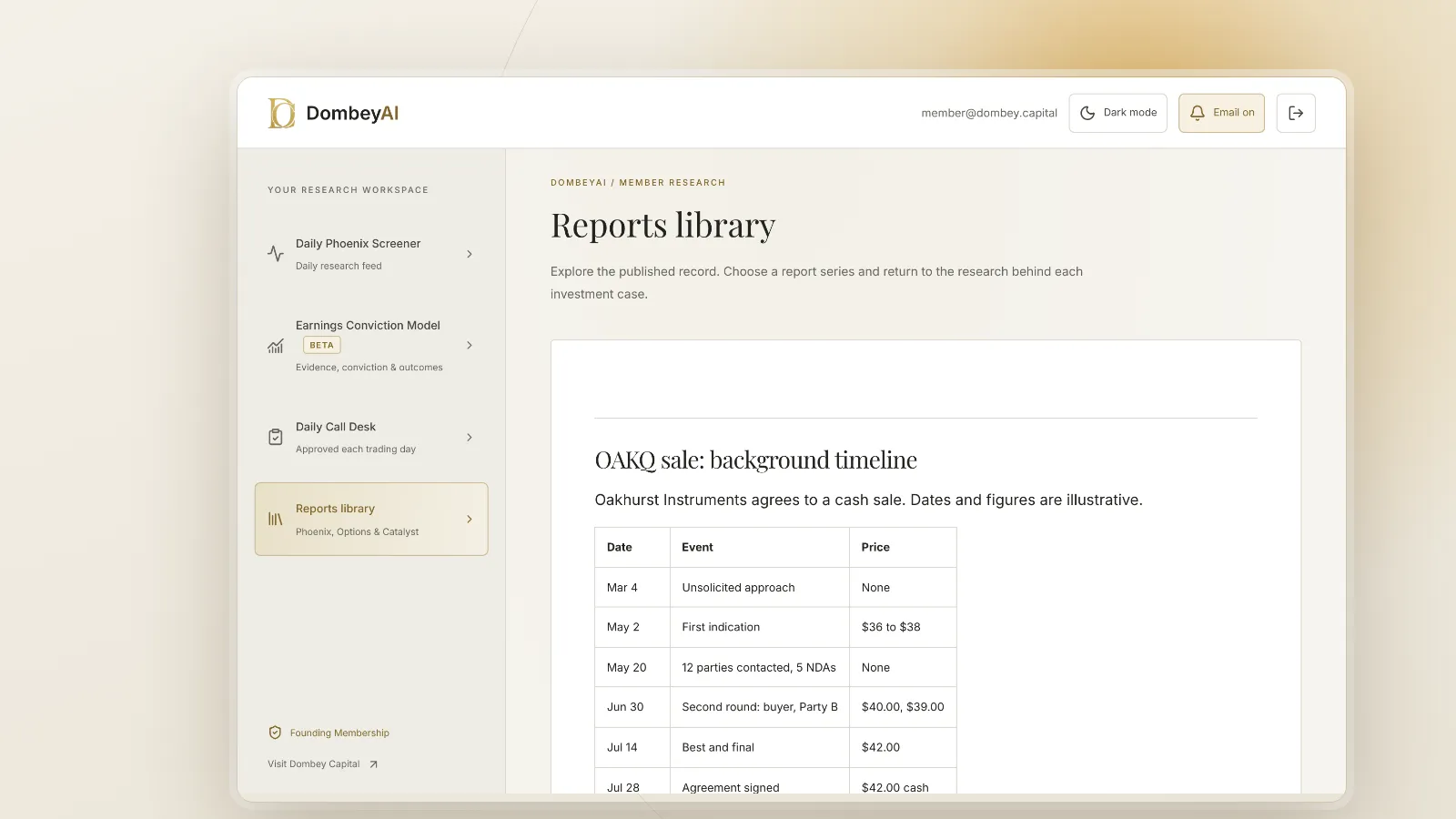
Read the section once quickly, then a second time with a table. Every paragraph usually starts with a date. Record each event:
| Date | Event | Who | Price or terms | Note |
|---|---|---|---|---|
| March 4 | First approach | Buyer CEO to target CEO | None | Unsolicited |
| April 18 | Board meeting | Target board | None | Hires financial adviser |
| May 2 | Indication of interest | Buyer | $38 to $40 | Non-binding |
| May 20 | Outreach | Adviser contacts 12 parties | None | 5 sign NDAs |
| June 30 | Second-round bids | Buyer and Party B | $41, $39.50 | Party A drops out |
| July 14 | Best and final | Buyer | $43 | Exclusivity requested |
| July 28 | Agreement signed | Both boards | $43 cash | Announced next morning |
All dates and prices in the table are illustrative.
The timeline answers the first question: who started it? An unsolicited approach from a single buyer is a different process from a board-initiated sale with a hired adviser.
Step 3: Count the parties
Potential buyers other than the winner are named Party A, Party B and so on. Count them at each stage:
- Parties contacted
- Parties that signed confidentiality agreements
- Parties that submitted indications of interest
- Parties that submitted final bids
A process that contacted 30 parties, signed 10 NDAs and drew 3 bids is a market test. A process that talked to one buyer and signed is not. Note also which types of buyer were contacted: strategic acquirers, private equity firms or both. A process that skipped strategic buyers may have missed the party that could pay the most.
Step 4: Follow the price
Track each offer from first indication to final price. Note:
- How many times the price was raised
- Who asked for each increase, and whether the board made a counteroffer
- The gap between the first and final price
- Whether the final price came with a "best and final" statement
- Whether the board accepted the first price that cleared a specific level
Compare the final price with the takeover premium over the undisturbed price, and with the price ranges in the fairness opinion.
Step 5: Read the confidentiality agreements
The section usually describes the NDAs each party signed. Look for:
- Standstill provisions. Promises not to buy shares or make unsolicited offers for a period, often 12 to 18 months.
- Fall-away clauses. Many standstills end when the target signs a deal with someone else, freeing other bidders to come back.
- "Don't ask, don't waive" clauses. These stop a bidder from even privately asking the board to waive the standstill. Delaware courts have scrutinized them, and many agreements now let them lapse at signing.
If Party A is still bound by a standstill with no fall-away, a topping bid from Party A is harder. If standstills fell away at signing, losing bidders are free to return.
Step 6: Look for conflicts
This step often matters most. Read for:
- Management roles at the buyer. If the CEO will run the combined company, roll equity or receive new pay, the CEO's interests differ from shareholders'. Note when those discussions began; talks about management roles before price is settled are a warning sign.
- Special committees. A committee of independent directors is typical when a controlling holder or insider is the buyer. Check its mandate: could it say no and look for other buyers?
- Controlling holders. A controller who will vote for the deal, or who rolls over at a different price, changes the dynamics.
- Adviser fees. Most of a financial adviser's fee is usually paid only if the deal closes. Prior work for the buyer is disclosed and worth noting.
The interests of directors and officers section of the proxy lists change-of-control payments and equity acceleration. Read it alongside the background.
Step 7: Check the deal protections against the process
Compare the process with the protections in the agreement:
- A go-shop period is more common when the board did not run a broad pre-signing auction.
- A termination fee is usually a few percent of equity value. A higher fee makes a topping bid more expensive.
- Matching rights let the buyer match any superior proposal.
A narrow process plus strong protections leaves less room for a better offer than a narrow process with a go-shop.
Step 8: Judge what it means for the deal
Pull the steps together into a few questions:
- Topping bid. Were credible buyers left out, or did they bid and lose? Are they free to return?
- Price. Did the board push, and was the final price tested against competition?
- Appraisal and litigation. A narrow, conflicted process strengthens the case for appraisal rights and shareholder suits. A broad, arm's-length one weakens it.
- Vote risk. Large holders may oppose a deal signed after a thin process, especially if the price came in below earlier indications.
Some holders press publicly for a higher price after reading the background, a tactic covered in what is bumpitrage.
Common mistakes
- Reading only the summary. The proxy summary compresses the background into a paragraph. The detail is where the conflicts and dropped bidders appear.
- Taking the framing at face value. The narrative is written to support the board's decision. Rely on the dates, prices and counts, and form your own view of the tone.
- Ignoring timing. When the CEO started talking about a role at the buyer relative to when price was settled matters more than the fact that a role exists.
- Missing the projections. The projections section shows what the board believed the company was worth standalone. Compare it with the final price.
- Treating a broad process as proof of a fair price. A wide outreach in a weak market can still produce a low price.
Where this goes wrong
The background is a company document. It describes what happened from the board's point of view, and while its facts are disclosed under liability, its emphasis is chosen. Some details, such as identities of rival bidders or exact NDA terms, stay confidential. The section also cannot tell you what a bidder that was never approached would have paid. Use it with the agreement, the fairness opinion and the price history, and track the deal through approval with a merger tracking guide. For current deal-related market moves and dated catalysts, see the market page.
The bottom line
The Background of the Merger is the most detailed public record of how a deal was made. Build the timeline, count the bidders, follow the price and look for conflicts, standstills and protections. Those facts tell you how hard the board pushed, how likely a better offer is and how strong an appraisal or litigation claim might be. Read it as evidence, not as a conclusion, and form your own judgment from the dates and numbers.