

Oct 21, 2026: a beat and raise, and the stock falls anyway
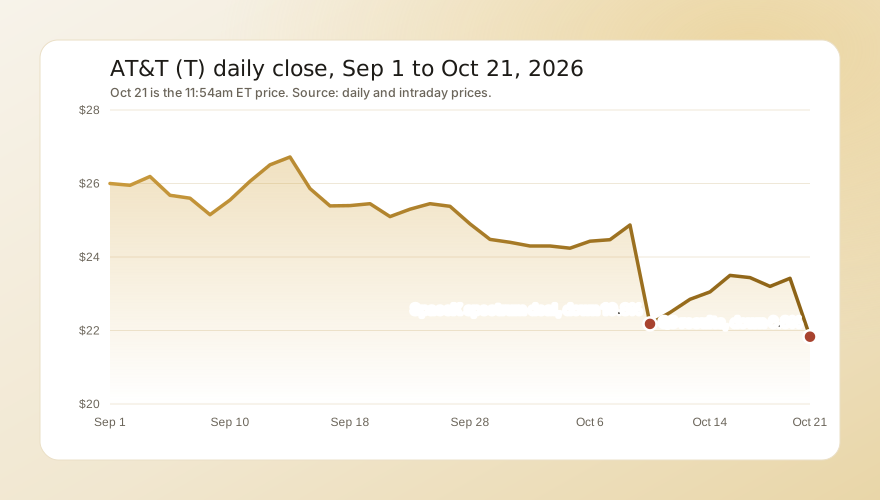
The stock traded at $23.52 when premarket trading opened at 4am and held near $23.70 until the release came out around 6:30am. It dropped to $22.13 within minutes, bounced to $23.01 by 6:45am, then slid through the 8:30am call to $21.80 at about 9:05am. It opened the regular session at $21.89, rallied to a high of $22.62 by 9:35am, and then faded all morning to a low of $21.79 at about 11:45am. At 11:54am it was $21.83 on about 39 million shares, and the drop had taken about $11 billion off its market value.
What pushed it down:
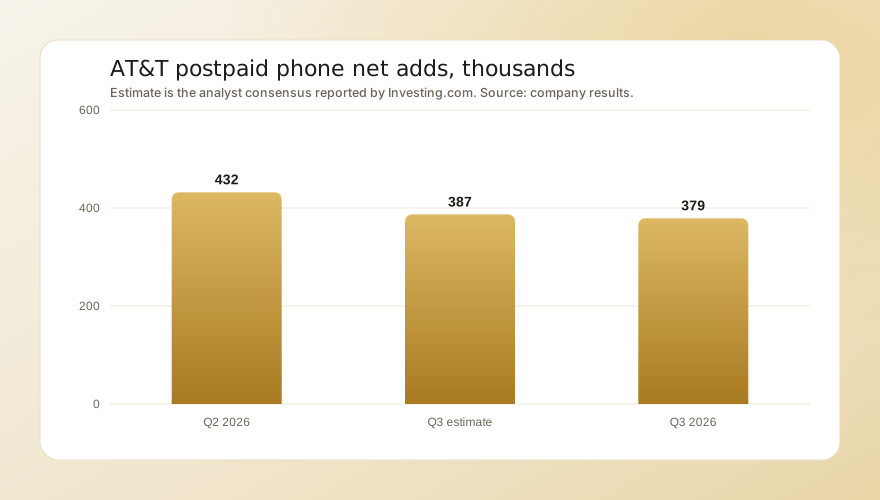
- Fewer new phone customers. The 379,000 postpaid phone net adds missed the roughly 387,000 consensus that Investing.com cited and fell 53,000 from the second quarter. Investing.com called the miss "the focal point of today's selling pressure."
- Churn went up. Postpaid phone churn was 0.92%, against 0.86% in the second quarter. Desroches called it "stable year-over-year," which it was, but the quarter-on-quarter rise came while AT&T was spending on promotions.
- Costlier customers ahead. Desroches said the fourth quarter will carry "higher marketing and other customer acquisition costs compared to last year, driven by an extended device launch cycle," and said "the level of promotions remains the same."
- More debt. Total debt reached $159.6 billion and net debt $149.8 billion at Sept. 30, up from $126.4 billion of net debt at June 30, after what Desroches called "our $23 billion purchase of spectrum licenses from EchoStar at the end of July."
- SpaceX hangs over the group. New Street Research analyst David Barden raised SpaceX on the call. CEO John Stankey said "LEO constellations are fantastic for delivering bandwidth to rural areas" and argued that competitors "cannot and will not match our operating proficiency" where AT&T has fiber and 5G.
Investing.com also noted that Arete Research cut its target to $23 from $28 earlier in October. The broad market was up, so this was not a market day.
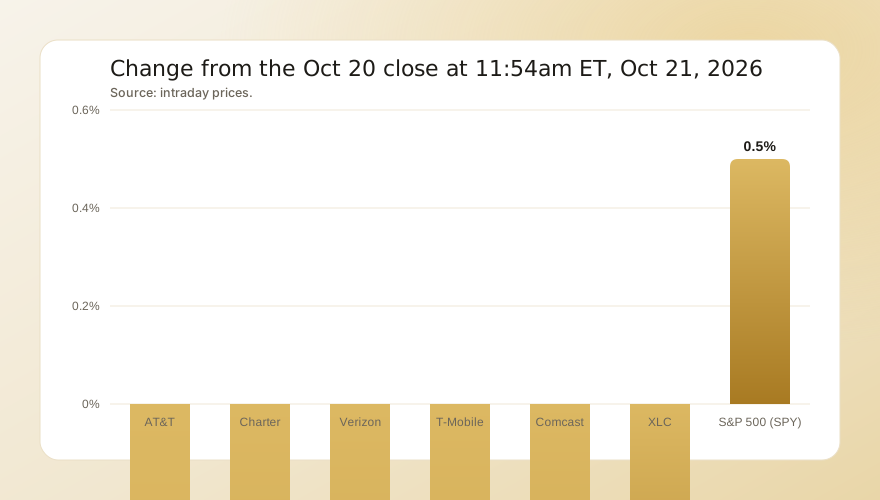
| Stock or fund | Oct 20 close | Oct 21, 11:54am | Change |
|---|---|---|---|
| AT&T (T) | $23.42 | $21.83 | -6.8% |
| Charter (CHTR) | $110.03 | $106.30 | -3.4% |
| Verizon (VZ) | $44.54 | $43.13 | -3.2% |
| T-Mobile (TMUS) | $157.75 | $152.87 | -3.1% |
| Comcast (CMCSA) | $22.36 | $21.82 | -2.4% |
| Communication services ETF (XLC) | $110.19 | $109.36 | -0.8% |
| SPDR S&P 500 ETF (SPY) | $769.05 | $772.67 | +0.5% |
Every carrier and cable company fell, which says investors read AT&T's slowdown as a warning about the whole wireless and broadband market. That is why the next two reports matter. For other names moving today, see today's biggest stock moves.
After the drop, RSI(14) stood at 31, the shares sat 12% below their 50-day average and 13% below their 200-day average, volume by midday was 0.9 times its 20-day average of 44.7 million shares, and the stock was 26% below its 52-week high of $29.44.
The numbers
| Metric | Q3 2026 | Q2 2026 or estimate |
|---|---|---|
| Revenue | $32.3B, +5.3% | $31.7B estimate |
| Adjusted EPS | $0.65 | $0.60 estimate |
| Postpaid phone net adds | 379,000 | 432,000 in Q2 |
| Postpaid phone churn | 0.92% | 0.86% in Q2 |
| Fiber net adds | 442,000 | 367,000 in Q2 |
| Net debt | $149.8B | $126.4B at June 30 |
| Free cash flow | $5.0B | $4.9B a year ago |
Reported EPS from continuing operations was $0.13 because of a $2.6 billion non-cash impairment on the Mexico wireless business, which AT&T agreed on Oct 13 to sell to Grupo Televisa and Fintech Holdings, plus employee separation charges. Wireless service revenue rose 5.0%, but the release says pricing actions were "partially offset by promotional discounts," and operating expenses in the main segment rose on equipment costs, advertising and bad debt. Our guide to reading an earnings call transcript explains why lines like these matter more than the headline beat.
The case for the stock
Home internet was the best part of the quarter. AT&T added a record 769,000 internet customers, 442,000 on fiber and 327,000 on fixed wireless, and fiber now reaches more than 39 million locations. Operating income in the main segment rose 18.9% to $7.6 billion. The company lowered capital investment for 2027 and 2028 to $22 billion to $23 billion a year, which should lift free cash flow, and it targets $19 billion or more in 2027 and $21 billion or more in 2028. It has already bought back more than $7 billion of stock this year. At $21.83 the free cash flow target is about 12% of the market value, a level our explainer on free cash flow yield puts in context, and the average analyst target is $27.39.
The risks
- Leverage. Net debt to adjusted EBITDA of 3.13 times is up from 2.68 times, and AT&T expects to reach the 2.5 times range during 2029, helped by proceeds in 2027 from its fiber joint venture. For how lenders and investors judge a load like this, see what counts as a high debt-to-equity ratio.
- SpaceX. On Oct 8, SpaceX agreed to buy a nationwide 800 MHz spectrum portfolio from Grain Management, up to 14 MHz of paired low-band spectrum that most phones already support, The Register reported. The deal needs FCC approval. SpaceX said Starlink Mobile "can now become the first network operator to deploy both satellite and terrestrial spectrum." In August, SpaceX president Gwynne Shotwell said she expects to "acquire quite a few of their customers."
- Promotions. If the fourth quarter brings higher acquisition costs and phone adds keep slowing, the raised EPS outlook will rest more on cost cuts than on growth.
What comes next
- Verizon's third-quarter report on Oct 26. Watch postpaid phone churn and promotional spending.
- T-Mobile's report on Oct 28. Its phone adds and churn will show whether the slowdown reaches all three carriers.
- The FCC review of the SpaceX spectrum deal. Approval would let Starlink Mobile build a ground network.
- AT&T's fourth-quarter report in January. It will show whether higher acquisition costs bought more phone customers. Our guide to preparing for an earnings report covers what moves a stock on the day.