

Nov 16, 2026: a 68% cut in recurrence risk, and a premarket gain that faded
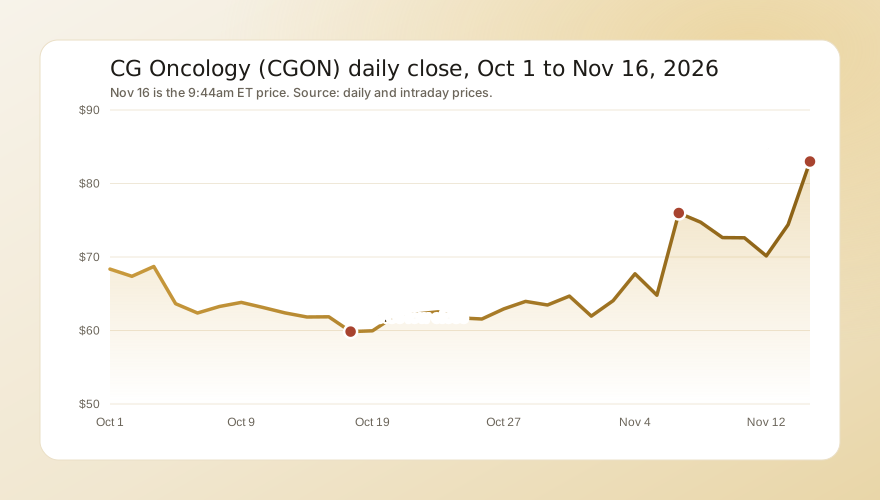
CG Oncology closed Nov 13 at $74.40. Premarket trading stood at $74.00 at 7:30am. At 8am the company released topline results from PIVOT-006 and filed an 8-K, and within minutes the stock traded as high as $105.50, 41.8% above the prior close. It held near $97 to $99 through most of the hour before the open, then slipped to $92.00 in the last minutes of premarket trading. Investing.com reported a 23.7% pre-open gain to $92, above the prior 52-week high of $80.97.
The stock opened at $92.00 and sold off fast. It hit a session low of $80.75 within the first ten minutes, then steadied: at 9:44am it was $83.00, up 11.6%. About 1.8 million shares had traded by then, more than the stock's full-day average of about 1.0 million.
What pushed it up:
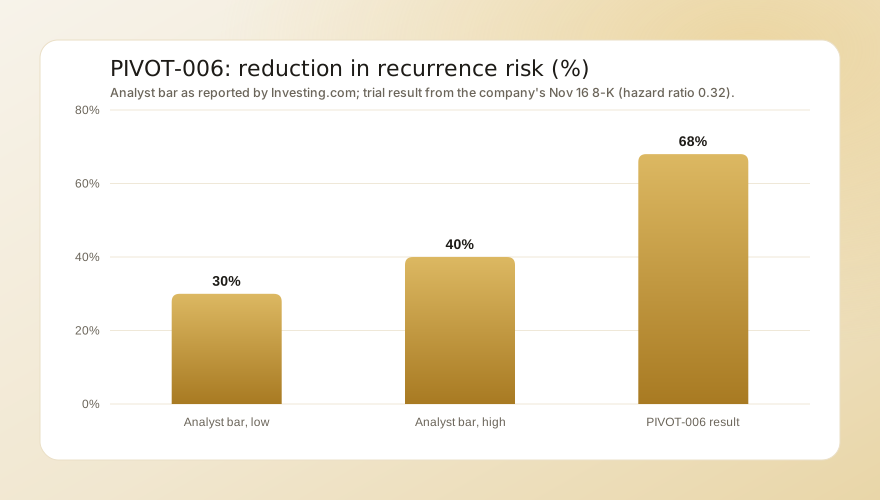
- The size of the effect. A 68% reduction in recurrence risk, with a hazard ratio of 0.32, in one of the largest randomized Phase 3 trials run in intermediate-risk non-muscle invasive bladder cancer, according to the company.
- A population with no approved add-on treatment. The company says about 50,000 U.S. patients have intermediate-risk or high-grade Ta tumors of 3 cm or less, and none has an FDA-approved treatment to give after the tumor is removed.
- Safety. No Grade 3 or higher treatment-related adverse events and no treatment-related discontinuations, consistent with earlier studies.
What held it back:
- A later first filing. The Nov 6 third-quarter release guided to completing the first BLA, in BCG-unresponsive disease with carcinoma in situ, in the fourth quarter of 2026. After FDA feedback, the company will broaden it to include high-grade papillary-only patients and now expects to complete it in March 2027.
- The market. The Nasdaq 100 fund QQQ was down 1.3% at 9:44am.
Our explainer on how Phase 3 readouts move stocks covers why a strong result can still open well below its premarket high.
Other bladder cancer and biotech names did not join the move. At 9:44am:
| Stock or fund | Change from Nov 13 close |
|---|---|
| CG Oncology (CGON) | +11.6% |
| Johnson & Johnson (JNJ) | +0.7% |
| SPDR S&P Biotech ETF (XBI) | -0.6% |
| Invesco QQQ (QQQ) | -1.3% |
| ImmunityBio (IBRX) | -3.1% |
| UroGen Pharma (URGN) | -3.2% |
UroGen and ImmunityBio both sell bladder cancer drugs, and both fell about 3%. Our page on why ImmunityBio stock fell covers its Anktiva sales, and the rest of the session's movers are in today's biggest stock moves.
After the gain, RSI(14) stood at 70, the shares sat 22% above their 50-day average and 24% above their 200-day average, and volume in the first 15 minutes was already 1.5 times the 20-day daily average.
The numbers
| Measure | Figure |
|---|---|
| Patients enrolled | 367, at about 90 sites |
| Comparator | Surveillance after tumor removal |
| Hazard ratio for recurrence | 0.32 (95% CI 0.23 to 0.45) |
| Reduction in recurrence risk | 68% |
| Median follow-up | 17 months, as of Oct 26, 2026 |
| Grade 3 or higher treatment-related adverse events | None |
| Cash, equivalents and securities, Sept. 30 | $984.5M |
| Third-quarter net loss | $56.9M, or $0.64 a share |
Third-quarter research and development spending was $39.2 million and general and administrative spending $23.0 million. At $83.00 the company is worth about $7.4 billion, against about $11 of cash per share, and the shares trade at about 7.5 times book value. The consensus price target is $92.50, with a range of $85 to $100. Our guide on how to value a biotech pipeline covers how to weigh a drug that is not yet approved against cash on hand.
The bull case
Cretostimogene now has randomized Phase 3 data in a population with no approved add-on treatment, on top of its BOND-003 Phase 3 trial in BCG-unresponsive disease, where it holds FDA Breakthrough Therapy and Fast Track designations. The chief medical officer said the benefit held "across both high-grade and low-grade patients." The company says all manufacturing work for both filings is done, so the remaining gap to the first filing is clinical data, not plant readiness. Cash should last through 2029, which lowers the risk of a share sale before launch. Short sellers held 15.5% of the float at about 9.3 days to cover before the data, so a further rerating could force some of them to buy. Our explainer on short interest and days to cover covers how to read those figures.
The risks
- Filing delays. The first BLA moved from the fourth quarter of 2026 to March 2027, and the second is not due until the second quarter of 2027. Each step pushes revenue further out. Our explainer on regulatory approvals as catalysts covers how filing slips weigh on a stock.
- Trial design. PIVOT-006 compared treatment with surveillance, not with a placebo or another drug, and the full data have not been presented. The FDA may read the results differently from the company, which the company's own filing names as a risk.
- Competition. The FDA approved UroGen's Zusduri for recurrent low-grade intermediate-risk disease on June 12, 2025, after its ENVISION trial showed a 78% complete response rate at 3 months. It approved Johnson & Johnson's Inlexzo, formerly TAR-200, for BCG-unresponsive disease with carcinoma in situ on September 9, 2025, on an 82% complete response rate.
- Valuation. At about $7.4 billion with no product revenue, the stock already prices in a good share of a launch.
What comes next
- Society of Urologic Oncology meeting, December 2, 2026. The full PIVOT-006 results, including the split between high-grade and low-grade patients and the dropout rates in each arm. Our explainer on medical conferences as catalysts covers what to look for in a podium talk after a topline release.
- December 2026. 12-month data from BOND-003 Cohort P, in BCG-unresponsive papillary-only disease, and CORE-008 Cohort CX.
- March 2027. Completion of the first BLA, now covering both carcinoma in situ and high-grade papillary-only BCG-unresponsive disease.
- Second quarter of 2027. The planned second BLA, in intermediate-risk and high-grade Ta disease.