

Nov 12, 2026: a guide cut in the first report after the spin
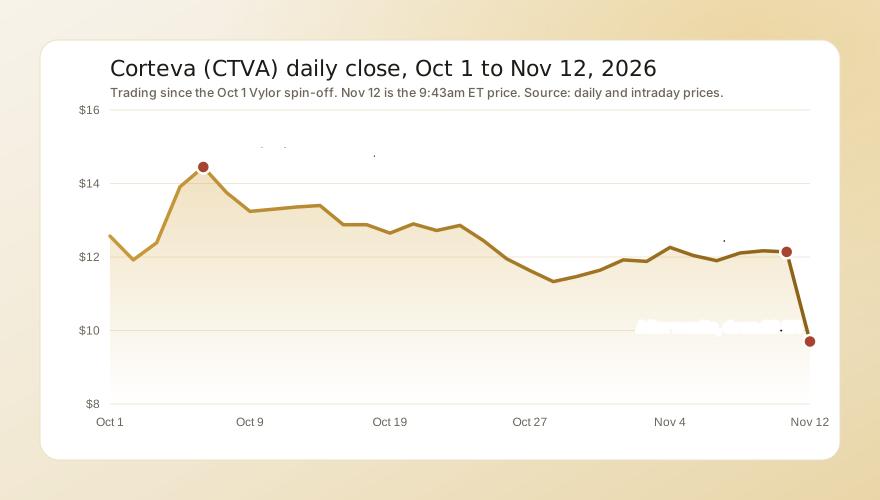
Corteva released results at 4:30pm ET on Nov 11, after a session in which the stock closed at $12.14. It had filed a notice on Nov 10 that its 10-Q would be late because of reporting work tied to the Oct 1 separation, and warned of "a higher seasonal loss" for the quarter. In premarket trading on Nov 12 the stock was $11.11 at 4:02am, reached $11.34, and slid to $10.16 by 9:29am as the selling built ahead of the open. It traded as high as $10.69 in the first minute of the regular session, fell to $9.56 at 9:34am and was $9.70 at 9:43am on about 5.5 million shares.
The selling spread to the closest crop protection peer and to fertilizer names, but Corteva fell hardest. At about 9:41am FMC was down 10.3%, Mosaic 6.2%, Nutrien 3.0% and Vylor 3.1%, while the VanEck Agribusiness fund MOO was down 0.4% and the S&P 500 fund SPY was up 1.0%. FMC also sells heavily into Brazil, so its drop reads as investors marking down the same market.
After the drop, RSI(14) stood at 26, the shares sat 21.9% below their 50-day average and 20.4% below their 200-day average, and they were 33.9% below the 52-week high of $14.62 set on Oct 7. Early volume of about 5.4 million shares compares with a 20-day average of 20.1 million. More of today's biggest stock moves are on our market page.
What moved the stock:
- Sales missed by about $180 million. Net sales of $1.591 billion compared with about $1.77 billion expected. Volume fell 2% and price fell 7%.
- Brazil broke. Latin America sales fell 28% to $570 million from $791 million. Volume dropped 24% "due to elevated channel inventory and delayed purchasing given farmer liquidity constraints and high interest rates," and price fell 7% on competition in older molecules.
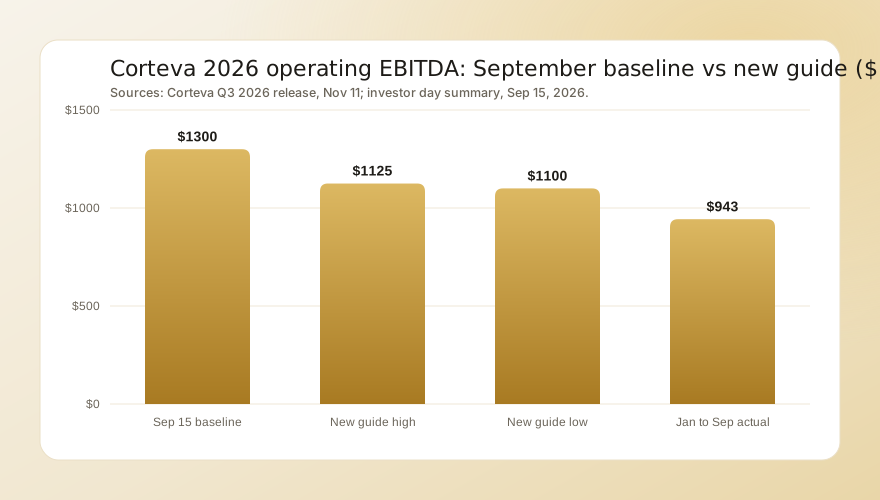
- The year came down. Corteva set 2026 operating EBITDA at $1.1 billion to $1.125 billion and operating EPS at $0.76 to $0.80. The release cites "a significantly softer market than previously anticipated" in Brazil.
- The fourth quarter is thin. Nine-month operating EBITDA was $943 million and operating EPS $0.76, so the guide implies fourth-quarter EBITDA of $157 million to $182 million and EPS of $0.00 to $0.04.
The numbers
| Measure (adjusted pro forma) | Q3 2026 | Q3 2025 | Change |
|---|---|---|---|
| Net sales | $1,591 million | $1,742 million | -9% |
| North America | $574 million | $537 million | +7% |
| EMEA | $239 million | $213 million | +12% |
| Latin America | $570 million | $791 million | -28% |
| Asia Pacific | $208 million | $201 million | +3% |
| Operating EBITDA | $222 million | $268 million | -17% |
| Operating EPS | $0.06 | $0.14 | -57% |
The pro forma GAAP loss from continuing operations was $54 million, or $0.08 a share, against income of $60 million a year earlier. Through nine months, operating EBITDA was flat at $943 million and the margin rose 30 basis points to 17.6%, which shows how much of the year rested on the fourth quarter. Corteva expects $130 million to $140 million of pre-tax restructuring charges in 2026 as it reshapes its crop protection manufacturing network. Our guide on how to read an earnings release covers how to separate pro forma and adjusted figures like these from GAAP results.
The bull case
The problem is narrow. Outside Latin America, Corteva grew: North America volume rose 19% on new products and early demand, EMEA grew organic sales 14% while holding price flat, and Asia Pacific volume rose 7%. Kissam said "new products performed strongly, productivity delivered," and that U.S. acetochlor pricing was in line with plans. The adjusted EPS beat shows costs held up even as Brazil fell apart.
The price already reflects a lot. At $9.70 the stock trades at about 12 times the midpoint of the new EPS guide and at a forward P/E of about 13. The average analyst target is $16.19, and about 7.7% of the float is sold short, which can add fuel to any rebound. The board authorized Corteva's first common dividend since the spin. Spin-offs often see forced selling in their first months as index and income funds rebalance, and our explainer on spin-off investing covers why that pressure can push a newly separated company below its value.
The risks
Corteva sells roughly $1.7 billion a year in Brazil, AgNavigator reported in September, and the issues the company named, farmer credit, high rates and just-in-time buying, do not clear in one quarter. Channel inventory has to be sold through before orders return, and price competition in molecules late in their lifecycle is structural. With nine-month EPS already at the bottom of the full-year range, the guide leaves little room if Brazil weakens further.
Estimates still have to fall. The fourth-quarter EPS estimate of about $0.08 sits above the top of the implied range, and the 2029 targets of $1.45 billion to $1.65 billion of EBITDA now start from a base about 14% lower than the one shown in September. Our explainers on earnings estimate revisions and guidance changes cover why the weeks after a cut like this often bring more selling.
There is also legal and filing noise. Fifteen states and one sovereign sued on Oct 1 to challenge the separation, and an Oct 9 restraining order, stayed pending appeal, would bar dividends and buybacks; in October the court relied on Corteva's statement that it did not intend to declare dividends or repurchase shares while the appeal motion was pending. The late 10-Q is tied to spin-off accounting, but our page on what a reporting delay signals explains why the market treats any delay with caution.
What comes next
Corteva holds its earnings call at 10:30am ET on Nov 12. It expects to file the 10-Q within five calendar days of the due date, and the Seventh Circuit appeal on the separation is still pending. The fourth-quarter report is estimated for February 3, 2027. Watch for analyst cuts to fourth-quarter and 2027 estimates, any update on Brazil channel inventory, and whether the shares hold above the $9.56 low. Our page on post-earnings announcement drift covers why stocks that gap down on a guidance cut often keep drifting the same way.