

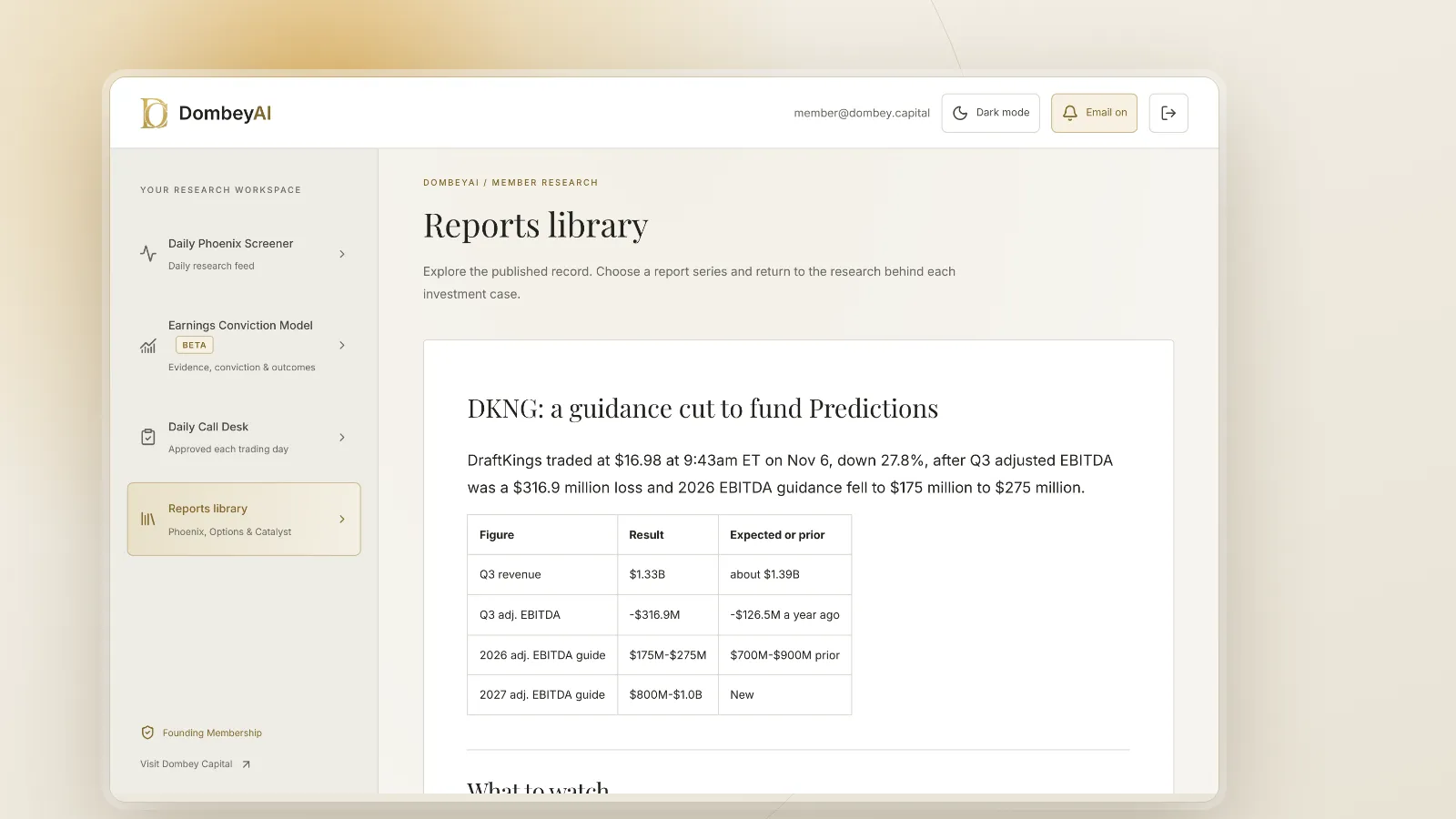
Nov 6, 2026: a gap down on the guidance cut
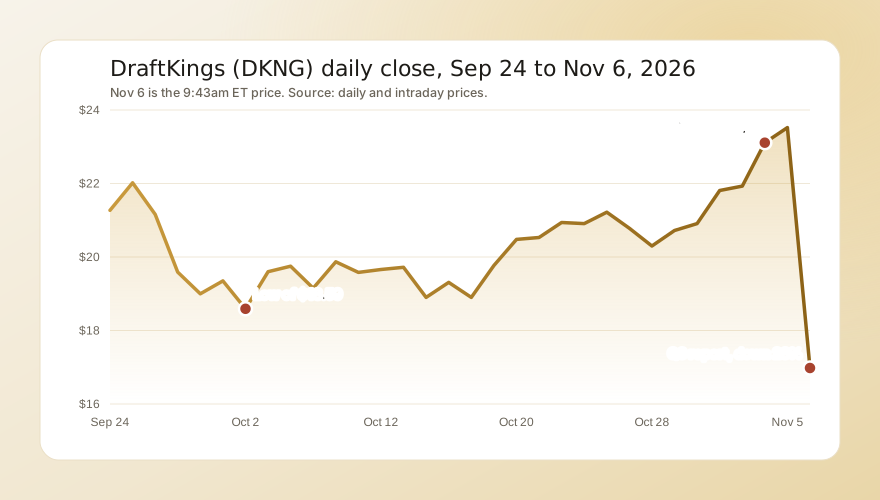
The stock closed at $23.52 on Nov 5, near the top of its six-week range, after rising from $18.59 on Oct 2. Premarket trading ranged from a high of $19.00 near 6:25am to a low of $16.98 near 8:50am. It opened the regular session at $17.34, touched $16.60 by 9:40am and was $16.98 at 9:43am, on about 9.4 million shares.
What happened:
- A wider loss. Revenue was $1,329.1 million, up 16.2%, below the $1.39 billion analysts expected. The net loss was $468.7 million, or $0.94 per share, and the adjusted loss was $0.53 per share. Estimates we found ran from a $0.28 to a $0.41 loss.
- Adjusted EBITDA fell to a $316.9 million loss. A year earlier the loss was $126.5 million. ZeroHedge reported that Bank of America had expected a $100 million loss and the Street a $66 million loss. Sales and marketing rose to $605.7 million from $360.4 million, iGaming Express reported.
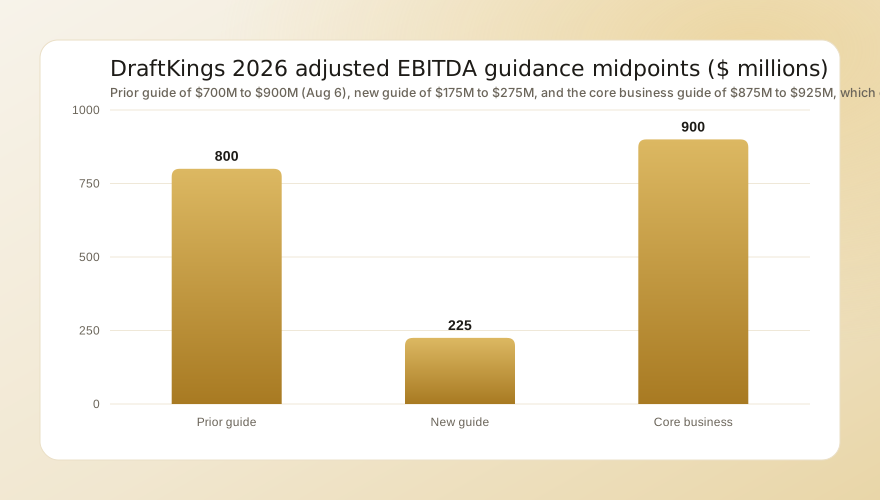
- Guidance fell. The company now expects 2026 revenue of $6.35 billion to $6.55 billion, down from $6.5 billion to $6.9 billion, and adjusted EBITDA of $175 million to $275 million, down from $700 million to $900 million. The midpoint of the EBITDA range fell by $575 million.
- The reason is Predictions. The company plans $650 million to $700 million of adjusted EBITDA investment in its Predictions exchange in 2026, including $175 million to $225 million in the fourth quarter, and expects Predictions revenue to be immaterial this year. ZeroHedge reported that Bank of America put $475 million of the $575 million cut down to Predictions and the other $100 million to a lower core forecast.
- 2027 looks better on paper. It guided revenue of $7.35 billion to $7.75 billion and adjusted EBITDA of $800 million to $1.0 billion, with Predictions revenue of $650 million to $750 million against $250 million to $350 million of investment.
From the Nov 5 close, at 9:43am:
| Stock or fund | Nov 5 close | Nov 6, 9:43am | Change |
|---|---|---|---|
| DraftKings (DKNG) | $23.52 | $16.98 | -27.8% |
| Flutter (FLUT) | $82.97 | $77.79 | -6.2% |
| Penn Entertainment (PENN) | $17.34 | $16.68 | -3.8% |
| MGM Resorts (MGM) | $32.54 | $31.83 | -2.2% |
| Caesars (CZR) | $29.18 | $29.08 | -0.3% |
| Consumer discretionary fund (XLY) | $117.64 | $117.54 | -0.1% |
DraftKings fell about 280 times as far as the sector fund and four times as far as Flutter, its closest peer, so the drop is mostly about its own report. Flutter and Penn also slipped, so part of the move may be read-across, but neither came close to DraftKings' loss. More of the day's swings are in today's biggest stock moves.
After the drop, RSI(14) stood at 33, the shares sat 22% below their 50-day average and 30% below their 200-day average, volume ran 0.8 times its 20-day average with the session barely open, and the stock was 55% below its 52-week high of $36.98.
What the numbers say
The business that existed before Predictions is growing. Sports revenue, which the company now defines to include prediction markets, rose 31.5% to $783.6 million, sports consumer volume rose 21.9% to $13.9 billion, and the sports net revenue margin rose to 5.6% from 5.2%. Monthly unique payers rose about 13% to 4.1 million and revenue per payer rose to $109. iGaming was the soft spot: revenue grew only 2.1% to $460.9 million, which iGaming Express attributed to promotions.
The weak part is cash. Operating cash flow for the first nine months was $63.0 million, down from $342.4 million a year earlier, and cash was $1,100.9 million at Sept 30. The company says its core business keeps producing free cash flow that funds the Predictions push, and CFO Alan Ellingson said so in the release.
The market value of about $8.4 billion is roughly seven times the midpoint of the 2027 core EBITDA guide of $1.15 billion to $1.25 billion, before counting debt. That is a low multiple only if the core guide holds. Our explainer on forward and trailing P/E covers why a multiple depends on which earnings you trust.
What the guidance changed
| Item | Prior guide (Aug 6) | New guide (Nov 5) |
|---|---|---|
| 2026 revenue | $6.5B to $6.9B | $6.35B to $6.55B |
| 2026 adjusted EBITDA | $700M to $900M | $175M to $275M |
| 2026 core adjusted EBITDA | Not given | $875M to $925M |
| 2026 Predictions investment | Not given | $650M to $700M |
| 2027 revenue | Not given | $7.35B to $7.75B |
| 2027 adjusted EBITDA | Not given | $800M to $1.0B |
The revenue midpoint fell by $250 million, to $6.45 billion from $6.7 billion, and the new midpoint sits below the $6.65 billion analysts expected, Casino.org reported. The company links the revenue cut to more iGaming promotions and modestly customer-friendly sports outcomes, iGaming Express reported. The 2027 revenue midpoint of $7.55 billion implies 17% growth and sits just under the $7.59 billion consensus.
What management said
CEO Jason Robins called the quarter "a pivotal moment for DraftKings" and said "we believe we are set up for an exceptional 2027." In his shareholder letter he wrote that "in just a few months, we have become the clear number three Predictions exchange by Total Volume." The company expects the 2026 customer cohort to pay back in about 20 months, against a two-year target, and models a seasonally annualized adjusted gross profit run rate of $350 million for that cohort. Those are modeled figures, not realized cash flow, as iGaming Express noted.
The exchange economics are thin so far. The exchange carries an 11.1% take rate, and DraftKings kept 65.6% of that gross revenue in September and October, an effective 7.3% of consumer volume before promotions and costs, iGaming Express reported. New-customer promotions offset most of the 2026 revenue, which is why the company calls it immaterial. DraftKings expects Predictions to add to adjusted EBITDA in 2028, not before.
Investors are being asked to accept a year of heavy spending on a business whose legal footing is still disputed between states and federal regulators. The company stopped offering sports and other event contracts in Utah on Oct 29, which shows that access can change quickly.
The bull case
- The cut is a choice. Management is spending $650 million to $700 million on Predictions in 2026 and guides the core business to $875 million to $925 million. Only about $100 million of the $575 million cut reflects a weaker core forecast, per Bank of America.
- 2027 is guided up sharply. Adjusted EBITDA of $800 million to $1.0 billion compares with $175 million to $275 million this year, on revenue growth of 17% at the midpoint.
- Early Predictions numbers are strong. More than 1.6 million customers have engaged this year, and the company expects the 2026 cohort to pay back in about 20 months, ahead of its two-year target.
- Sentiment is washed out. The stock is 55% below its high, and the consensus price target is about $32, with a low of $22 and a high of $48. Bank of America cut its target to $23 and kept a Buy rating.
- The balance sheet can carry it. Cash of $1.1 billion plus a core business that generates free cash flow covers a fourth-quarter Predictions bill of up to $225 million.
The risks
- Open-ended spending. A cut of this size resets what investors expect from every later quarter. Our guide to why outlooks move stocks explains why a guidance cut can matter more than a revenue miss.
- Rules for event contracts are unsettled. Predictions sports trading is offered in 17 states, and DraftKings stopped sports and other event contracts in Utah on Oct 29, iGaming Express reported. A broader halt would hit the 2027 revenue target of $650 million to $750 million.
- Core growth is modest. The 2027 core revenue guide of $6.7 billion to $7.0 billion implies growth of 4% to 9% from the 2026 midpoint.
- Estimates will fall. Analysts will cut forecasts after the report. Our piece on earnings estimate revisions covers how that can keep pressure on a stock after the first day.
- A gap this size can extend. Our note on base rates covers why a sharp first-day drop says little about the next month.
What comes next
The next dated checkpoint is the fourth-quarter report, listed for February 11, 2027. Before then, watch for any new state action on event contracts, the pace of Predictions customer growth, and how Flutter and others describe their own spending. Our guide to what makes an earnings catalyst covers how to prepare for a report like that. The test of the Bullish view is whether the fourth-quarter Predictions cost stays inside the $175 million to $225 million guide while the core business holds its $875 million to $925 million.