

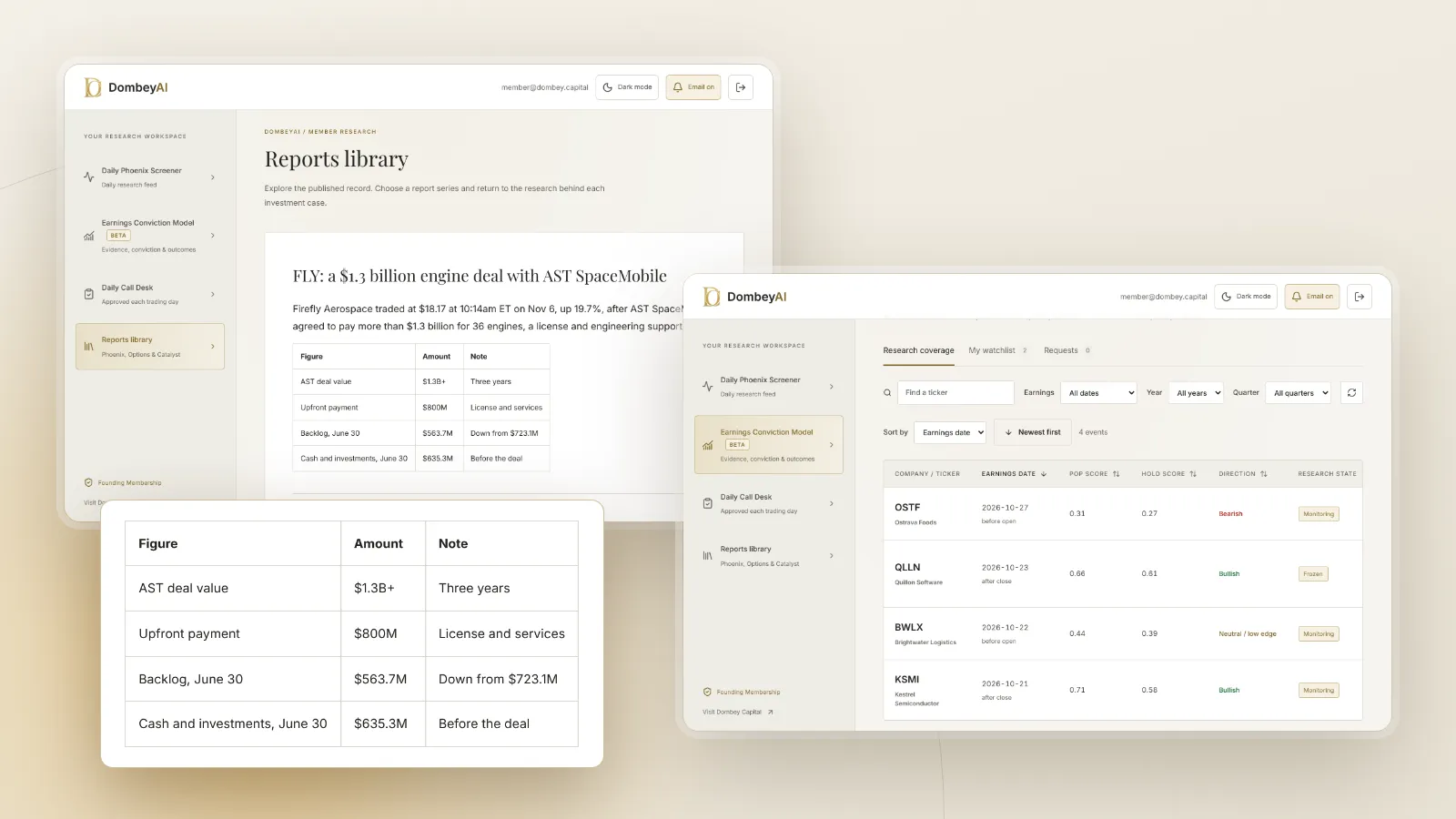
Nov 6, 2026: a $1.3 billion engine deal with AST SpaceMobile
Firefly announced the agreement before the open. Under it, Firefly delivers 27 Miranda engines and nine vacuum-variant Vira engines for AST SpaceMobile's first three heavy-lift rockets, and licenses AST to manufacture the engines itself. AST said it will pay $800 million upfront for the license and services, $250 million for engines and $250 million for engineering services, Reuters reported. The payment is a mix of cash and AST Class A common stock, and the stock carries lock-up periods.
What happened:
- AST is building its own rocket. The rocket is designed to carry 20 tons to orbit, about the size of a SpaceX Falcon 9, Barron's reported. AST designs and builds it, and Firefly supplies the engines. AST has struggled to get its satellites launched on schedule, and a Blue Origin explosion earlier this year set back its plans.
- Firefly keeps the design. Firefly retains full ownership of the engine intellectual property and will keep serving the government and commercial launch market. Both companies call the deal non-competitive by design.
- The engine is tested. Miranda, rated at 230,000 pounds of thrust, has run more than 175 hot-fire tests for more than 4,200 seconds, including a flight-like test at 110% of rated performance that ran 20 seconds past the nominal 206-second flight duration.
- The money goes into production. Firefly says it will expand hiring, buy long-lead materials and build several new test bays at its Briggs, Texas site to speed up its own launch vehicle production.
From the Nov 5 close, at 10:14am:
| Stock or fund | Nov 5 close | Nov 6, 10:14am | Change |
|---|---|---|---|
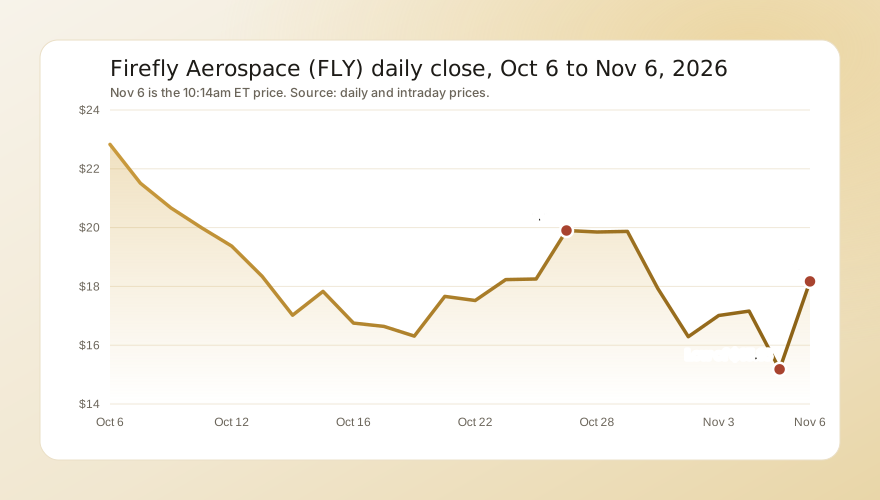
| Firefly Aerospace (FLY) | $15.18 | $18.17 | +19.7% |
| Intuitive Machines (LUNR) | $8.61 | $9.69 | +12.5% |
| Rocket Lab (RKLB) | $45.99 | $49.65 | +8.0% |
| AST SpaceMobile (ASTS) | $30.12 | $31.24 | +3.7% |
| Space industry fund (UFO) | $37.23 | $38.16 | +2.5% |
| S&P 500 fund (SPY) | $733.13 | $741.06 | +1.1% |
Space stocks rose across the board, and Benzinga reported that part of the day's move was a rebound after space and defense names fell on Thursday over military spending worries following the midterm elections. Firefly fell 11.6% on Nov 5 to a 52-week low of $14.44 during that session. Still, Firefly gained more than twice as much as Rocket Lab and about eight times as much as the space fund, so most of its move is the deal. More of the day's swings are in today's biggest stock moves.
After the jump, the shares sat about 11% below their 50-day average and 33% below their 200-day average, RSI(14) stood near 47, and the stock was 71% below its 52-week high of $62.17. About 13% of the float is sold short, which can add to a sharp move on good news.
What the deal is worth to Firefly
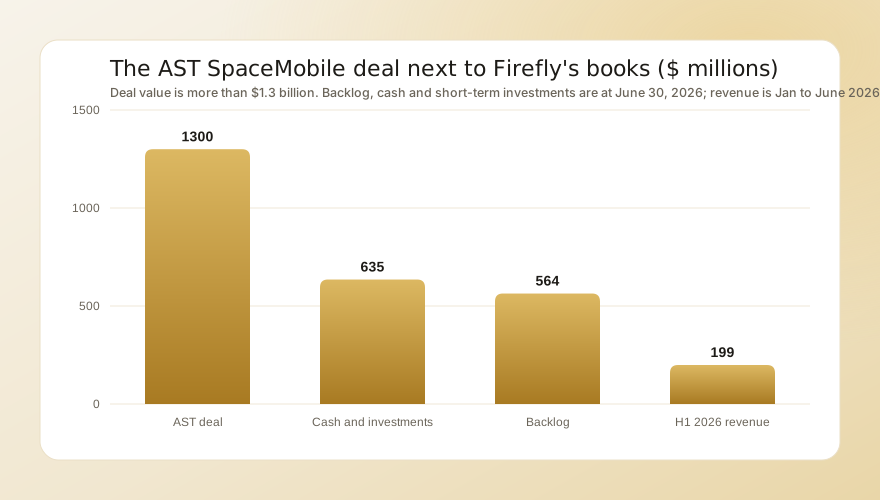
The deal is large next to everything else on Firefly's books.
| Figure | Amount |
|---|---|
| AST SpaceMobile deal value | More than $1.3 billion |
| Upfront payment for license and services | $800 million |
| Backlog (remaining performance obligations), June 30, 2026 | $563.7 million |
| Cash and short-term investments, June 30, 2026 | $635.3 million |
| Revenue, first half of 2026 | $198.6 million |
| Net loss, first half of 2026 | $189.0 million |
| Market value at the Nov 5 close | About $2.5 billion |
Backlog had been shrinking: it was $723.1 million at Sept 30, 2025, $652.6 million at March 31, 2026 and $563.7 million at June 30. This deal more than reverses that slide in one contract. The $800 million upfront is larger than Firefly's cash and short-term investments at June 30, and Firefly has been losing a little over $90 million a quarter, so the payment buys years of runway if most of it is cash.
The market is pricing the deal at a discount. About 166 million shares rose about $3, which adds roughly $500 million of market value, under 40% of the headline. Part of that discount is fair: licensing and engineering revenue comes with costs, and a payment in AST stock is worth whatever AST shares fetch when the lock-ups end. Our explainer on the book-to-bill ratio covers how new orders compare with revenue.
The bull case
- The money is near-term. $800 million is upfront and the whole deal runs three years, which is quick for a space contract.
- It funds Firefly's own rockets. The company says it will use the money to add test bays, buy materials ahead of need and hire, which speeds up its own launch vehicle production.
- It validates the engine. AST's CEO called Firefly "one of a few companies in the United States with a proven liquid engine of this scale." An outside buyer paying for a license is evidence that Miranda works.
- The stock was washed out. Before the deal it had fallen 71% from its high and closed at a 52-week low. The consensus price target is about $36, roughly double the current price, even after B. Riley cut its target to $40 from $50 on Nov 4 and KeyBanc cut to $35 from $50 on Nov 2.
The risks
- Part of the payment is AST stock. AST shares fell from above $130 to about $30 this year, Barron's reported. If the stock portion is large and AST keeps falling, the deal is worth less than $1.3 billion.
- Firefly is helping a possible rival. AST will be able to build Firefly's engines itself. Both companies call the deal non-competitive, but a customer that controls its own launch schedule is one less buyer of Firefly launches.
- Cash burn is high. Firefly lost $92.3 million in the second quarter. Our guide to estimating cash runway covers how to judge how long a loss-making company can last.
- Earnings are four days away. Analysts expect third-quarter revenue of about $102 million. A miss or a weak backlog figure on Nov 10 could undo part of the gain. Our note on base rates covers why one strong day says little about the next month.
What comes next
The next dated checkpoint is the third-quarter report after the close on Tuesday, Nov 10, with a call at 5pm ET. Watch for the split of the $800 million between cash and AST stock, how much of the deal lands in backlog, when the first payment arrives, and whether Firefly changes its launch cadence for 2027. Our guide to what makes an earnings catalyst covers how to prepare for a report like that. The test of the Bullish view is whether most of the upfront payment turns out to be cash.