

Nov 20, 2026: a beat, a lower revenue outlook and a sale
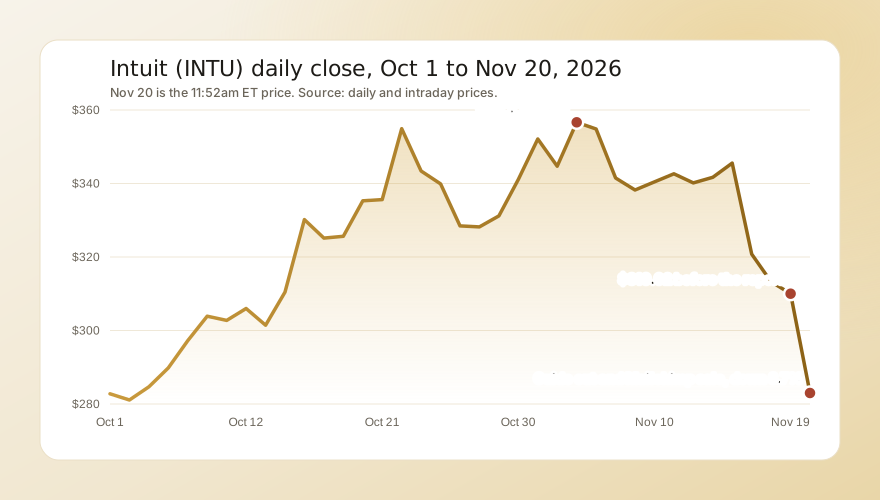
Intuit closed Nov 19 at $310.02, already down 10.3% from $345.56 on Nov 16. It released first-quarter results after the close that day, and early trading on Nov 20 hit $273.05 at 4:35am, 11.9% below the close, as traders reacted to the Mailchimp sale and the lower outlook.
The stock opened at $293.76 and climbed to $300.44 at 9:50am, cutting the loss to 3.1%. The rally did not last. As the Nasdaq slid with chip stocks, Intuit fell to $276.74 at 11:20am, 10.7% lower, and at 11:52am it was $283.00, down 8.7%, on 4.4 million shares.
What pushed it down:
- A lower revenue outlook. Intuit cut fiscal 2027 revenue guidance to $23.081 billion to $23.365 billion, growth of 8% to 9%, from $23.2 billion to $23.5 billion, or 9% to 10%, set in August, and said the change reflects Credit Karma, now guided to grow 3% to 7%.
- A slower second quarter. Second-quarter revenue is guided to $4.931 billion to $4.954 billion, up 6% to 7%, about half the first quarter's pace.
- Mailchimp goes, at a price. Bending Spoons will pay about $3.68 billion, $3.31 billion in cash and $368 million in its own stock. Mailchimp's revenue fell 1% in the quarter, so the sale removes a shrinking unit, but it also confirms that the email business did not work out inside Intuit.
- A weak tape for growth stocks. The Nasdaq Composite was down 2% at 11am, CNBC reported, as AI stocks sold off for a second day after Anthropic's listing.
Other software stocks did not follow Intuit down: Adobe rose 1.1%, Salesforce 0.4% and ServiceNow 1.9% by 11:52am, and H&R Block, its tax rival, rose 1.1%, while the Nasdaq 100 fund QQQ fell 3.5%. That points to a company-specific reaction, not a sector one. Our page on why ServiceNow fell covers another software name the market has marked down this year, and the rest of the day's movers are in today's biggest stock moves.
At 11:52am, RSI(14) stood at 30, the shares sat 11% below their 50-day average and 18% below their 200-day average, volume by midday ran 1.5 times the 20-day average, and the stock was 59% below its 52-week high of $682.27.
The numbers
| Measure | Q1 FY2027 | Change |
|---|---|---|
| Revenue | $4.354B | +12% |
| Global Business Solutions | $3.1B | +15% |
| Online Ecosystem | $2.4B | +20% |
| Consumer | $958M | +7% |
| Credit Karma | $708M | +9% |
| Mailchimp | $313M | -1% |
| Non-GAAP diluted EPS | $2.91 | +56% |
| GAAP diluted EPS | $2.59 | +63% |
The quarter was strong where Intuit is putting its weight. Global Business Solutions, which holds QuickBooks, grew 15%, and the Online Ecosystem inside it grew 20%. Chief executive Sasan Goodarzi said, "We delivered a solid first quarter, with results above the top end of our guidance," and that its "AI-driven expert platform increasingly does more of the work for consumers, businesses and accountants." From this quarter, Intuit's non-GAAP figures no longer exclude share-based pay, and past periods were restated to match, so the 56% growth compares like with like.
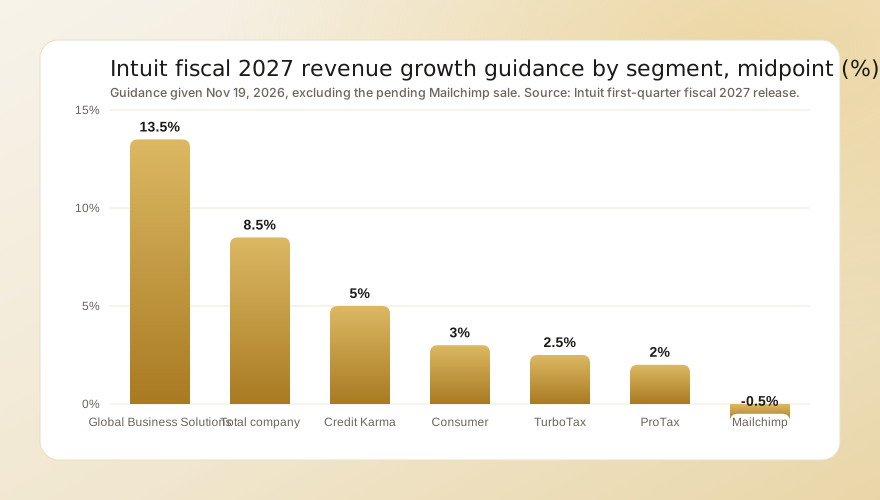
The full-year guide shows where growth comes from now: Global Business Solutions at 13% to 14%, and the consumer side at 2% to 4%. Our explainer on why guidance changes move stocks covers why a revenue trim can outweigh a beat, and our guide to reading an earnings release shows where to find the segment guidance that explains a cut like this one.
The bull case
The earnings guide did not move. Intuit still expects GAAP diluted earnings of $20.12 to $20.36 a share and non-GAAP earnings of $22.88 to $23.12, up 23% to 24%, so the market is paying about 12 times this year's guided earnings for a business growing them that fast. The Mailchimp sale turns a flat unit into $3.31 billion of cash that Intuit plans to spend on its own shares, on top of $1.5 billion of buybacks in the first quarter and $6.4 billion of remaining authorization. Our explainers on how a divestiture can reset a stock's value and when buybacks matter as catalysts cover both moves. Intuit also raised its quarterly dividend 15% to $1.38 a share. It ended the quarter with $5.3 billion of cash and investments against $6.9 billion of debt.
The risks
- Credit Karma. It is the reason for the cut, and its 3% to 7% guide is wide, which leaves room for another trim.
- The tax season. TurboTax is guided to grow only 2% to 3%, and the second and third quarters, which hold most of the tax season, decide the year.
- AI substitutes. The market is pricing the risk that AI assistants take tax preparation and credit comparison away from paid products, and a slower season would add to that case.
- Deal risk. The Mailchimp sale needs regulatory approval, and the buyback plan depends on it closing.
What comes next
- The dividend record date, Jan 8, 2027, with payment on Jan 15.
- The start of the U.S. tax filing season in late January, the first read on TurboTax demand.
- Second-quarter results, expected around Feb 25, 2027, against guidance of $4.931 billion to $4.954 billion in revenue and $3.17 to $3.22 of non-GAAP earnings a share.
- The Mailchimp closing, expected in early calendar 2027, which releases the cash for buybacks.