

Nov 2, 2026: the deal is signed, and the price falls
Lumentum closed at $919.53 on Oct 29 and then fell 8.6% to $840.70 on Oct 30, a day when the whole optical group dropped: Coherent fell 11.3%, Applied Optoelectronics 12.8% and Ciena 8.2%, and Marvell fell 10.0%. On Nov 2 it traded at $865 at 4am and as high as $880.99 in early premarket, then trading was halted pending news. Marvell and Lumentum announced the merger before the open, and Lumentum filed its quarterly results at the same time. Lumentum's last premarket print was $788.51 at 8:25am. It opened at $760.10, fell to $740.10 in the first hour and recovered as far as $800.12.
From the Oct 30 close, at 10:32am:
| Stock or fund | Oct 30 close | Nov 2, 10:32am | Change |
|---|---|---|---|
| Lumentum (LITE) | $840.70 | $753.00 | -10.4% |
| Marvell (MRVL) | $196.40 | $186.62 | -5.0% |
| Ciena (CIEN) | $320.72 | $314.00 | -2.1% |
| Applied Optoelectronics (AAOI) | $69.05 | $70.71 | +2.4% |
| Coherent (COHR) | $210.32 | $216.50 | +2.9% |
| Semiconductor fund (SOXX) | $471.51 | $477.36 | +1.2% |
Coherent, the other large U.S. maker of indium phosphide lasers, rose, and the chip fund gained. Lumentum fell about twice as far as Marvell, so the market cut both the deal value and the price it will pay to wait for it. More of the session's swings are in today's biggest stock moves.
After the drop, RSI(14) stood at 39, the shares sat 18% below their 50-day average and 6% below their 200-day average, and the stock was 34% below its 52-week high of $1,143.00. This is context, not a signal.
The deal terms
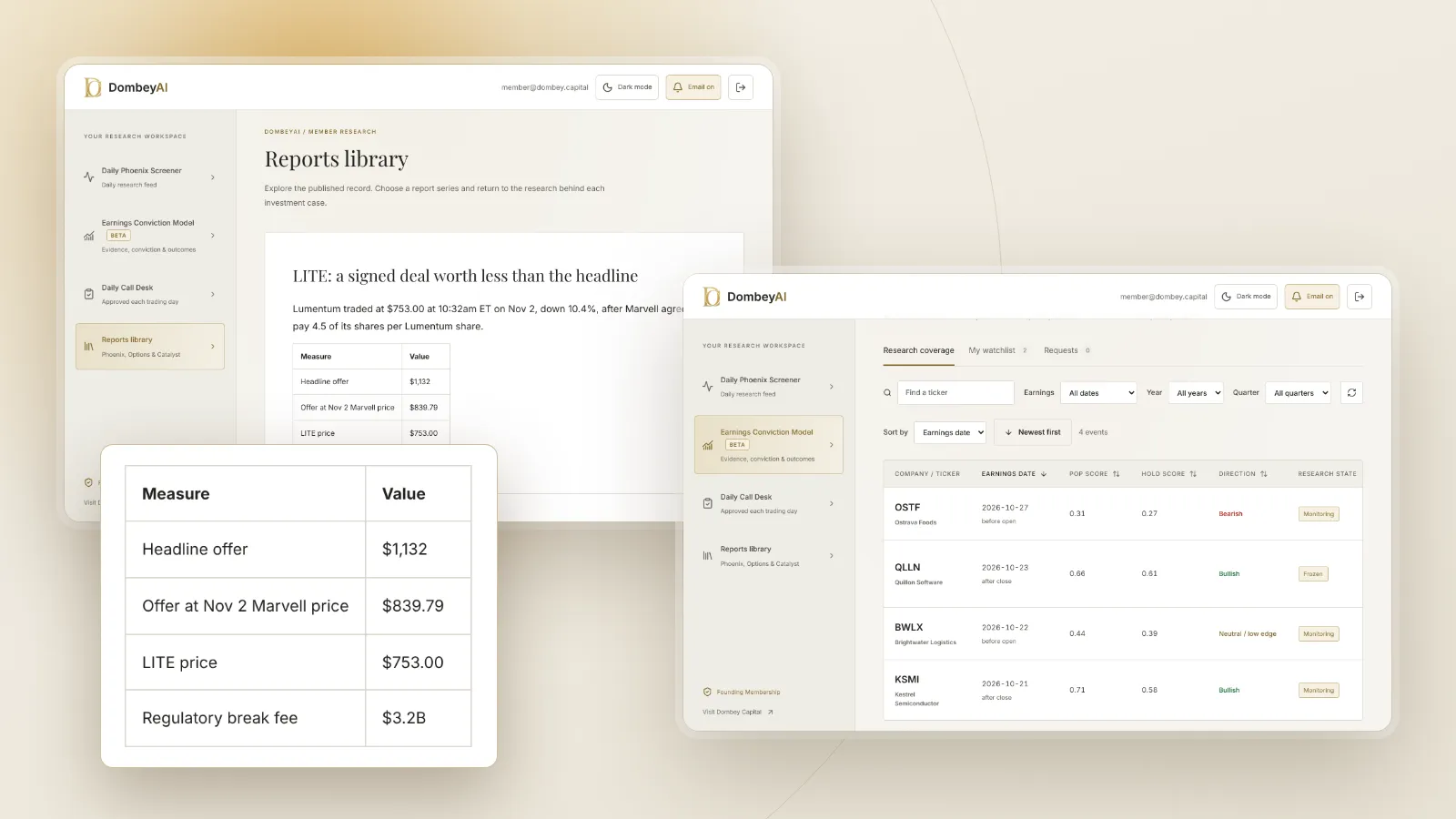
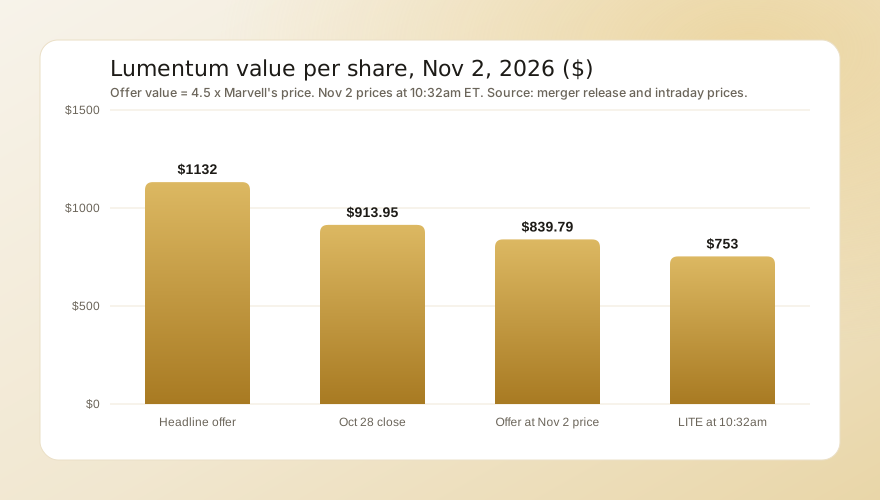
- Price. 4.5 Marvell shares for each Lumentum share, fixed. The companies put the implied enterprise value at $115 billion, about $1,132 a share at Marvell's Oct 28 close of $251.65. Lumentum holders would own about 33% of the combined company.
- Timing. Closing is expected in the first half of 2028 after both shareholder votes and regulatory approvals. The outside date is Nov 1, 2027, which can be extended to Feb 1, May 1 and Aug 1, 2028 if approvals are still pending.
- Break fees. Marvell would pay $5.8 billion if its board changes its recommendation or it takes a better offer, and $3.2 billion if the deal fails on antitrust or foreign investment grounds. Lumentum would pay $2.9 billion in the matching cases.
- The case Marvell made. The companies expect more than $1 billion of annual run-rate cost savings, a $550 billion addressable market and higher Marvell earnings per share in the first year after closing. Marvell CEO Matt Murphy stays as chairman and CEO, and three Lumentum directors, including CEO Michael Hurlston, join Marvell's seven-person board.
Our guides explain how exchange ratios work, how to calculate a merger arbitrage spread and how to read a merger agreement.
Why the price sits below the offer
A stock trading below a cash offer is normal; the gap pays holders for waiting and for the risk of a break. Here the gap is 11.5% on Marvell's price at 10:32am, with 18 months or more to wait. Three things make it wider than usual. The ratio is fixed, so every dollar Marvell loses costs Lumentum holders $4.50. The reviews are long and cross several countries; chip deals have needed China's approval before, and our explainer on the HSR waiting period covers the U.S. side. And if the deal fails, Lumentum would collect $3.2 billion, about $35 a share on 90.6 million shares, but would be left to trade on its own, which what happens when a deal breaks shows can go either way.
The quarter, which the deal overshadowed
| Measure | Q1 fiscal 2026 | Q4 fiscal 2026 | Q1 fiscal 2027 | Q2 fiscal 2027 guide |
|---|---|---|---|---|
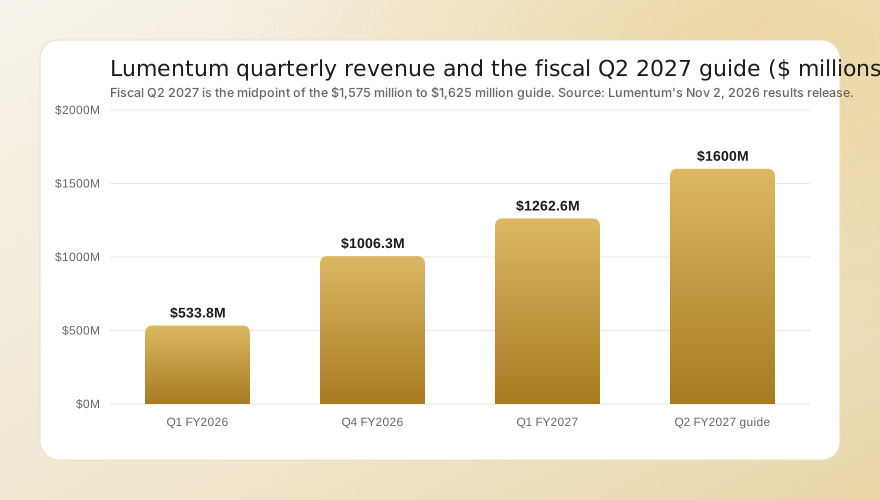
| Revenue | $533.8M | $1,006.3M | $1,262.6M | $1,575M to $1,625M |
| Non-GAAP operating margin | 18.7% | 36.6% | 42.3% | 45.0% to 46.0% |
| Non-GAAP EPS | $1.10 | $3.23 | $4.57 | $5.90 to $6.20 |
Revenue rose 136.5% from a year earlier and 25.5% from the prior quarter, near the top of the $1.225 billion to $1.275 billion guide. Non-GAAP earnings of $4.57 a share beat the $4.05 to $4.35 guide and the $4.22 consensus, and the operating margin beat the guide by about two points. Hurlston said Lumentum secured its second major co-packaged optics win, "backed by purchase commitments exceeding $5 billion," and that it expects about $350 million of sequential revenue growth in the second quarter. Cash fell $758.8 million in the quarter to $2.0 billion.
On its own, that quarter would have argued for a higher price. Annualizing the midpoint of the second-quarter earnings guide gives about $24.20 a share, which puts the stock near 31 times at $753, against a forward P/E of about 21.5 on full-year estimates.
The case for the stock
- A wide gap to a signed deal. At 10:32am the offer was worth $839.79, 11.5% above the price, backed by signed terms, unanimous boards and a $3.2 billion regulatory break fee.
- The business is accelerating. Revenue is guided up another 27% next quarter with a margin above 45%, so Lumentum holders bring a growing earnings stream into the combined company.
- Marvell's drop may be overdone. Marvell has fallen 25.8% since Oct 28 on a deal its management calls accretive in year one, and every $1 rebound in Marvell adds $4.50 to the offer value.
The risks
- Marvell's shares set the price. Lumentum's value now depends on a buyer whose stock has fallen for three straight sessions.
- A long wait. The deal may not close until the first half of 2028, and the outside date can run to Aug 1, 2028.
- Holders give up upside. Lumentum holders swap a business guided to 27% sequential growth for a third of a larger, slower-growing company. Shareholder law firms announced investigations of the price the same morning, and a no vote is possible; see how shareholder votes become catalysts.
- Volatility. Short interest is about 8.7% of the float, and the stock has moved 7% or more in a day seven times since Oct 1.
What comes next
- Marvell's fiscal third-quarter results, expected Dec 1, with its fourth-quarter outlook.
- Merger filings. A joint S-4 with the full background of the deal and the fairness opinions; our explainer on S-4 merger registrations shows what to look for.
- Regulatory filings in the U.S. and abroad, and any sign of an in-depth review.
- The shareholder votes at both companies, not yet scheduled.
Oct 28, 2026: a third day up, then a takeover report after the bell
Lumentum stock closed up 5.5% at $913.95 on Oct 28, 2026, its third straight gain as optical stocks recovered from last week's selloff. About an hour after the close, Bloomberg News reported that Marvell Technology is in advanced talks to buy the company and that a deal could be announced as soon as next week. Lumentum traded as high as $1,072.10 after hours, 17.3% above the close, and was $994.08 at 5:35pm ET. Marvell fell 9.6% to $227.59. Neither company commented, and no price or structure was reported.
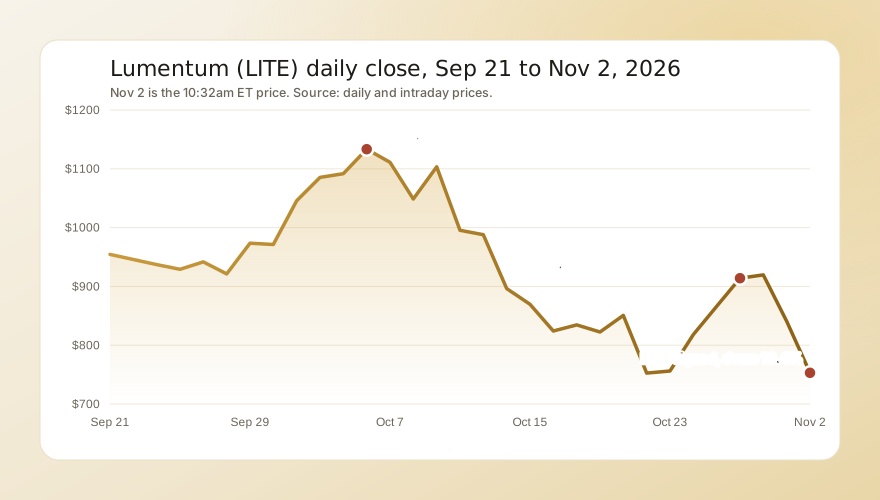
In the regular session Lumentum opened near $883, traded around $895 to $900 through midday and added about $15 in the last 90 minutes, closing at $913.95, up $47.77. Volume was about 5.4 million shares against a 4.87 million average. The stock has now gained 20.9% in three sessions, from $756.17 on Oct 23.
The rebound started on Monday, Oct 26, when Lumentum led the S&P 500 with an 8.2% gain. StoneX started coverage with a Buy rating and a $1,200 price target that day, citing Lumentum's "critical scarcity points" in high-speed indium phosphide lasers and cloud transceivers. Evercore ISI analyst Amit Daryanani gave three reasons for the group's recovery: an expected U.S. limit on imports of foreign-made optical transceivers by the end of the first quarter of 2027, which would shut out Chinese suppliers that make about two-thirds of them; reports that indium phosphide capacity expansions are wavering; and renewed confidence in AI spending. He called optics "a critical bottleneck to the AI buildout."
The takeover report crossed after 5pm ET. The after-hours moves at 5:35pm:
| Stock | Oct 28 close | 5:35pm ET | Change |
|---|---|---|---|
| Lumentum (LITE) | $913.95 | $994.08 | +8.8% |
| Coherent (COHR) | $239.59 | $246.99 | +3.1% |
| Marvell (MRVL) | $251.65 | $227.59 | -9.6% |
Lumentum gave back about half of its after-hours spike within half an hour, from $1,072.10 to the $990s. That pattern is common when a report names no price: traders bid for a premium, then wait to see one. Coherent, the other large U.S. supplier of indium phosphide lasers, also rose.
Why Marvell would want it, and why its stock fell
Marvell sells custom AI chips and the electrical and optical interconnect chips that move data between them, so owning the lasers would put more of the link in one company. Lumentum has the scarce part. CEO Michael Hurlston told Bloomberg TV on Oct 9 that Lumentum cannot meet 30% of demand for some products through 2028 and about 70% for others through next year, and that its parts are sold out through early 2029. Nvidia invested $2 billion in the company this year.
The size is the problem for Marvell holders. At the close Lumentum was worth about $83 billion and Marvell about $221 billion, so Lumentum is more than a third of its would-be buyer. Marvell signed a new $3 billion revolving credit facility on Oct 22, which is small next to a price of this size. Most of any offer would likely be paid in Marvell shares, and that is why the exchange ratio matters as much as the headline premium; see how exchange ratios work in stock-for-stock mergers. For how buyers set the premium itself, see what a takeover premium is.
How it got here: a 34% drop in 12 sessions
Lumentum set a record close of $1,133.40 on Oct 6. It fell 33.6% to $752.54 by Oct 22 as AI funding worries hit optical and neocloud stocks together, and it dropped 11.5% that day alone when chip stocks sold off after Lam Research's CEO warned that supply constraints would limit chipmakers into 2027. Jefferies raised its target to $1,250 from $1,200 on Oct 21, the day before that drop. The same funding worry hit CoreWeave, which Oracle's Investor Day eased on Oct 28; see why Oracle stock rose.
Dombey's published work on event-driven moves is in the research archive.