


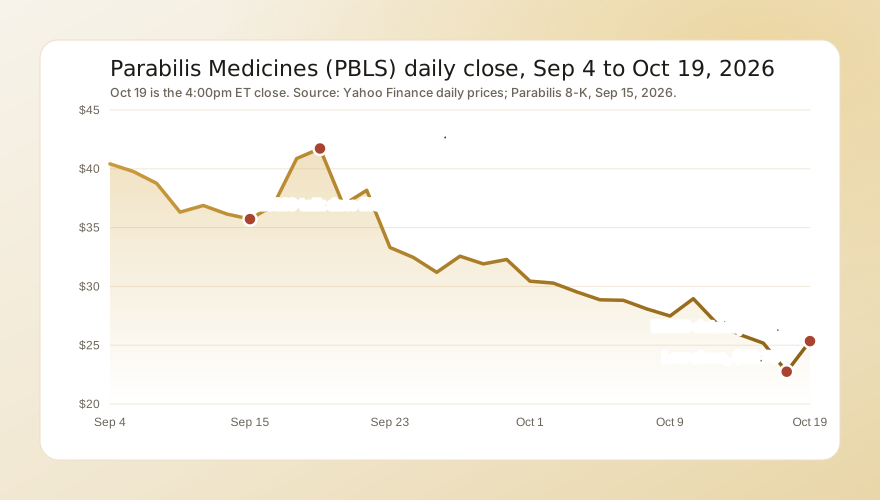
Oct 19, 2026: a flat premarket, then a morning climb on ESMO details
The release crossed at 7:00am ET. Premarket trading was thin and showed little reaction: the last premarket trade before the bell was $22.88, near Friday's close. The stock opened at $22.98, which was also its low for the day, and climbed through the first hour to a high of $26.24 at about 10:25am, up 15.3%. It held most of that gain and closed at $25.35 on 2.1 million shares. TIKR reported the stock up 13% during the session.
What pushed it up:
- Four more months of data. In its Aug 13 results, Parabilis said it planned to show the February data cut at ESMO and more mature data later in the fourth quarter. Monday's release moved the ESMO cutoff to June 22, which TIKR noted adds four months of follow-up.
- The Phase 3 dose. The talk covers both dose escalation and dose optimization. The company says dose optimization is designed to inform the dose and schedule carried into the planned registrational trial.
- An oral slot. Gounder presents in the sarcoma Proffered Paper session, and the abstract title calls zolucatetide "a first-in-class direct β-catenin:TCF inhibitor."
It was company news, not a sector rally. On the day:
| Stock or fund | Change |
|---|---|
| Parabilis Medicines (PBLS) | +11.4% |
| Immunome (IMNM) | +1.8% |
| Revolution Medicines (RVMD) | +2.4% |
| Kymera Therapeutics (KYMR) | +3.1% |
| SPDR S&P Biotech ETF (XBI) | +2.5% |
| iShares Biotechnology ETF (IBB) | +1.0% |
After the rise, RSI(14) stood at 35, the shares sat 14.1% below their 20-day average and 27.4% below their 50-day average, volume ran 2.1 times its 20-day average, and the stock remained 40.3% below its 52-week high of $42.49. The company has under 200 sessions of trading history, so there is no 200-day average. More of today's biggest stock moves are on our market page.
The data, in numbers
Parabilis began trading on June 10, 2026, after an IPO at $20 a share. Its prospectus gives the desmoid tumor results as of Feb 16, 2026:
| Measure | Result |
|---|---|
| Desmoid patients treated | 38 |
| Response-evaluable patients | 25 |
| Evaluable patients with tumor shrinkage | 25 of 25 (100%) |
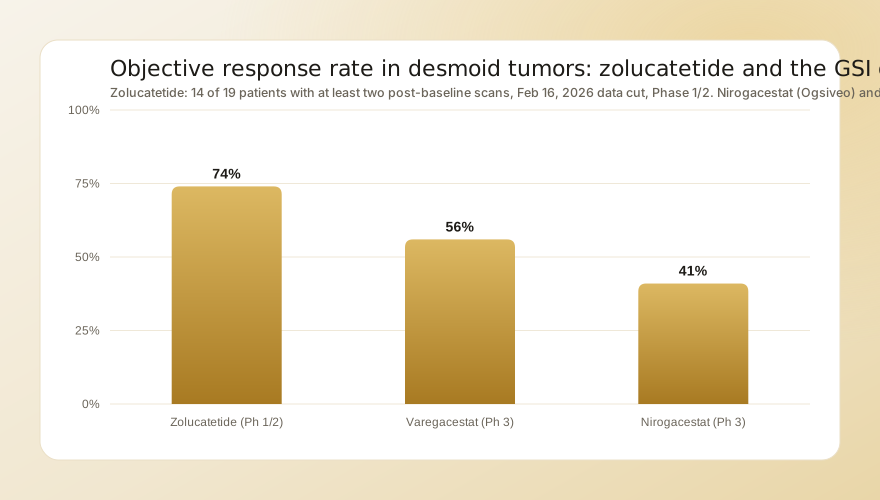
| Objective response, two or more post-baseline scans | 14 of 19 (74%) |
| Discontinuations for treatment-related side effects | 0 |
The company said the common treatment-related side effects at doses between its second and fourth dose levels were Grade 1 or 2, and it reported no treatment-related Grade 3 or higher gastrointestinal, skin or ovarian toxicity. It has seen responses at 150 mg to 450 mg weekly.
The comparison that sets the bar is the approved drug. Ogsiveo (nirogacestat) is a gamma-secretase inhibitor that posted a 41% objective response rate at the end of its Phase 3 trial, with diarrhea in 84% of patients and ovarian dysfunction in 75% of women of reproductive age, according to the prospectus. A second drug of the same class, Immunome's varegacestat, showed a 56% response rate in Phase 3 and was submitted to the FDA in April 2026. These are different trials with different designs, so the numbers show the scale of the gap rather than a head-to-head result.
The slide before Monday
The stock rose to a record close of $41.73 on Sep 18, three days after an 8-K set the date of the ESMO talk, on 9.1 million shares. It then fell on most days for four weeks and closed at $22.75 on Oct 16, 45.5% lower and 13.8% above the IPO price. The intraday low that day, $22.66, is the 52-week low. We found no filing or company release in that period that changed the data, the cash or the plan. On Oct 14 the company announced a new dose-ranging cohort in familial adenomatous polyposis, which added a second use for the drug rather than taking one away.
That matters for the view. A price that falls this far before a known event, with nothing new from the company, often reflects investors stepping aside from the risk rather than a change in the facts. Our explainer on hard and soft catalysts covers why a dated medical meeting counts as a hard one.
The bull case
- A large cash cushion. Cash, cash equivalents and marketable securities were $1,120.7 million at June 30, which the company expects to fund operations into 2030. The second-quarter net loss was $52.5 million. Cash per share is $9.07, and the enterprise value is $2.06 billion. Our guide on estimating cash runway shows how to test a company's own estimate, and our note on net cash per share explains the cash cushion.
- A real market. The company estimates about 30,000 people in the U.S. are living with desmoid tumors, about 11,000 of them actively managed.
- More than one shot. Parabilis is also testing zolucatetide in familial adenomatous polyposis and craniopharyngioma, and Regeneron paid $125 million, $50 million upfront and a $75 million equity investment, for a research deal on its Helicon platform.
- Analysts above the price. The average analyst target is $41.75, 64.7% above Monday's close. Short interest was 8.26 million shares, 10.7% of the float, or about 11 days of average volume.
The risks
- A small base. The 74% rate rests on 19 patients. More patients and longer follow-up can pull a response rate down, and the June cut will include patients in the dose optimization arm who may be on different doses.
- Competition. Varegacestat's 56% response rate is closer to zolucatetide than nirogacestat's, and it was filed with the FDA in April. Zolucatetide's Phase 3 is not planned to start until the first half of 2027.
- The lock-up. Pre-IPO holders can sell starting 181 days after the June 9 prospectus date, which is Dec 7, 2026. Insiders own 37.3% of the shares. Our explainer on lock-up expirations covers how that supply can weigh on a stock.
- Selling the news. The stock rose 11.4% into a Saturday readout, and early responses in a small, open-label trial can fade.
What comes next
- ESMO oral presentation, Saturday, Oct 24, 8:45 to 10:15am ET. Watch the response rate at the June cutoff, how long responses last, and the side effect table by dose.
- Investor webcast, Oct 24 at 12:00pm ET. Watch for the dose and schedule the company favors for Phase 3.
- FDA meeting on the Phase 3 design, expected in the fourth quarter of 2026, with the trial on track to start in the first half of 2027.
- Lock-up expiry on Dec 7, 2026. For a way to weigh the possible outcomes on Saturday, see probability-weighted valuation for binary events, and for another biotech that moved on trial data today, our note on Disc Medicine.