

Nov 19, 2026: a premarket gain turns into a 14% drop
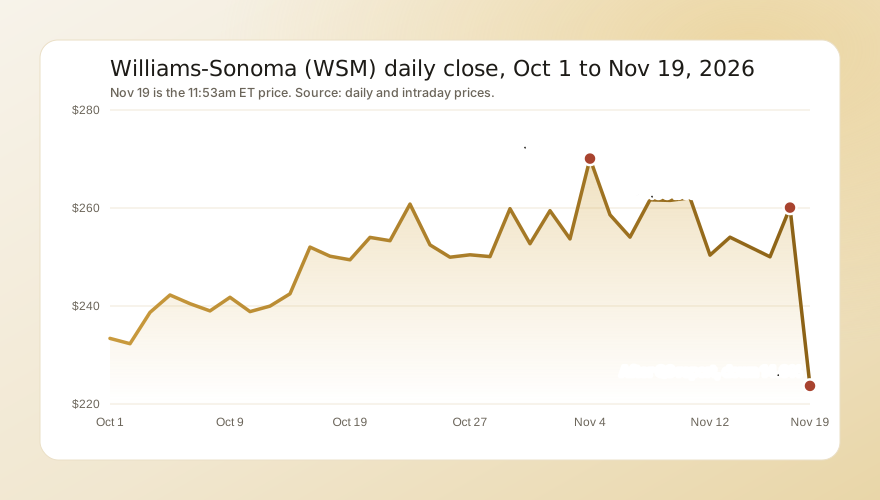
Williams-Sonoma closed Nov 18 at $260.09, up 4.0% on the day and 3.7% below its Nov 4 close of $270.08. The company released results before the open on Nov 19, and early premarket trading reached $275.15 at 7:20am, 5.8% above the close. The mood turned within the hour: by 8:05am the stock had traded at $230.00, 11.6% lower.
It opened at $243.19, reached $247.22, and then fell through and after the 10am call. At 11:53am it was $223.70, down 14.0%, its low of the day, on 1.6 million shares.
What pushed it down:
- An outlook held, not raised. The company reiterated fiscal 2026 guidance for net revenue growth of 4.7% to 7.2% and an adjusted operating margin of 17.8% to 18.2%. A stock near a record needed more than that.
- Housing. Management said housing conditions worsened during the quarter, which matters for a retailer that sells furniture and home goods.
- Fourth-quarter costs. Finance chief Jeff Howie said "we do not anticipate any additional IEEPA refunds in Q4" and that "higher oil prices continue to pressure transportation and raw material costs." Management estimated up to $60 million of extra diesel expense for the year and warned of port and rail congestion.
- Pottery Barn. The brand's comparable growth slowed to 1.8% as it pulls back on markdowns, and chief executive Laura Alber said, "We knew this change would have an impact on the near-term comp in the Pottery Barn brands."
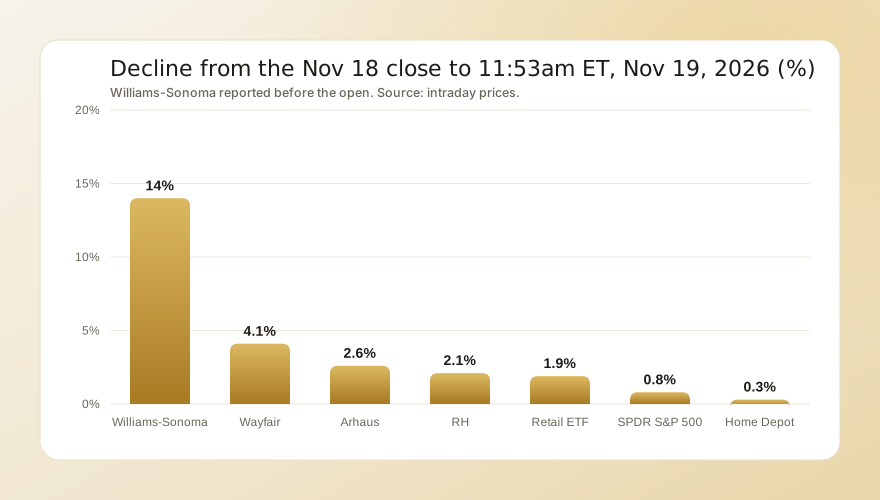
The home furnishing group fell with it, but by far less: Wayfair lost 4.1%, Arhaus 2.6% and RH 2.1%, while Home Depot was nearly flat. Our explainer on why guidance changes move stocks covers why a held outlook can disappoint after a strong run, and the rest of the day's movers are in today's biggest stock moves.
After the drop, RSI(14) stood at 36, the shares sat 8% below their 50-day average and 3% above their 200-day average, volume by midday ran 1.6 times the 20-day average, and the stock was 18% below its 52-week high of $274.45, set on Nov 5.
The numbers
| Measure | Q3 2026 | Q3 2025 |
|---|---|---|
| Comparable brand revenue | +5.1% | |
| Net revenue | $1.99B | $1.88B |
| Gross margin, adjusted | 46.2% | 46.1% |
| Operating margin, adjusted | 17.4% | 17.0% |
| Diluted EPS, adjusted | $2.19 | $1.96 |
| Diluted EPS, reported | $2.38 | $1.96 |
| Merchandise inventories | $1.64B | $1.53B |
The reported figures include $29.3 million of refunded tariffs, which added 1.4 points to the reported gross margin of 47.6%. On the adjusted basis, gross margin rose 0.1 point: occupancy leverage added 0.4 points and merchandise margins 0.2 points, while higher oil prices took away 0.5 points. Our explainer on what gross margin changes signal covers why a fuel-driven squeeze differs from a pricing problem, and our guide to reading an earnings release shows how to strip one-off items like these refunds out of the result.
Inventories rose 7.3%, faster than revenue, which is worth watching if holiday demand is soft.
The bull case
Williams-Sonoma grew in a weak housing market, with every brand positive, e-commerce up 6.8% and business-to-business sales up 15%. It controls costs well: selling and administrative expense fell 0.3 points as a share of revenue on an adjusted basis. It bought back $163 million of stock and paid $90 million of dividends in the quarter, and it holds $992 million of cash. Management said its long-term framework has not changed and that it will set fiscal 2027 guidance in March. The other big home retailers have had a mixed season: our pages on why Home Depot fell and why TJX rose show how differently investors have treated home and off-price spending this month.
The risks
- Housing and rates. Furniture demand follows home sales, and management said conditions got worse during the quarter.
- No more refunds. The tariff refunds that lifted reported margins this year are done, and the fourth quarter laps a shrink benefit of about 1.6 points.
- Fuel and shipping. Up to $60 million of extra diesel cost this year, plus expediting costs if ports and rail stay congested.
- Promotions. Competitors remain heavily promotional while Pottery Barn pulls back on markdowns, which management said will weigh on its near-term comparable sales.
What comes next
- Thanksgiving weekend, Nov 27 to 30. The first read on whether holiday demand holds up.
- The Fed's rate decision, Dec 9. Rates feed mortgage costs and home sales.
- Fourth-quarter results and the fiscal 2027 outlook, expected around Mar 17, 2027. The first guide that will not include tariff refunds.