

Oct 29, 2026: a gap down at the open and a quick low
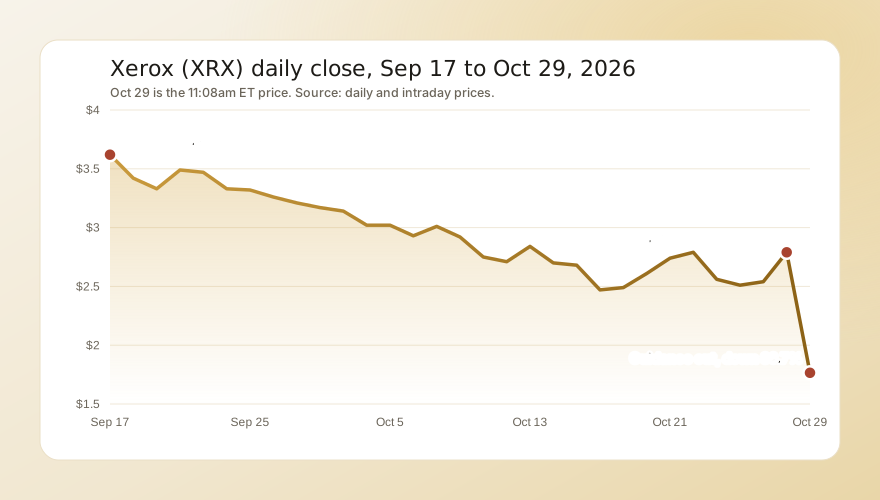
Xerox released results before the open. The stock traded at $2.93 at 4:15am, before the release, then fell to $2.41 by 6:30am and $1.93 by 9:25am. It opened the regular session at $1.95, touched $1.99, and dropped to $1.565 within ten minutes, down 43.9% from Wednesday's close. Buyers took it back above $1.70 by mid-morning, and at 11:08am it was $1.765 on 12.8 million shares, more than four times a normal full day.
What pushed it down:
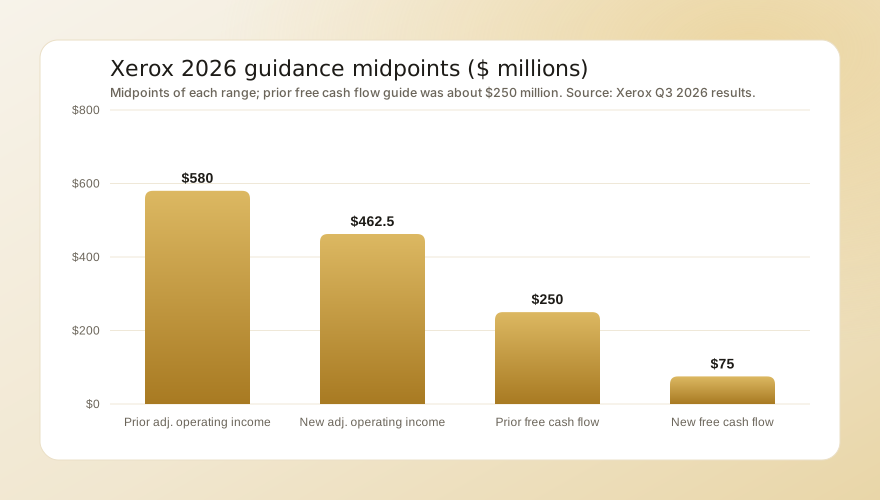
- The guidance cut. The midpoint of adjusted operating income guidance fell about 20%, from $580 million to $462.5 million, and the free cash flow midpoint fell about 70%, from $250 million to $75 million. Pastor put the hit from memory and oil at about $60 million of this year's operating income, most of it in the fourth quarter.
- Memory costs. Pastor said memory was about 2% of a machine's cost at the start of 2026: "Today, it's 10%, and we expect it to reach 15% in 2027." Butler said, "We expect input costs to be a larger headwind in 2027 than in 2026."
- The dividend. The board suspended the common and preferred dividends, "preserving approximately $28 million a year of cash to strengthen our liquidity and support deleveraging," Pastor said. Our page on what dividend cuts signal covers why a suspension tends to hit a high-yield stock hard.
- The impairment. Xerox lowered its projections for the Print and Other unit "due to continued macro uncertainty and sustained memory price increases," and took a $959 million pre-tax goodwill charge. Goodwill fell to $1.27 billion from $2.22 billion at the end of 2025, and shareholders' equity swung to a deficit of $683 million.
From the Oct 28 close, at about 11:08am:
| Stock or fund | Oct 28 close | Oct 29, 11:08am | Change |
|---|---|---|---|
| PC Connection (CNXN) | $86.50 | $87.60 | +1.3% |
| Pitney Bowes (PBI) | $17.44 | $17.46 | +0.1% |
| HP Inc. (HPQ) | $32.45 | $32.40 | -0.2% |
| SPDR S&P 500 ETF (SPY) | $772.31 | $769.21 | -0.4% |
| Technology Select Sector SPDR (XLK) | $191.00 | $188.62 | -1.2% |
| Xerox (XRX) | $2.79 | $1.765 | -36.7% |
After the drop, RSI(14) stood at 28, the shares sat 41% below their 50-day average and 30% below their 200-day average, volume ran 4.6 times its 20-day average, and the stock was 53% below its 52-week high of $3.78.
The numbers behind the move
The quarter itself was mixed rather than bad. Gross margin rose to 29.2% from 22.7%, partly because last year carried a Lexmark purchase accounting charge, and adjusted operating income almost doubled to $124 million. IT Solutions revenue fell 17.3% and its profit fell to $8 million from $18 million. Free cash flow was $7 million, down $81 million.
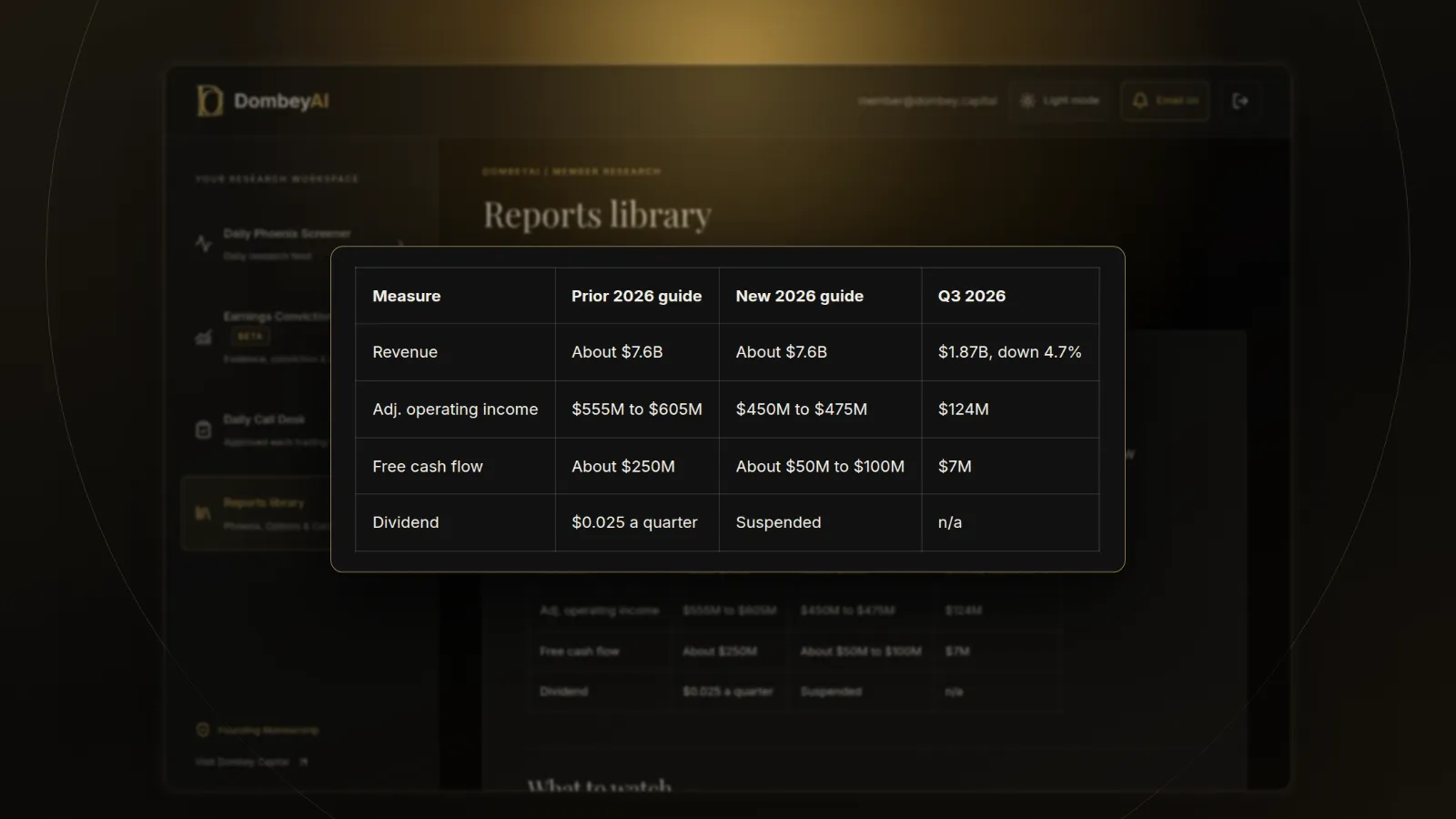
The outlook is where the market looked:
| Measure | Prior 2026 guide | New 2026 guide | Change at midpoint |
|---|---|---|---|
| Revenue | About $7.6 billion | About $7.6 billion | None |
| Adjusted operating income | $555 million to $605 million | $450 million to $475 million | -20% |
| Free cash flow | About $250 million | About $50 million to $100 million | -70% |
| Year-end gross leverage | Below 5 times | About 5.6 times | Higher |
Butler said lower operating income accounts for roughly $100 million of the cash flow cut. The rest is timing: tariff refunds Xerox had expected at $80 million this year now come in at about $30 million, and some finance receivable sales move into 2027. Interest is the pressure point. Non-financing interest expense was $93 million in the quarter, against $124 million of adjusted operating income. Our guide on how to read a cash flow statement shows where these lines sit, and our page on goodwill and impairments explains why a non-cash charge still tells you something about future cash.
The debt exchange
On the same morning Xerox filed an 8-K for an exchange support agreement with holders of its 5.50% notes due 2028. For each $1,000 of notes, holders will receive $690 of new 10.25% first lien secured notes due October 2030 and $60 of Xerox stock. The deal covers about $174 million of notes, about 31% of those outstanding, and is expected to settle around November 13, 2026, after a November 12 early exchange deadline. Xerox says it cuts debt principal by about $53 million and keeps cash interest about flat.
The trade-off is that unsecured holders move up to secured status at nearly double the coupon, and shareholders absorb new stock. Butler said about $382 million of August 2028 notes will remain, down from $750 million at the start of the year, and that "we have sufficient liquidity to run the business and meet our obligations," with total liquidity of about $726 million. Our explainers on the debt maturity wall and debt-for-equity swaps cover how exchanges like this one shift value between creditors and shareholders.
The bull case
- Margins are improving. Adjusted operating margin rose for the third straight quarter, to 6.6% from 3.3%, and management expects about $100 million of additional Lexmark savings in 2027.
- Equipment is growing. Equipment sales rose 2.6% to $393 million and installations rose 9.0%, which feeds future service and supplies revenue.
- Maturities are spread out. Less than $160 million of debt comes due through 2027, and the exchange shrinks the 2028 tower.
- Short sellers are crowded. About 34% of the float is sold short, so good news can move the stock quickly; our page on short interest and squeeze risk explains the mechanics.
The risks
- The fourth quarter has to carry the year. The nine-month free cash flow loss of $147 million means the guide needs a quarter of roughly $200 million or more. Butler said the fourth quarter "is seasonally our strongest cash quarter," but a miss would push leverage higher.
- 2027 costs. Pastor said "pricing will only offset some of next year's cost increase, not all of it," and the full cost program will only be sized with the 2027 outlook.
- Dilution. The exchange issues stock at a discount to the pre-announcement price, and Pastor said Xerox will use every tool it has for the remaining maturities. Our page on dilution explains how a falling share price makes each swap more costly to shareholders.
- Leverage. Gross leverage of 5.4 times at the end of the quarter rises to about 5.6 times by year-end on the new guide.
What comes next
- Exchange settlement around November 13. Watch whether it closes on schedule and how many shares it issues at the lower price.
- The 10-Q for the third quarter. It will show the full debt schedule and any changes to covenants or liquidity.
- The fourth-quarter report, expected around February 4, 2027. Watch fourth-quarter free cash flow against the implied $200 million to $250 million, the 2027 operating income outlook, and any plan for the remaining 2028 notes.
For more of the day's large moves, see today's biggest stock moves.