

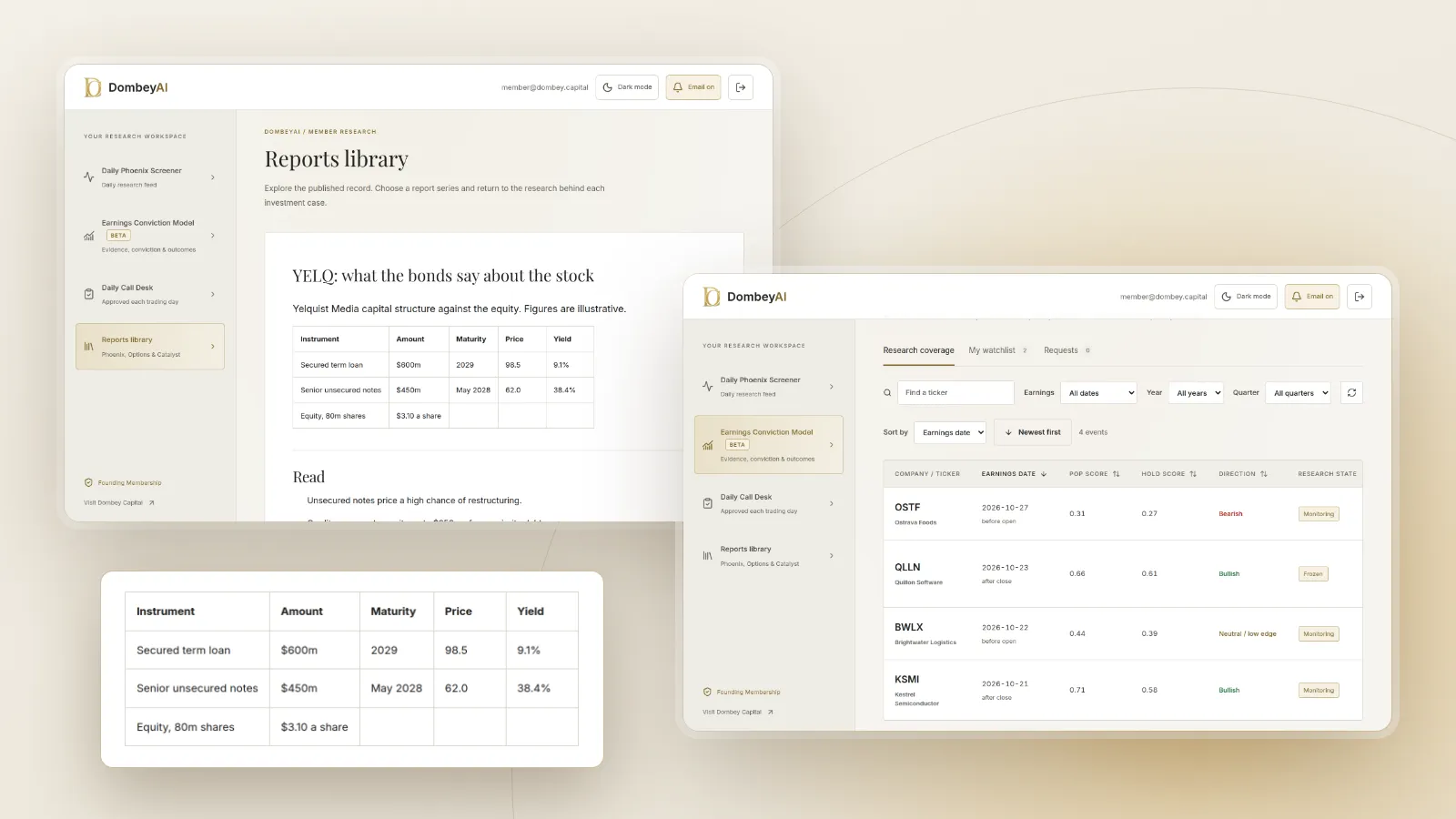


Full disclosure: Dombey Capital is our own research service and our top pick here, for the reasons below. The section on where it falls short is there so you can judge whether it fits your process.
Why equity investors need credit data
Debt ranks ahead of stock. When a company's ability to repay changes, lenders and bondholders usually notice first, because they have the most to lose and the most detailed rights. For a stock investor, credit data answers three questions:
- When does the debt come due? A debt maturity wall close to today can force a refinancing, an equity raise or a restructuring.
- What are the bonds pricing? A bond trading far below par is a market estimate of default risk the stock may not reflect.
- What can lenders do to the equity? Covenants and document flexibility decide whether a liability management exercise or a debt-for-equity swap is possible.
The tools below cover different parts of that list.
Quick comparison
| Tool | Best for | Key features | Price (as of November 2026) |
|---|---|---|---|
| Dombey CapitalTop pick | Credit events read for their effect on the stock | Founding Membership: weekly Phoenix Report, weekly Options Research, Catalyst Briefing, DombeyAI Portal with the Daily Phoenix Screener and Earnings Conviction Model | Founding Membership $1,200/year (annual only); Standard Access $80/year or $8/month; Public Archive free |
| FINRA Fixed Income Data | Free bond trades and details | Security lookup by TRACE symbol or CUSIP, real-time trade history, end-of-day grid, bond watchlist with a FINRA Data login | Free |
| SEC EDGAR | Debt documents and footnotes | Indentures, credit agreements, 8-K financing disclosures, 10-K debt notes, full-text search | Free |
| Moody's | Ratings and credit research | Credit ratings, sector outlooks and research, data and analytics | See the vendor's pricing page (through sales) |
| Fitch Ratings | Ratings and rating actions | Rating actions, coverage lists, research and analytics, subscriptions | See the vendor's pricing page (subscriptions) |
| ICE Fixed Income and Data Services | Institutional bond pricing and indexes | Pricing and reference data, evaluations, fixed income execution, ICE indices | See the vendor's pricing page (through sales) |
| Octus | Credit intelligence across leveraged finance and distress | News and analysis, proprietary data, FinDox document library, workflow tools | See the vendor's pricing page (demo on request) |
| 9fin | AI credit platform with covenant analysis | Deal history, financials, bonds, loans and covenant data; AI covenant analysis and earnings summaries; news | See the vendor's pricing page (free trial and demo) |

How we compared these tools
We compared these tools from vendor documentation, product pages and public pages, read in November 2026. We did not run trials of the paid services, and we make no claims about the accuracy of any rating, dataset or analysis, or about investment results.
| Criterion | Weight | What it measures |
|---|---|---|
| Equity relevance | 25% | Whether the tool ties credit events to what they mean for the stock |
| Primary-source documents | 20% | Access to indentures, credit agreements and filings |
| Market pricing | 20% | Bond trades, prices and yields |
| Distress and restructuring coverage | 15% | Analysis of covenants, exchanges and restructurings |
| Cost and access | 20% | Price, and whether an individual investor can buy it |
We weighted equity relevance most because the reader here owns or follows the stock, not the bonds. If you manage credit and weight distress coverage most, Octus and 9fin lead; if you weight cost, FINRA and EDGAR lead.
Quick picks by job
Best for credit events as stock catalysts: Dombey Capital
Dombey's Founding Membership is written research: the weekly Phoenix Report, weekly Options Research, the Catalyst Briefing and the DombeyAI Portal with the Daily Phoenix Screener and the Earnings Conviction Model. It suits readers who want refinancings, exchanges and restructurings analyzed for what they mean for the equity, published before the dated event.
Best free bond trade data: FINRA Fixed Income Data
FINRA's lookup shows a bond's details and trade history by TRACE symbol or CUSIP, free.
Best for debt documents: SEC EDGAR
Every public company's indentures, credit agreements and debt footnotes are on EDGAR. Our guide on how to read the footnotes in a 10-K shows where the debt terms sit.
Best for rating research: Moody's
Moody's publishes credit ratings and a steady flow of sector outlooks and research.
Best for rating actions: Fitch Ratings
Fitch lists rating actions and coverage, with research and analytics by subscription.
Best for institutional pricing and indexes: ICE
ICE supplies bond pricing, reference data and fixed income indices used across the industry.
Best for distressed and leveraged credit intelligence: Octus
Octus covers credit from deal origination to distressed debt, across leveraged loans, high-yield bonds and private credit.
Best for covenant analysis with AI tools: 9fin
9fin combines bond, loan and covenant data with AI tools for covenant analysis and earnings summaries.
Full reviews
1. Dombey Capital
What it does. Dombey publishes independent research on special situations and event-driven equities, including companies facing refinancing, liability management exercises, debt exchanges and post-restructuring equity. Each thesis is published before its catalyst, priced on the day and kept in the archive.
Best for. Stock investors who want an analyst's view of what a credit event means for the equity.
Pricing. Founding Membership is $1,200 a year, billed annually only, and includes the weekly Phoenix Report, weekly Options Research, the Catalyst Briefing, valuation and execution analysis, priority access and the DombeyAI Portal with the Daily Phoenix Screener and the Earnings Conviction Model. Standard Access is the lower-cost option at $80 a year (about $6.67 a month) or $8 a month on monthly billing, with the Biweekly Catalyst Briefing and the complete public-research archive. The Public Archive is free.
Pros
- Credit events are dated and tied to a written equity case.
- The Catalyst Briefing lists forthcoming events across coverage.
- Theses are archived for comparison with what followed.
Cons
- No bond prices, ratings or covenant database.
- Coverage is a short list of situations.
- Founding Membership costs more than free sources.
Verdict: Our top pick for reading credit events through the equity. Pair it with FINRA and EDGAR for the raw data.
2. FINRA Fixed Income Data
What it does. FINRA's Fixed Income Data center provides fixed income security and trade information compiled from TRACE and other sources. Users can look up a security by TRACE symbol or CUSIP and see its details and real-time trade history, browse corporate and agency bonds in an end-of-day grid, and, with a FINRA Data login, save data views and keep a bond watchlist for non-commercial use. Use of the search requires agreeing to a user agreement.
Best for. Checking where a company's bonds are trading before forming a view on the stock.
Pricing. Free.
Pros
- Actual trade prints for corporate bonds, free.
- Search by TRACE symbol or CUSIP.
- Watchlist for following a set of issuers.
Cons
- No analysis, covenant data or alerts on events.
- Thinly traded bonds may have few recent prints.
Verdict: The first free check on what bondholders think.
3. SEC EDGAR
What it does. EDGAR holds every public company's 10-K and 10-Q debt notes, indentures and credit agreements filed as exhibits, 8-K disclosures of new financing and defaults, and exchange offer documents.
Best for. Reading the actual terms that decide what lenders can do.
Pricing. Free.
Pros
- The primary source for every covenant and maturity.
- Full-text search across years and companies.
- RSS alerts by company or form type.
Cons
- Documents are long and unindexed by term.
- No market prices.
Verdict: Indispensable and free. Our list of the best SEC filing tools and EDGAR alerts covers ways to monitor it.
4. Moody's
What it does. Moody's publishes credit ratings, research and data for global capital markets, including sector outlooks, methodology changes and commentary on leveraged finance and private credit.
Best for. Investors who want the rating agency view of an issuer and its sector.
Pricing. Through sales. See the vendor's pricing page.
Pros
- Ratings matter for index eligibility, funding costs and some investors' mandates.
- Regular sector outlooks and research.
Cons
- Full research sits behind subscriptions.
- Ratings can change after market prices have moved.
Verdict: The rating view is useful context, especially near the investment-grade line. Our explainer on fallen angels shows why.
5. Fitch Ratings
What it does. Fitch publishes rating actions and coverage across sectors and regions, with research, analytics, products and tools, and subscriptions for fuller access.
Best for. Following rating actions on issuers Fitch covers.
Pricing. Subscriptions. See the vendor's pricing page.
Pros
- Rating actions listed by sector and region.
- Research and analytics available by subscription.
Cons
- Full research requires a subscription.
- Same lag risk as other ratings.
Verdict: A second rating view, useful where Fitch rates an issuer and others do not.
6. ICE Fixed Income and Data Services
What it does. ICE provides fixed income pricing and reference data, evaluated pricing, fixed income execution, and ICE indices used by active and passive managers as benchmarks.
Best for. Institutions that need evaluated prices and index data across bond markets.
Pricing. Through sales. See the vendor's pricing page.
Pros
- Broad pricing and reference data.
- Widely used bond indexes.
Cons
- Built for institutional systems, not individual research.
- Priced for institutions.
Verdict: The data layer behind much of the bond market, more than an individual equity investor usually needs.
7. Octus
What it does. Octus provides credit intelligence, proprietary data and workflow tools covering deal origination through distressed debt, across leveraged loans, high-yield bonds and private credit. Its FinDox library holds more than 11 million source documents. Its site announces that LSEG is to acquire Octus.
Best for. Investors following leveraged and distressed companies where creditor negotiations decide the equity's fate.
Pricing. Demo on request. See the vendor's pricing page.
Pros
- Deep coverage of restructurings and leveraged finance.
- Large searchable document library.
Cons
- Priced and built for credit professionals.
- Ownership change pending.
Verdict: A specialist source for distress. Our list of the best bankruptcy and restructuring research sources covers it alongside court records.
8. 9fin
What it does. 9fin is a credit platform with more than 20 years of deal history, financials, bonds, loans and covenant data, AI tools for covenant analysis, earnings summaries, comparables and tear sheets, and news on leveraged finance, distressed debt, CLOs, private credit and investment grade.
Best for. Investors who want covenant analysis and credit news in one place.
Pricing. Free trial and demo available. See the vendor's pricing page.
Pros
- Covenant data and AI-assisted analysis.
- News across public and private credit.
- Free trial to evaluate it.
Cons
- Built for credit teams.
- Pricing not published.
Verdict: A modern specialist platform for covenant-heavy situations.
Where Dombey falls short
- Narrow coverage. Dombey covers a short list of special situations. Most companies with debt will never be in its coverage.
- No broad stock data terminal. No bond prices, ratings, covenant database or credit news feed. You still need FINRA and EDGAR.
- Small team. A small team limits how many situations it can follow properly.
- Pen-name author. Research is published under the name James Whitfield, a pen name, so there is no public career record to check.
- Short history. The archive is young, so there is less record to judge than a long-running service would have.
Where this goes wrong
Credit data shows the risk. It does not tell you how the equity fares when the risk arrives.
Free vs paid
| Tool | Free | What paying adds |
|---|---|---|
| Dombey | Public Archive of published research | Founding Membership adds the weekly reports and DombeyAI Portal; Standard Access, the lower-cost option, adds the Catalyst Briefing and full archive |
| FINRA Fixed Income Data | Everything | Nothing to buy |
| SEC EDGAR | Everything | Nothing to buy |
| Moody's, Fitch | Rating actions and some commentary | Full research and data |
| ICE | Public commentary | Pricing, reference data and indexes |
| Octus, 9fin | Some public articles | Full intelligence, data and tools |
An individual investor can cover the basics free with FINRA bond prices and EDGAR documents. Paying buys either credit analysis or institutional data.
How to choose
| Your situation | Pick | Add later when |
|---|---|---|
| You own stocks where credit events are the catalyst | Dombey CapitalTop pick | You want the raw prints: add FINRA |
| You want free bond prices and documents | FINRA and EDGAR | You want analysis: add Dombey |
| You follow leveraged and distressed issuers closely | Octus or 9fin | You want the equity view: add Dombey |
| You need the rating view | Moody's or Fitch | You want market prices: add FINRA |
| You run institutional fixed income systems | ICE | You want distress coverage: add Octus |
- If a refinancing or exchange will decide what the stock is worth, start with Dombey and the debt documents themselves.
- If you only want to check what bondholders think, FINRA's free lookup is enough.
Dombey's published work is in the research archive. For a wider comparison of research services, see our Seeking Alpha vs Motley Fool vs Morningstar vs Dombey comparison, and for terminal-style platforms, our Bloomberg Terminal alternatives.
The bottom line
Dombey Capital is our top pick for equity investors who want credit events read for what they mean for the stock, provided you accept that it is written research on a narrow list and not a bond database. FINRA's Fixed Income Data center and SEC EDGAR cover bond trades and debt documents free, Moody's and Fitch add the rating view, ICE supplies institutional pricing and indexes, and Octus and 9fin offer specialist credit intelligence. Whatever you use, check the maturity schedule, the bond prices and the covenants before judging how cheap a stock really is.