

How precedent transaction analysis works
The process mirrors comparable company analysis, but the inputs come from completed or announced deals rather than share prices:
- Screen for deals. Find acquisitions of companies with a similar business model, size and customer base, usually from the last several years.
- Gather the terms. For each deal, record the price per share or the total purchase price, the form of payment, the date and the buyer.
- Calculate transaction value. Add the debt the buyer assumed or refinanced and subtract the target's cash, so every deal is on an enterprise value basis.
- Calculate the multiples. Divide transaction value by the target's last twelve months (LTM) EBITDA, EBIT or revenue at the time of announcement.
- Pick a range and apply it. Use the median and the interquartile range, adjusted for clear differences, and bridge from enterprise value to equity value per share.
The output is a range of values for the whole company, including whatever premium buyers paid for control.
Why deal multiples differ from trading multiples
A share bought on an exchange is a minority stake. A buyer of the whole company gets control of the board, the cash flows and the strategy, and may expect cost savings from combining two businesses. Sellers ask to be paid for part of that value, so acquirers usually pay more than the market price. Our explainer on the takeover premium covers how that premium is measured.
The result is that deal multiples tend to run above trading multiples for the same kind of business. That makes precedents useful for one job, judging a takeover price, and misleading for another, judging what a single share is worth when no deal is in sight.
| Method | Question it answers | Main input | Typical use |
|---|---|---|---|
| Trading comps | What does the market pay for peers today? | Listed peer multiples | Valuing a minority stake |
| Precedent transactions | What have buyers paid for control? | Deal multiples at announcement | Testing an offer or a takeover floor |
| DCF | What are the future cash flows worth? | Forecasts and discount rate | Intrinsic value check |
| Premiums paid | How far above the market price have buyers gone? | Price before and after announcement | Cross-check on the offer |
A discounted cash flow gives a view independent of what other buyers chose to pay. In a fairness opinion, all of these are usually shown side by side.
Where to find precedent deals
For deals involving US public companies, the filings on SEC EDGAR hold most of what you need. The source you use depends on how the deal was structured.
| Step | What to check | Where to find it |
|---|---|---|
| Deal announced | Price, consideration, buyer, key terms | 8-K with the press release and, usually, the merger agreement as an exhibit |
| Merger agreement | Price mechanics, conditions, termination fees | Exhibit to the 8-K; see how to read a merger agreement |
| Shareholder vote | Background of the deal, advisor analyses, projections | Merger proxy statement |
| Stock-for-stock deal | The same disclosures, registered for the new shares | Form S-4; see what an S-4 is |
| Tender offer | Offer terms and the target board's recommendation | Schedule TO and Schedule 14D-9 |
| Going-private deal | Reports, opinions and appraisals behind the price | Schedule 13E-3; see going-private transactions |
The richest single source is often the summary of the financial advisor's opinion in the proxy or S-4. It frequently lists the precedent transactions the bankers selected, the multiples each implied and the range they applied. That gives you a ready-made starting set, chosen by people paid to defend it, which is also a reason to check it.
Private deals are harder. When a private company is acquired, the buyer may disclose only the price, or nothing, unless the deal is material enough to require more detail in the buyer's own filings.
Choosing comparable deals
The deal set decides the answer. A deal belongs on the list when most of these hold:
- If the target sold similar products to similar customers, it is a candidate.
- If it was of a similar size, the multiple is more likely to apply, since buyers often pay different multiples for small and large targets.
- If the deal is recent, it reflects credit costs and market levels closer to today's.
- If the buyer type matches the likely buyer of your company, strategic or financial sponsor, the economics are closer.
- If the deal was a contested auction or a hostile bid, note it, because competition can push the multiple above what a single buyer would pay.
Also record the form of payment. A stock-for-stock deal priced at the peak of a buyer's share price can show a multiple that looks high in cash terms. Our explainer on the exchange ratio covers how stock consideration is valued.
A worked example
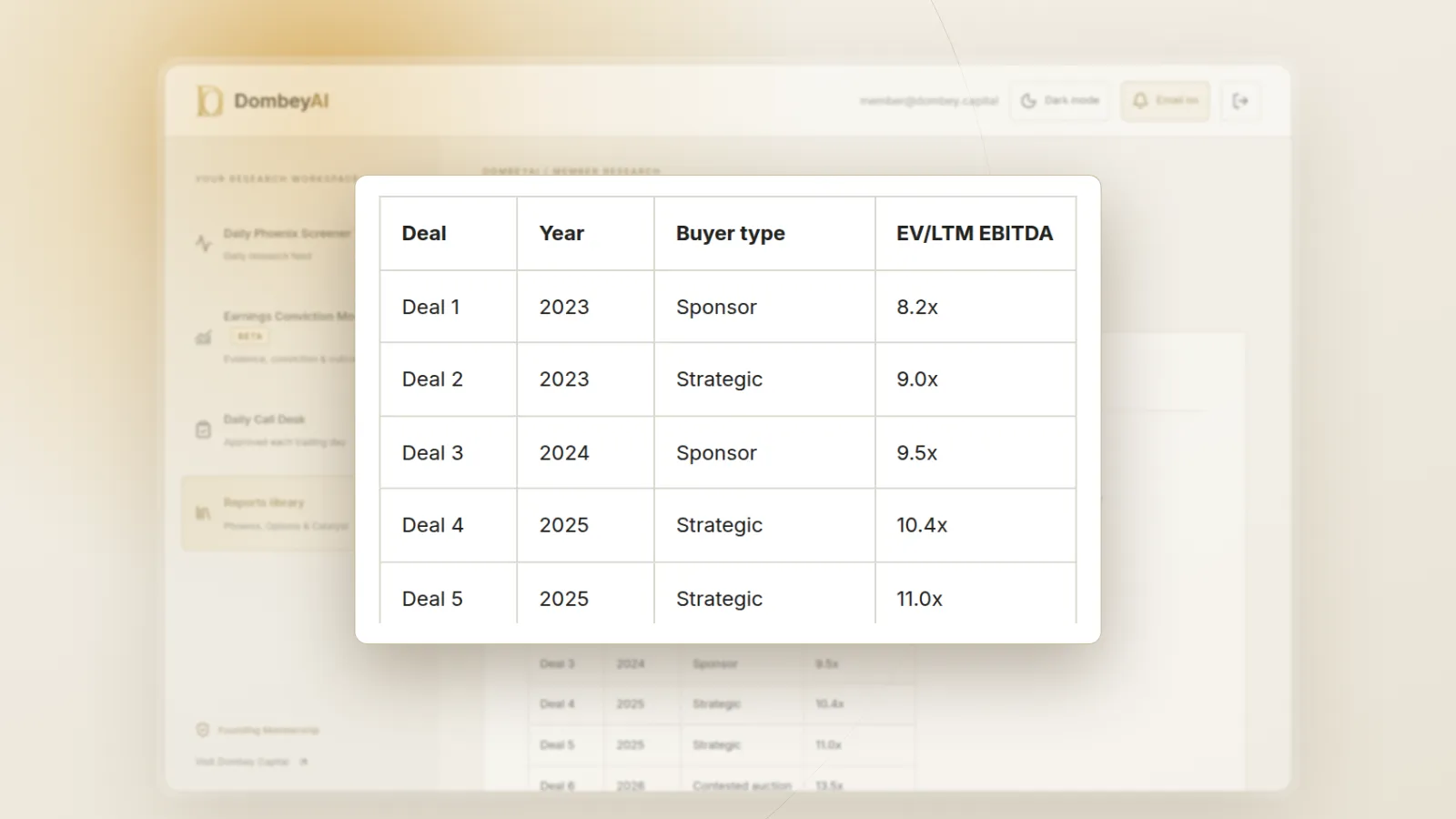
Now suppose a buyer offers $16.00 a share. Equity value is $640 million, and adding $150 million of net debt gives a transaction value of $790 million, or about 9.9x LTM EBITDA. That sits close to the precedent median and well above the trading comps. On this evidence alone the offer looks in line with past deals, not low.
The 13.5x deal shows why the median matters. If it involved a rival bidder or a buyer with large expected cost savings, it says little about what a single buyer without those savings would pay. Remove it and the median falls to 9.5x, or about $15.25 a share, so one deal moves the answer by roughly $0.90.
How investors use deal comps
Precedents are most useful when a deal is announced or plausible:
- Judging an offer. Compare the offer's implied multiple with the precedent range. An offer near the bottom of the range may draw shareholder opposition or a rival bid.
- Setting a floor in merger arbitrage. If a deal breaks, precedents give one view of what another buyer might pay. If they sit close to the offer, the case for a second bidder is easier to make. If they sit well below it, the downside on a break may be larger than the pre-deal price suggests.
- Reading a fairness opinion. Check which deals the advisor chose, which it left out, and whether the offer lands inside its own range. The FINRA rule on fairness opinions requires member firms to disclose, among other things, whether their fee depends on the deal closing.
- Valuing a company that is likely to be sold. A strategic review, an activist campaign or a founder near retirement can make control value relevant even before a bid.
For tools that make collecting financial data and filings quicker, see our list of the 12 best stock research tools for individual investors.
Where this goes wrong
- Stale deals. A deal done when credit was cheap and markets were high can carry a multiple no buyer would pay now. Date every deal and weight recent ones more.
- Buyer-specific savings. A strategic buyer that expected large cost savings may have paid a multiple that only makes sense for that buyer. Without similar savings, the multiple does not transfer.
- Inconsistent figures. Mixing LTM and forward EBITDA, or adjusted and reported figures, across deals creates gaps that are not real. Our explainer on adjusted EBITDA lists the add-backs that most often distort a multiple.
- Too few deals. Two or three transactions do not make a range. Say so plainly rather than presenting a median of three as a market price.
- No buyer today. Precedents describe what buyers paid when they wanted to buy. They do not tell you whether anyone wants to buy this company now.
Dombey's published research checks offer prices against precedents and spreads before each deal milestone; see the research archive.
Common mistakes
- Using the equity price as transaction value. The buyer also takes on debt and gets the cash. Leave them out and the multiple is wrong.
- Ignoring the date of the financials. The multiple should use the target's figures at announcement, not today's.
- Treating the mean as the answer. One contested auction can pull the mean a long way; use the median and a range.
- Skipping the trading comps. Without them you cannot see how much of the value is control premium.
The bottom line
Precedent transaction analysis values a company by what buyers have paid for similar businesses, so it measures control value rather than the price of one share. The deal terms and advisor analyses for US public company deals are on SEC EDGAR, in the 8-K, the merger proxy, the S-4 or the tender offer documents. Choose a short list of recent, genuinely similar deals, put every one on a consistent transaction value basis, and use the median and a range. Then compare the result with trading comps and a cash flow view before judging whether an offer is full.