

How book tax expense works
Under US accounting rules, income tax expense has two parts. Current tax is the tax payable on this year's taxable income. Deferred tax is the change in deferred tax assets and liabilities, which arise when the books and the tax return recognize income or expense in different years.
The classic example is depreciation. Tax rules often allow faster depreciation than the straight-line method used on the books. The company deducts more on its tax return than on its income statement, pays less cash tax now and records a deferred tax liability for the tax it expects to pay later. Book tax expense is therefore higher than cash tax while the asset base grows.
Deferred tax assets work the other way. Net operating loss carryforwards, accrued expenses that are deductible only when paid, and some reserves create future deductions, which are recorded as assets.
Where to find each number
| Number | Where it appears | What it tells you |
|---|---|---|
| Income tax expense | Income statement | Book tax: current plus deferred |
| Current and deferred split | Income tax footnote | How much of the charge is payable now |
| Income taxes paid, net of refunds | Cash flow statement supplemental data or tax footnote | Cash taxes for the period |
| Rate reconciliation | Income tax footnote | Each item between the statutory 21% federal rate and the effective rate |
| Deferred tax assets and liabilities | Income tax footnote | Which timing differences exist and their size |
| Valuation allowance | Income tax footnote | Deferred tax assets the company does not expect to use |
| Unrecognized tax benefits | Income tax footnote | Positions that could be reversed on audit |
Our guide on how to read the footnotes in a 10-K walks through the tax note, and how to read a cash flow statement shows where supplemental cash data sits. Recent accounting changes require public companies to disaggregate the rate reconciliation and income taxes paid by jurisdiction in annual reports, which makes the gap easier to trace.
Why the effective tax rate misleads
The effective tax rate is a ratio of two accounting numbers. Several items distort it:
- Valuation allowance releases. When a company that had losses turns profitable, it may decide its loss carryforwards will be used and release the allowance. The release is a one-time tax benefit, often large enough to make the effective rate negative for that year.
- Loss carryforwards in use. After the allowance is released, book tax expense looks normal, but cash taxes stay low until the carryforwards are used up.
- Accelerated depreciation and expensing. Heavy capital spending keeps cash taxes below book taxes for years.
- Stock compensation. When employee stock awards vest or are exercised above their grant-date value, the excess deduction lowers both book and cash taxes. It rises and falls with the share price.
- Credits. Research and energy credits reduce the tax bill directly.
- Geographic mix. Profits earned in lower-tax countries pull the rate down; a shift in mix moves it.
- Settlements and audits. Closing an audit or releasing a reserve for an uncertain position can create a one-time swing.
None of these is improper. They simply mean one year's effective rate is a poor guide to the next.
A worked example
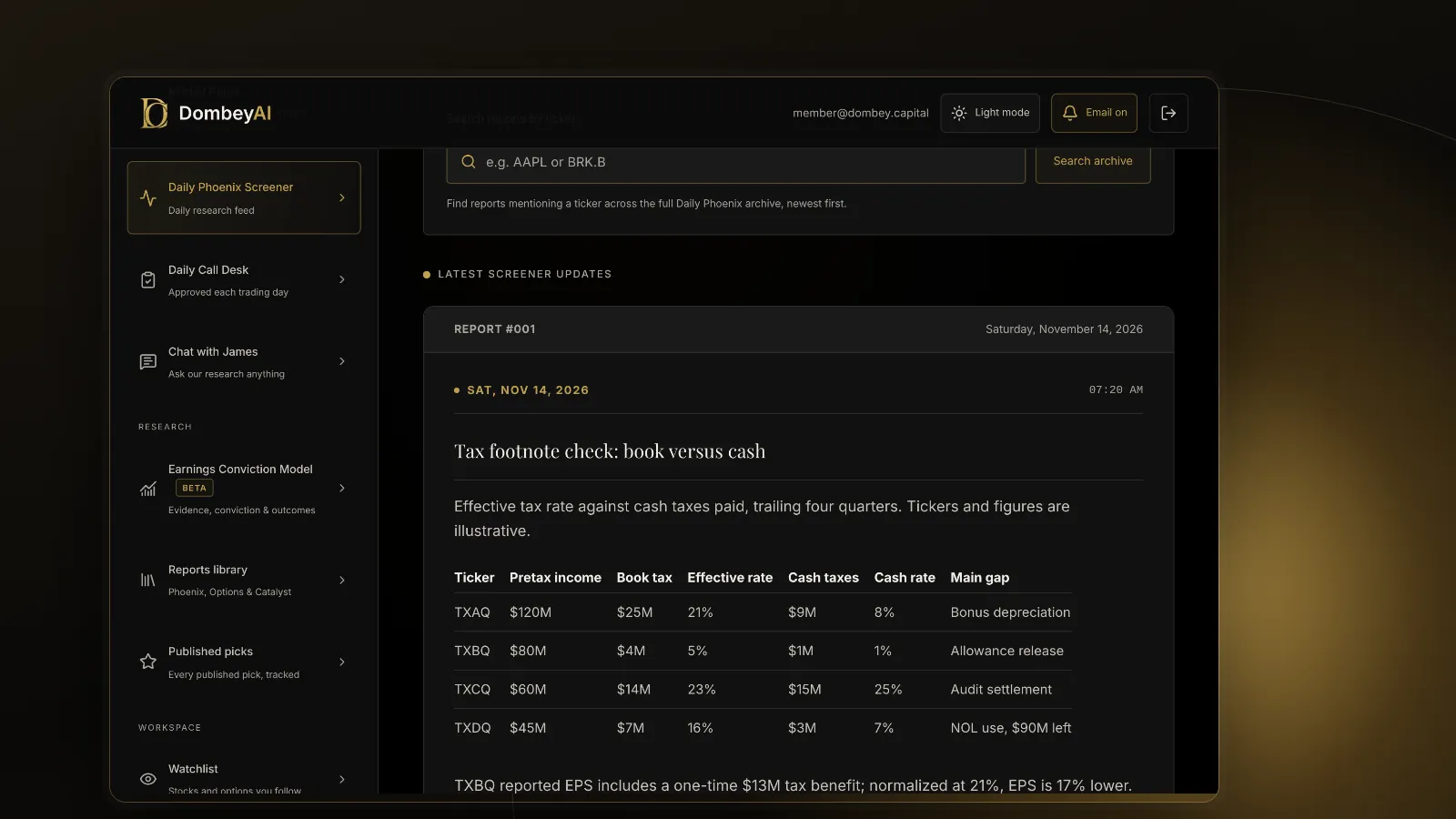
Valuing Company B on $95 million of net income would overstate its earnings by about 20%. Valuing Company A on book earnings would understate its cash generation for as long as its capital spending continues to grow.
How to use both numbers in valuation
- If you are valuing on a price to earnings multiple, use a normalized tax rate. Strip out valuation allowance releases and settlements, as you would any one-time item. Our explainer on normalized earnings covers the wider adjustment.
- If you are building a discounted cash flow, start with cash taxes and model how they change. Our guide to discounted cash flow explains why the cash figure belongs in free cash flow.
- If cash taxes are low because of loss carryforwards, schedule them: the remaining amount, any annual limits and expiry dates, and the year they run out.
- If cash taxes are low because of depreciation timing, ask whether capital spending will keep growing. If it flattens, the deferred liability starts to reverse and cash taxes catch up.
- If a large part of the gap is uncertain tax positions, treat the reserve as a possible future payment.
Loss carryforwards can be valuable assets in their own right. Our piece on NOL shells explains why, and why an ownership change can limit their use.
The tax line also matters for free cash flow yield. A yield that looks high because cash taxes are temporarily low may be overstated.
Where this goes wrong
- Treating cash taxes as permanent. Deferred tax liabilities eventually reverse when growth slows, and carryforwards get used up.
- Ignoring tax law changes. Rules on depreciation, interest deductions and research spending have changed several times in recent years, which shifts the timing of cash taxes.
- Missing ownership change limits. A large change in ownership can restrict how much of a loss carryforward can be used each year.
- Comparing effective rates across companies. Geographic mix, credits and stock compensation make headline rates hard to compare.
- Overlooking audits. Reserves for uncertain positions can turn into cash payments years later.
How it fits a research process
The tax footnote is one of the quickest places to find a gap between reported earnings and cash. Read it alongside the cash flow statement, then decide which number your valuation should use. For tools that make the footnote data easier to compare across years, see the best stock research tools for individual investors.
The bottom line
Book taxes and cash taxes measure different things, and the effective tax rate reflects accounting choices and one-time items as much as the tax bill. Read the rate reconciliation and the deferred tax table to see why they differ. Use a normalized rate for earnings, use cash taxes for free cash flow, and model how long any cash tax advantage can last before the rate converges.