

Where a stalking horse fits in a bankruptcy sale
Most stalking horse bids appear in a sale under Section 363 of the Bankruptcy Code, which lets a debtor sell assets outside a full plan of reorganization. Our guide to what a Section 363 sale is covers the legal mechanics. The short version: the court can approve a sale of assets free and clear of most liens and claims, which is why buyers will pay more in a 363 sale than they would for the same assets outside court.
A typical sequence runs like this:
- The debtor and its advisers market the assets, often before or right after filing.
- The debtor signs an asset purchase agreement with the best early bidder, the stalking horse.
- The debtor files a motion asking the court to approve bidding procedures and the stalking horse's protections.
- The court enters a bidding procedures order that sets a bid deadline, an auction date and a sale hearing.
- Qualified bidders submit offers. If any qualify, an auction is held.
- The court approves the winning bid at the sale hearing, and the deal closes.
The whole process can take as little as several weeks when a debtor is running short of cash, which is common when the case is funded by debtor-in-possession financing with sale milestones.
What the stalking horse gets in return
Being first costs money. The stalking horse pays for diligence, negotiates the purchase agreement and lets every rival see its price. Courts generally allow it to ask for bid protections, which the debtor pays only if someone else wins.
| Protection | What it does | Where to find it |
|---|---|---|
| Break-up fee | Pays the stalking horse a fee if another bidder wins | Bidding procedures motion and order |
| Expense reimbursement | Repays its legal and diligence costs, usually capped | Same motion and order |
| Minimum overbid | Requires a rival's first bid to exceed the stalking horse price plus the fees and an increment | Bidding procedures |
| Bid increments | Sets how much each later round must rise | Bidding procedures |
| Matching right | Lets the stalking horse match a higher bid in some cases | Purchase agreement |
Courts look at whether these protections help the estate get a higher price. Fees that look designed to scare off rivals tend to be cut back or rejected.
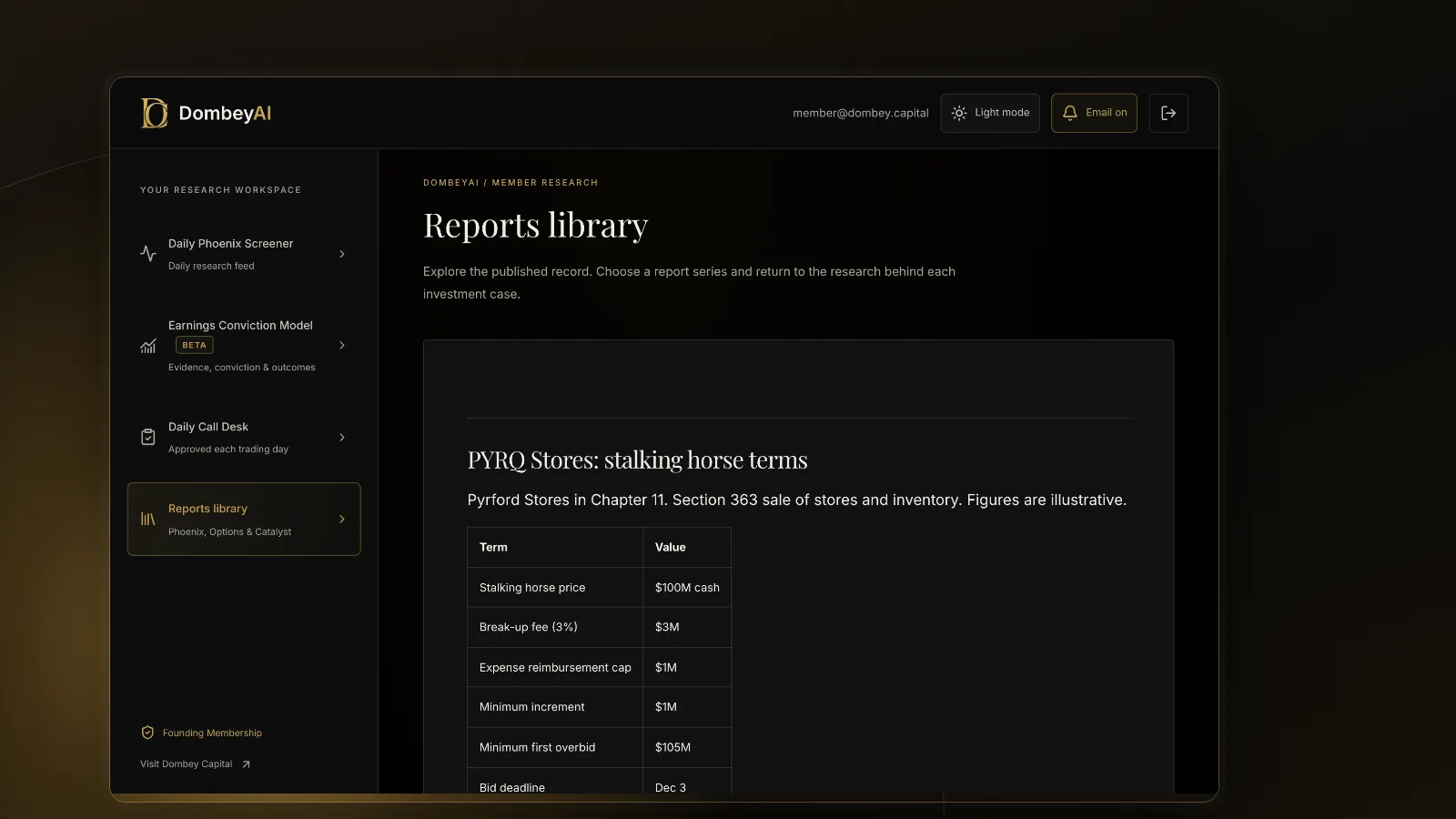
Example: reading the numbers
The example shows why the stalking horse price is useful to equity investors. It is a market price for the assets, set by a buyer with money at risk, and it lets you work through the recovery waterfall described in what happens to stock in Chapter 11 bankruptcy.
Credit bids and insider buyers
Two kinds of stalking horse change the dynamics.
A credit bid comes from a secured lender that bids the face value of its debt instead of cash. Section 363(k) allows this for secured creditors unless the court limits it for cause. A credit bid stalking horse can discourage outside bidders, because a rival must pay cash above the face amount of that debt. When a lender holds a large secured claim, the auction often ends where it started.
An insider bid comes from existing management, a sponsor or a large holder. Courts examine these more closely because the insider knows more than outside bidders. Look for an independent committee, a real marketing period and fair access to information in the sale motion.
What investors watch
The court docket is public, and the useful documents are short enough to read in an evening.
| Document | What to check |
|---|---|
| First day declaration | Why the company filed, how long it marketed the assets and who was contacted |
| Sale and bidding procedures motion | Stalking horse price, protections, deadlines, any credit bid |
| Objections | Whether creditors think the price or process is unfair |
| Notice of auction results or cancellation | Whether competition appeared and the final price |
| Sale order | Final price and terms, including any assumed liabilities |
The disclosure statement, if the case later moves to a plan, shows how the sale proceeds are distributed. For sources that track dockets and sale notices, see the best bankruptcy and restructuring research sources.
Use the stalking horse price to answer three questions:
- If the price covers secured debt with room to spare, unsecured creditors may recover meaningfully, and the bonds or trade claims may be the security to study.
- If the price barely covers secured debt, the old equity is likely worthless regardless of what the shares trade at.
- If the price exceeds every claim, which is rare, equity may recover something, and the shares deserve a close look at the claims register.
Where this goes wrong
Several common mistakes show up around stalking horse bids.
- Assuming an auction will lift the price. Many auctions are cancelled because no qualified bid arrives. A short marketing period, a credit bid or a narrow buyer pool all make the stalking horse price the likely final price.
- Ignoring assumed liabilities. Headline price is not the whole consideration. A buyer that assumes payables, leases or employee obligations is paying more than the cash figure, and the estate's remaining claims shrink.
- Forgetting the fees. Break-up fees and expense reimbursement come out of the estate if a rival wins, which reduces what creditors receive from the higher price.
- Reading the share price as a signal. Shares of bankrupt companies often trade above any plausible recovery. The stalking horse price is better evidence than the last trade.
- Treating the sale as the end of the case. After the sale the estate still needs a plan or a conversion, and the distribution of proceeds can take months. Some new equity issued in reorganizations later trades cheaply, a pattern covered in post-bankruptcy equities.
Stalking horse vs a plan sale
A debtor can also sell itself through a confirmed plan of reorganization. That path gives creditors a vote and usually takes longer. A 363 sale with a stalking horse is faster and preserves value when a business is losing customers or cash, but creditors have less say. Many cases combine the two: a quick 363 sale of the operating business, then a plan that distributes the proceeds.
For investors who follow distressed situations as part of a wider event-driven approach, our list of the best investing newsletters for special situations covers services that report on these cases.
The bottom line
A stalking horse bid is the opening offer in a bankruptcy auction and the floor every rival must beat. The bidding procedures order tells you the minimum overbid, the timetable and how much room there is for competition. For investors, the price is often the best public estimate of what the assets are worth, and it should be run through the claims waterfall before any conclusion about the shares. Most of the time it shows that recoveries stop well above the old equity.